[Asia Economy Reporter Yujin Cho] The World Bank has projected that up to 200 million people could become displaced by 2050 due to the impacts of climate change.
According to the Associated Press on the 13th (local time), the World Bank warned that without urgent measures to reduce global carbon emissions and close development gaps, more than 200 million people could be forced to leave their homes over the next 30 years, creating migration hotspots.
The climate change report released by the World Bank the previous day revealed this through scenario analysis of gradually emerging climate change impacts such as water shortages, reduced crop productivity, and sea level rise.
Under the most pessimistic scenario of "high emissions and unequal development," up to 216 million displaced people are expected across six regions.
The regions include Latin America, North Africa, Sub-Saharan Africa, Eastern Europe and Central Asia, South Asia, and East Asia and the Pacific.
Even under the most climate-friendly scenario of "low emissions and inclusive, sustainable development," 44 million people are projected to be displaced.
The AP reported that the study did not consider short-term climate change impacts such as extreme weather events or cross-border migration.
In the worst-case scenario, up to 86 million people in Sub-Saharan Africa are expected to be displaced. This region is highly vulnerable due to desertification, fragile coastlines, and heavy dependence on agriculture.
In North Africa, about 19 million people, approximately 9% of the population, are projected to migrate due to increased water shortages in northeastern Tunisia, northwestern Algeria, western and southern Morocco, and the foothills of the Middle Atlas Mountains, representing the highest proportion of climate migrants.
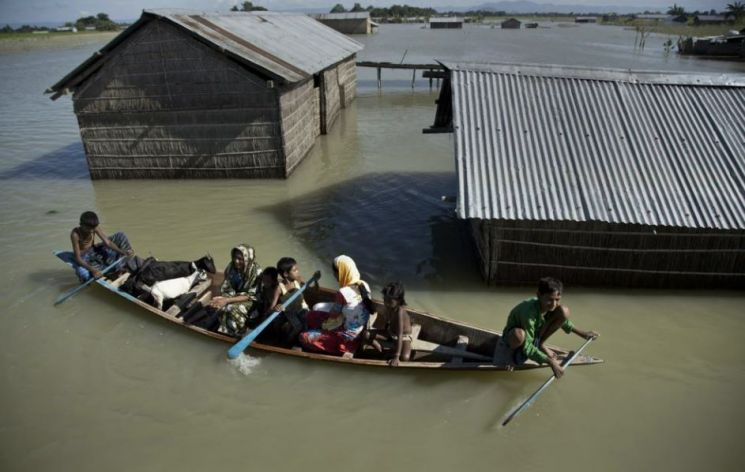
In South Asia, Bangladesh is expected to account for nearly half of the climate migrants, with 19.9 million people displaced primarily due to flooding and crop damage.
Vivian Wei Chen Clement, the World Bank’s lead climate change expert, stated, "This study reaffirms the potential of climate to drive internal migration within countries."
The report also warned that migration hotspots could emerge within the next decade and intensify by 2050.
Clement added, "If joint actions to reduce carbon emissions and invest in green development are not taken, the worst-case scenario could unfold."
The report recommends achieving net-zero carbon emissions by mid-century to limit global warming to within 1.5 degrees Celsius and investing in environmentally friendly, resilient, and inclusive development in line with the Paris Agreement.
© The Asia Business Daily(www.asiae.co.kr). All rights reserved.

















