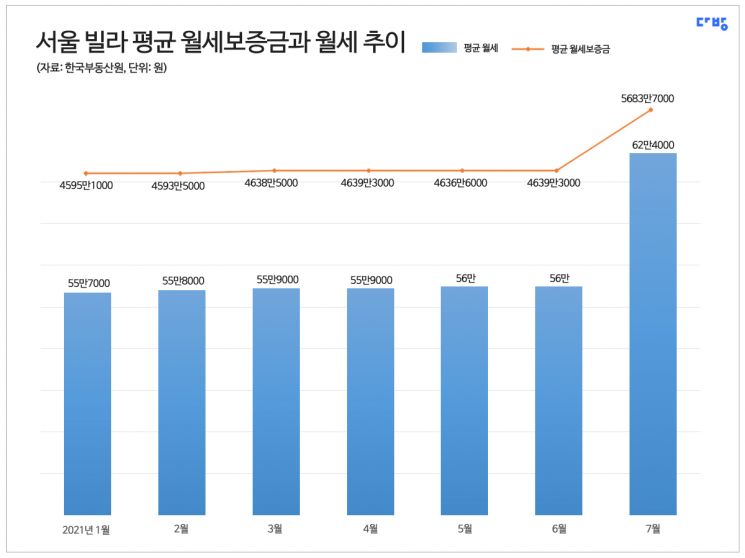
[Asia Economy Reporter Onyu Lim] To rent a Seoul row house or multi-family villa on a monthly lease, an average deposit of 56.83 million KRW and a monthly rent of 620,000 KRW are required.
According to a survey conducted on July 14 by the real estate platform Dabang on the average monthly rent and deposit trends for Seoul row houses and multi-family villas by the Korea Real Estate Board, the average monthly rent as of last July was recorded at 624,000 KRW. This is the highest figure since the Korea Real Estate Board began related surveys in July 2015.
The average monthly rent for villas in Seoul’s Gangbuk downtown area (Jongno, Jung, Yongsan districts) and Gangnam southeast area (Seocho, Gangnam, Songpa, Gangdong districts) reached 844,000 KRW and 888,000 KRW respectively, exceeding the Seoul average. In contrast, the Gangbuk northwest area, which includes Eunpyeong, Seodaemun, and Mapo districts (557,000 KRW), and the Gangnam southwest area, which includes Yangcheon, Gangseo, Guro, Geumcheon, Yeongdeungpo, Dongjak, and Gwanak districts (521,000 KRW), fell short of the average.
The average jeonse deposit for Seoul villas in July was 243 million KRW. Considering the jeonse-to-monthly-rent conversion rate of 4%, if the monthly rent deposit is 10 million KRW, the monthly rent can soar up to 780,000 KRW. This amount corresponds to 16% of the median income for a four-person household in 2023 (4,876,290 KRW).
Furthermore, the average monthly rent deposit for Seoul villas also reached a record high of 56.837 million KRW since statistics began. Compared to the national average (28.861 million KRW), it is about twice as high.
Gyeonggi Province also saw monthly rents and deposits reach record levels. The average monthly rent for villas in Gyeonggi’s Gyeongbu 1 area, which includes Gwacheon, Anyang, Seongnam, Gunpo, and Uiwang, was the highest among all cities, counties, and districts nationwide at 984,000 KRW. This is higher than the Gangnam area in Seoul and about twice the Gyeonggi average monthly rent (500,000 KRW). These areas have seen a significant rise in sale prices due to the construction of the Metropolitan Area Express Train (GTX) and the development of the third phase of new towns in the metropolitan area, which is believed to have also affected the rental market.
Additionally, the average monthly rent deposit in the Gyeongbu 1 area was 73.949 million KRW, 2.7 times the Gyeonggi average (27.305 million KRW). The Gyeongui area (Gimpo, Goyang, Paju) recorded 27.229 million KRW, and the Dongbu 1 area (Namyangju, Guri, Hanam, Gwangju) recorded 27.037 million KRW.
As the apartment jeonse shortage worsened in Seoul, last month the proportion of lease transactions involving monthly rent, such as half-jeonse, reached the highest level this year at 39.4%.
Due to the scarcity of jeonse and soaring prices, tenants who cannot find jeonse or cannot afford the increased jeonse prices are increasingly forced to enter into half-jeonse contracts reluctantly, and landlords also prefer monthly rent over jeonse. A Dabang official stated, "As the supply-demand balance in the rental market breaks down, both monthly rent and monthly rent deposits are rising," adding, "Due to the lease three laws including the right to request contract renewal, rental supply may remain limited next year, so the supply-demand situation is unlikely to improve rapidly."
© The Asia Business Daily(www.asiae.co.kr). All rights reserved.

















