Professor Jeon Haegon of Gwangju Institute of Science and Technology (GIST) and Co-Research Team
[Asia Economy Reporter Kim Bong-su] As large-scale disasters such as earthquakes, fires, and typhoons are rapidly increasing worldwide, rescue robots are being developed for quick and safe human rescue in dangerous disaster sites. Korean scientists have developed an algorithm through international joint research that enables robots deployed at disaster sites to assess the situation and quickly identify the location of victims for rescue.
Gwangju Institute of Science and Technology (GIST) announced on the 14th that Professor Jeon Hae-gon of the AI Graduate School collaborated with Professor Lim Seong-hoon of Daegu Gyeongbuk Institute of Science and Technology (DGIST), Professor Kwon In-so of Korea Advanced Institute of Science and Technology (KAIST), and Carnegie Mellon University in the United States to develop an artificial intelligence algorithm for visual perception of disaster rescue robots.
Despite the social demand for large-scale disaster response, research related to disaster rescue has not been actively conducted due to a lack of industrial demand. In particular, although advances in artificial intelligence technology were expected to present a revolutionary paradigm for disaster rescue operations, related research has been sluggish due to the lack of datasets for research and the absence of protocols to verify developed algorithms. Moreover, disaster site datasets are difficult to obtain, and even some acquired datasets are far from sufficient for annotation needed for AI algorithm training.
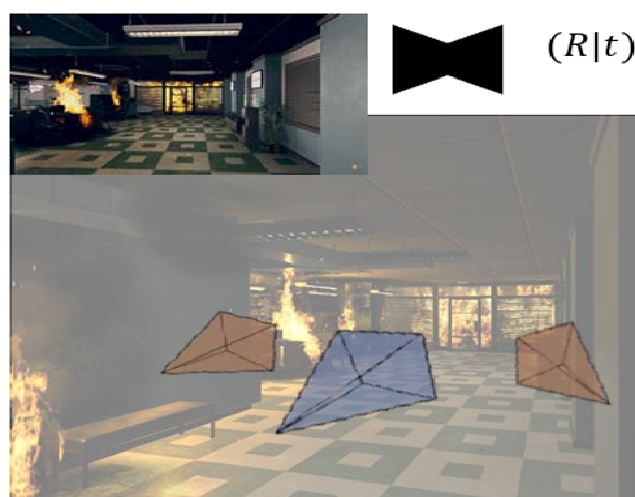
The research team proposed a large-scale dataset simulating disaster sites in virtual reality spaces. Earthquake and fire scenes were recreated in indoor and outdoor virtual environments. Videos were captured to allow precise comparison of pre- and post-disaster situations in the same space and time, and annotations were made for 3D information, camera position data, and semantic image segmentation information.
In particular, they developed an algorithm to estimate the location of victims at disaster sites. Based on spatial information learned from pre-disaster situations, they proposed an AI algorithm that can infer the victim’s location using only a single image in the event of a disaster.
Professor Jeon said, “We proposed an AI algorithm for visual perception of disaster rescue robots that can respond quickly through AI-based simulation of disaster situations in virtual reality spaces,” and added, “We hope this will be used to stimulate various disaster rescue research in the future.”
The research results were published online on July 7 in ‘IEEE Transactions on Pattern Analysis and Machine Intelligence,’ a top 0.3% journal in the field of computer science and artificial intelligence.
© The Asia Business Daily(www.asiae.co.kr). All rights reserved.
![Clutching a Stolen Dior Bag, Saying "I Hate Being Poor but Real"... The Grotesque Con of a "Human Knockoff" [Slate]](https://cwcontent.asiae.co.kr/asiaresize/183/2026021902243444107_1771435474.jpg)
















