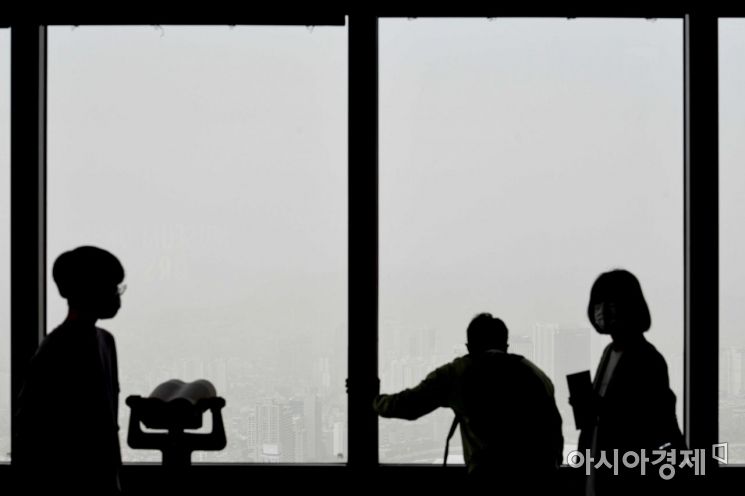
 The city center viewed from the observatory at 63 Square in Yeouido, Seoul, last May is shrouded in fine dust accompanied by yellow dust. Photo by Jinhyung Kang aymsdream@
[Asia Economy Reporter Chunhee Lee] A study has found that exposure to fine particulate matter (PM 2.5) during pregnancy may impair the growth of the child after birth.
The Korea Disease Control and Prevention Agency's National Institute of Health announced on the 13th that "children born to mothers exposed to high concentrations of fine particulate matter during mid-pregnancy showed a continuous decline in growth trajectory up to age 5, especially in girls."
This study was conducted by Professor Sujong Hong's team at Ulsan University, which is carrying out policy research for the 'Childhood Respiratory and Allergy Disease Longitudinal Cohort (COCOA)' project. They analyzed the impact of prenatal fine particulate matter exposure on the growth trajectories of 440 five-year-old children and related mechanisms.
Analysis of the risk of fine particulate matter showed that high exposure during mid-pregnancy (14?26 weeks) increased the risk of low birth weight by 1.28 times. Comparing the prenatal fine particulate matter exposure levels between groups with consistently high and low growth trajectories up to age 5 revealed that higher exposure during mid-pregnancy was associated with a continuous decline in growth trajectory, particularly in girls.
Methylation analysis using umbilical cord blood also showed increased methylation of the ARRDC3 gene, which is involved in energy metabolism, in female newborns with high fine particulate matter exposure and low birth weight. Notably, increased methylation of ARRDC3 was also observed in 5-year-old girls with low body weight.
The study suggests that appropriate management to reduce fine particulate matter exposure during mid-pregnancy could prevent epigenetic changes in ARRDC3 and thereby reduce the risk of impaired growth in children after birth. The research was published online in July in 'Environmental Research,' a top journal in environmental health and environmental science, and is scheduled for official publication this month.
Jung Eun-kyung, Director of the Korea Disease Control and Prevention Agency, stated, "It has been confirmed that high exposure to fine particulate matter during pregnancy can affect not only birth weight and height but also the growth process after birth." She advised, "Pregnant women and their families should pay attention to changes in fine particulate matter levels during pregnancy, especially during mid-pregnancy. During periods of high fine particulate matter concentration, outdoor activities should be minimized, health masks should be worn when going outside, and indoor ventilation and air purifiers should be used regularly to minimize exposure to fine particulate matter."
© The Asia Business Daily(www.asiae.co.kr). All rights reserved.

















