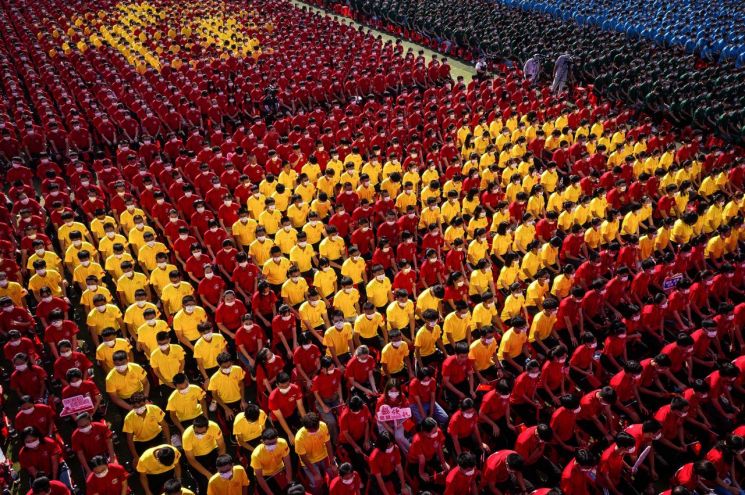
 University students in Wuhan, Hebei Province, China, are creating an image symbolizing the 100th anniversary of the founding of the Communist Party by using the colors of their uniforms at the opening ceremony on the 10th. Chinese intelligence agencies recently instructed the Ministry of Education and prestigious universities to strengthen Communist Party ideological education and discipline on campus.
 The term 'Hak(se)gwon' (school district) is one of the key variables explaining the heat in the real estate market. Construction companies never omit accessibility to nearby elementary, middle, and high schools when promoting sales. Educational enthusiasm has a profound impact on real estate price formation. Even when housing prices enter a downward phase, there is much expectation that demand for school district areas will not dry up, thus price defense will remain strong.
◆ A 3-pyeong school district property nears 1 billion KRW... Xi Jinping says "Issue of educational fairness"
In fact, the correlation between school district areas, educational enthusiasm, and housing prices is dramatically evident in China. When private education was regulated, housing prices plummeted.
In China, houses near prestigious schools, so-called 'Xuequfang (學區房)', are frequently featured in movies or dramas. Having a house near a good school allows children to enroll there, making such properties highly preferred and several times more expensive.
In Beijing, a few years ago, an old house of only 11.4㎡ (about 3 pyeong) located in a hutong (traditional alley) in Xicheng District was traded for 5.3 million yuan (approximately 950 million KRW).
Last March, Chinese President Xi Jinping personally took a tough stance. He said, "This is an issue of educational fairness. It is impossible to solve this problem all at once," adding, "This problem is prominent even in Beijing. Therefore, Xuequfang prices have been greatly inflated, and everyone rushes to good school districts."
As regulation of Xuequfang became a hot topic, more than ten cities including Beijing, Shanghai, Guangzhou, and Shenzhen introduced related measures.
Beijing officially announced measures to solve the Xuequfang problem. They plan to introduce a large-scale teacher rotation system in the new school semester starting in September. This year, it will be piloted in Dongcheng and Miyun districts and then expanded to six other districts.
They expect that the concept of 'excellent schools' or 'prestigious schools' will become blurred due to teacher mobility.
Shenzhen announced a draft of new regulations to resolve educational inequality. Until now, students from one apartment could only enter a specific elementary or middle school, but going forward, the school district range will be expanded so that one apartment can apply to 2 to 3 schools. Along with this, a teacher rotation system will also be introduced.
The Chinese authorities also introduced measures to reduce school burdens, including banning gifted classes and written exams for lower grades in elementary schools. AFP news agency evaluated these measures as efforts to resolve educational inequality in China.
◆ School district transaction volume down 50%... prices down 5%
Since these measures were implemented, housing prices have shown a downward trend.
According to China Central Television (CCTV), an apartment in a prestigious school district in Shenzhen, Guangdong Province, was auctioned off without a buyer at a price more than 5 million yuan (about 900 million KRW) below market value.
This 116㎡ apartment in Futian District, the center of Shenzhen, was put up for auction at 19.69 million yuan (about 3.5 billion KRW). The apartment is near schools preferred by parents, such as a foreign language elementary school, and the market price for the same size ranges from 25 to 30 million yuan, with a price per square meter exceeding 200,000 yuan (about 36 million KRW).
In some school districts in downtown Xicheng District, transaction volume decreased by more than 50% in the past month, and transaction prices dropped by 3 to 5%.
In the Zhongguancun area, the average price per square meter fell from 170,000?180,000 yuan before the new policy announcement to 140,000?150,000 yuan.
Real estate transaction volume in school district areas also declined. The Wall Street Journal (WSJ), citing data from a Shanghai real estate research firm, reported that the number of transactions in seven school district-dense areas in China decreased by 38% from the beginning of this year to July. It also added that the housing price increase trend has stopped.
However, it is unclear whether preference for Xuequfang will be completely eradicated and whether housing prices will continue to fall accordingly.
Chinese parents still view the college entrance exam, Gaokao (高考), as a means of social mobility, and some evaluations suggest that unless university admission policies change, educational enthusiasm will not easily disappear.
Although the monthly income of 600 million people in China is only about 1,000 yuan (approximately 180,000 KRW), the middle class is known to willingly spend about 100,000 yuan (approximately 18 million KRW) per year for their children's admission to top schools.
© The Asia Business Daily(www.asiae.co.kr). All rights reserved.

















