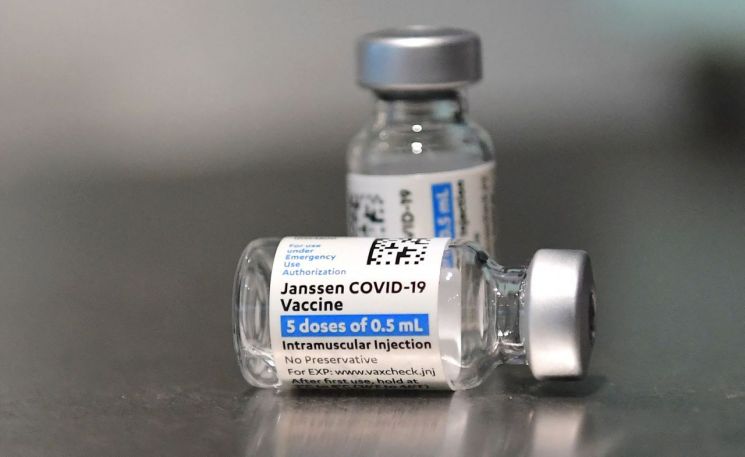
 Johnson & Johnson's (J&J) Janssen COVID-19 vaccine is contained in a vial. [Image source=Yonhap News]
[Asia Economy Reporter Hwang Sumi] As breakthrough infections surge due to the spread of the Delta variant, countries around the world are expanding decisions to administer booster shots. Amid this, foreign media reports have emerged that 14 million Janssen vaccine recipients in the United States are anxious because the Janssen vaccine is not included in the booster shot list.
On the 8th (local time), according to The Washington Post (WP), the UK's Medicines and Healthcare products Regulatory Agency (MHRA) approved the use of booster shots for Pfizer and AstraZeneca (AZ) vaccines. Italy authorized additional doses of Pfizer and Moderna vaccines for immunocompromised and elderly groups.
However, the booster shot vaccines they use do not include Janssen. WP reported that the Janssen vaccine was not listed even in countries such as Germany, France, and Israel, which have already started or confirmed the introduction of booster shot vaccinations.
The United States, which will begin additional vaccinations for the entire population starting on the 20th, is also considering only Pfizer or Moderna vaccines initially.
Moreover, U.S. health authorities do not recommend mixed vaccine administration. As a result, it is difficult for Janssen recipients to receive booster shots with other vaccines.
Previously, the Janssen vaccine was evaluated as a "game changer" because it provided immune protection for at least eight months with a single dose and did not require ultra-cold storage facilities. However, in April, U.S. health authorities recommended halting vaccinations while reviewing rare but serious cases of thrombosis. Vaccinations resumed after 10 days, but concerns about safety have made people reluctant to receive the Janssen vaccine.
In addition, warnings have been issued that Janssen vaccine recipients may be more vulnerable to breakthrough infections. According to FDA aggregated statistics, the COVID-19 infection prevention rate is in the 90% range for Moderna and Pfizer vaccines, while Janssen's rate is relatively low at 66.9%.
In South Korea as well, breakthrough infection cases were highest among Janssen vaccine recipients. According to the Central Disease Control Headquarters on the 31st of last month, when examining by vaccine type, the breakthrough infection rate for the Janssen vaccine was the highest at 0.113%.
The AstraZeneca vaccine was 0.068% (68.2 cases per 100,000 people), and the Pfizer vaccine was 0.021% (20.9 cases per 100,000 people). No breakthrough infection cases have yet been confirmed for the Moderna vaccine. The breakthrough infection rate for those who received the first dose with AstraZeneca and the second dose with Pfizer was recorded at 0.016%.
Regarding this, Jeong Eun-kyung, Director of the Korea Disease Control and Prevention Agency, said at the National Assembly Budget and Accounts Committee plenary session on the morning of the 7th, "It is true that breakthrough infections are reported at a high rate with Janssen. However, since the fourth wave had a high incidence among people in their 20s and 30s, this also affected the Janssen recipients who were the target of vaccination during the outbreak. We will review with experts which vaccine to administer and at what intervals by vaccine type."
Currently, the amount of Janssen vaccine secured domestically is 8.01 million doses, of which 1.514 million doses have been introduced into the country. Vaccinations began in earnest in June, focusing on reservists and civil defense personnel.
© The Asia Business Daily(www.asiae.co.kr). All rights reserved.

















