Communication methods narrow and real-time conversations decrease... Time-wasting meetings down by 5%

[Asia Economy Senior Reporter Jinsoo Lee] A study from the tech giant Microsoft (MS) has revealed that working from home leads to declines in creativity, communication, and teamwork.
Researchers at MS, based in Redmond, Washington, examined data from their employees before and after the COVID-19 outbreak. The dataset included information from over 61,000 employees spanning from December 2019, before the pandemic, to June of last year.
In the September 9 issue (local time) of the online scientific journal Nature Human Behaviour, the research team reported that working from home narrowed employees' communication methods and reduced real-time conversations.
Acquiring and sharing new information across departments also became more difficult. Collaboration time between employees across departmental boundaries decreased by 25%. The time lag before new collaborators appeared increased. This has significant implications for corporate productivity and innovation.
There were some improvements as well. Communication among employees within existing personal networks increased, and interpersonal relationships became stronger.
The time spent in meetings, often criticized as "too long" and "a waste of time" due to remote work, decreased by 5%.
Interestingly, average weekly working hours, as well as the number of emails and instant messages sent and received, increased during remote work. This could be interpreted as remote work effectively pushing employees to work harder.
The exact cause remains unclear. However, it is speculated that since non-working hours are involved, when work-related thoughts arise, employees can quickly sit back in front of their computers to organize them.
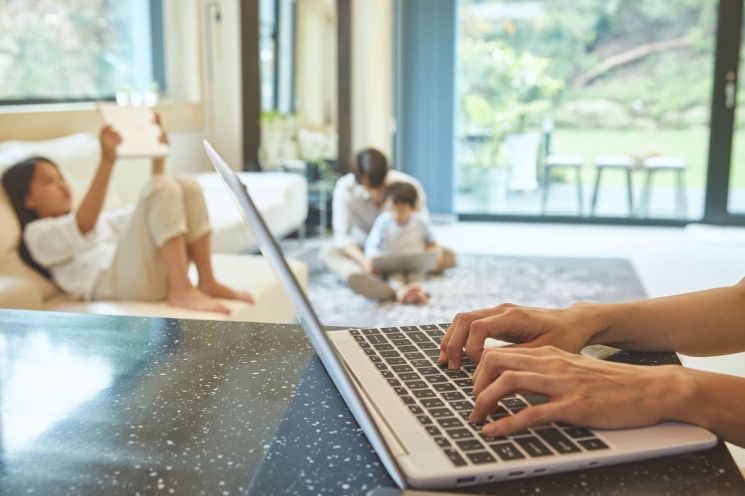
Before the work-from-home orders due to COVID-19, 18% of MS employees were already working remotely. The researchers focused on changes in employee behavior after the remote work mandate. For example, employees working from home experienced stress and anxiety while caring for children or family members in need.
David Holtz, Assistant Professor at the Haas School of Business, University of California, Berkeley, who led the study, explained, "It was difficult to gauge the causal effects of remote work in the past because only a very small portion of employees were allowed to work from home."
However, the situation changed with the COVID-19 pandemic. Nearly all employees who could work remotely began doing so.
Professor Holtz commented, "The remote work mandate provided a unique opportunity to understand how employees communicate and collaborate with each other."
The researchers also examined how remote work affected patterns of employee collaboration. They found that work was impacted both when the individual was working remotely and when their colleagues were working remotely.
Regarding this, Professor Holtz noted, "This has significant implications for companies like MS that are considering 'hybrid' work policies," adding, "When colleagues are in the office, communication and information flow improve for both employees inside and outside the office."
Satya Nadella, CEO of MS, has previously declared that the company will allow employees to choose the work style that suits them best going forward.
© The Asia Business Daily(www.asiae.co.kr). All rights reserved.
![Clutching a Stolen Dior Bag, Saying "I Hate Being Poor but Real"... The Grotesque Con of a "Human Knockoff" [Slate]](https://cwcontent.asiae.co.kr/asiaresize/183/2026021902243444107_1771435474.jpg)












