"Establishing Common Industrial Policies and Creating a Unified Electricity Market"
Putin: "Prioritize Economic Integration... Political Integration to Be Agreed Later"
Internationally Isolated Belarus Requests Expanded Support from Russia
Russia Demands Partial Policy Control in Exchange for Supporting Belarus
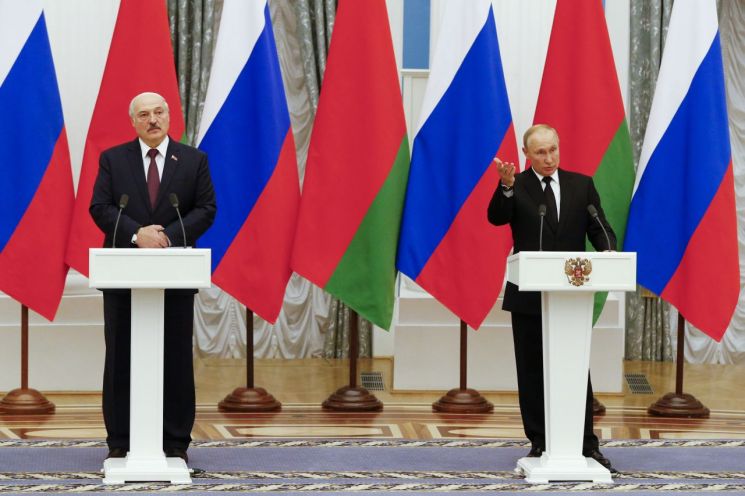 President Aleksandr Lukashenko of Belarus (left) and President Vladimir Putin of Russia [Image source=AP Yonhap News]
[Asia Economy Reporter Kim Suhwan] Russia and Belarus, former Soviet states and allies, have agreed on 28 roadmaps (programs) for the establishment of a 'Union State.'
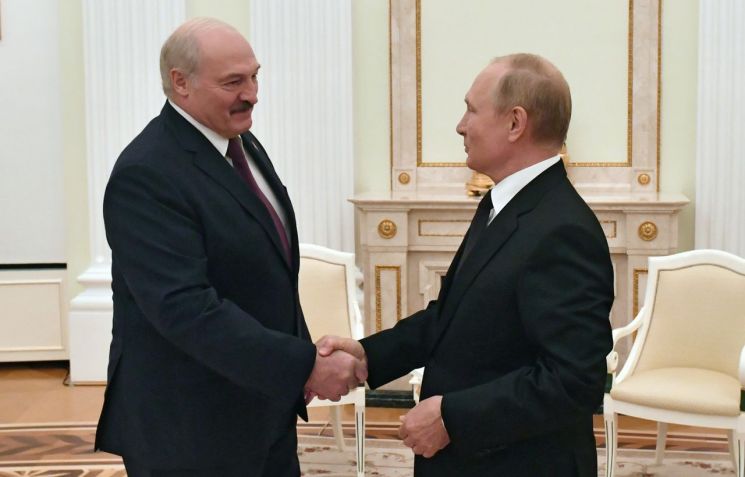
On the 9th (local time), Russian President Vladimir Putin announced this during a joint press conference following a three-hour meeting with Belarusian President Aleksandr Lukashenko, who visited Moscow, Russia.
Putin stated, "All 28 programs have been coordinated today," adding, "These programs aim to unify the laws of both countries across various economic sectors, equalize the operating conditions of economic entities in both countries, create a single financial and energy market, and establish and implement common industrial and agricultural policies."
Putin explained that these programs are scheduled to be approved at the Union State ministerial meeting to be held in Minsk, Belarus, on the 10th. Afterwards, they will be forwarded to the Union State Supreme State Council for approval within this year.
Lukashenko positively evaluated the agreement, saying, "We can only advance to a more developed state by moving forward together."
According to the agreed Union State roadmap, Russia and Belarus will gradually develop integrated macroeconomic policies, unify their national payment systems, and establish common monetary and credit policies.
By December 2023, they plan to sign a treaty for a single gas market and also pursue the integration of oil and petroleum product markets and the creation of a single electricity market.
At the press conference, Putin revealed that Russia plans to provide Belarus with an additional loan of up to $640 million (approximately 740 billion KRW) by the end of next year.
Belarus, which is experiencing severe economic difficulties, has received $1.5 billion in loans from Russia and the Eurasian Stabilization and Development Fund, a financial cooperation body of former Soviet states, from October last year until June this year.
Putin explained that economic integration between the two countries will be prioritized, while political integration will be reviewed later according to circumstances.
There was no official signing ceremony between the two countries during the meeting. It was also reported that no agreement was reached on the creation of a single currency or on political and military integration.
In Belarus, large-scale anti-government protests occurred following allegations of election fraud during last year's presidential election. The Lukashenko regime, which harshly suppressed these protests, is facing worsening economic crises due to Western sanctions and is calling for support from Russia.
In response, President Putin is demanding that Belarus hand over control of some government policies to Russia in exchange for economic support.
The Guardian reported, "Russia is leveraging Belarus's situation of international isolation due to Western sanctions and anti-government protests to accelerate political integration between the two countries by demanding greater policy integration from the Lukashenko regime."
President Lukashenko is concerned that Russia's expanding influence could threaten his power. The lack of agreement on political integration and the absence of an official signing ceremony during this meeting are interpreted as reflecting this tense relationship.
Meanwhile, the two countries appear to be accelerating defense cooperation.
Since last year's Belarusian presidential election, six meetings have been held between the two countries, including this one, during which Belarus has expressed its intention to purchase various combat aircraft and helicopters, including Russia's S-400 surface-to-air missile system.
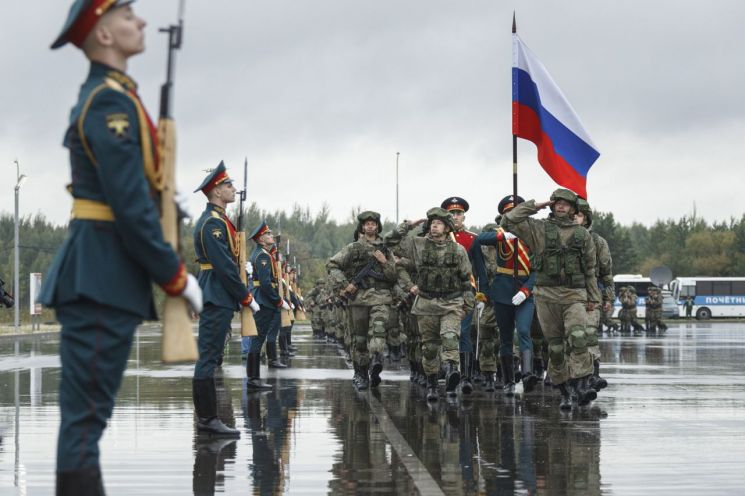
Additionally, the two countries conduct large-scale joint military exercises called 'Zapad' every four years. These exercises mainly take place near the European border, and NATO has opposed them, calling the drills threatening acts toward Europe.
The upcoming 'Zapad-2021' exercise is scheduled to be held from the 10th to the 16th. The Russian side announced that about 200,000 troops will participate in this exercise.
According to foreign media, Russia is using this exercise as a pretext to strengthen its defense deployment along the border with Europe.
Meanwhile, Russia and Belarus, both members of the Commonwealth of Independent States (CIS), a group of former Soviet countries, signed a separate Union State creation treaty in 1999 and have been pursuing national integration.
In 2019, marking the 20th anniversary of the treaty, a working group was formed to develop sector-specific roadmaps for the establishment of the Union State.
© The Asia Business Daily(www.asiae.co.kr). All rights reserved.
![User Who Sold Erroneously Deposited Bitcoins to Repay Debt and Fund Entertainment... What Did the Supreme Court Decide in 2021? [Legal Issue Check]](https://cwcontent.asiae.co.kr/asiaresize/183/2026020910431234020_1770601391.png)

















