KMA Completes Additional Installation at Over 2,200 Sites with Kyungpook National University, Korea Post, and Korea Coast Guard Cooperation
Expanding to Over 8,000 Sites Within the Year in Collaboration with the National Fire Agency... Nationwide Network Completion
Fixed Locations Enable Large-Scale Sensor Data Collection, Expected to Greatly Aid Earthquake Analysis

[Asia Economy Reporter Eunmo Koo] SK Telecom, the Korea Meteorological Administration (KMA), and Kyungpook National University announced on the 9th that they will significantly expand the installation scale of small earthquake detection sensors by partnering with public institutions nationwide equipped with infrastructure such as the National Fire Agency, Korea Post, and the Korea Coast Guard, aiming to advance South Korea's earthquake response system.
SK Telecom, KMA, and Kyungpook National University's Hyperconnected Convergence Technology Research Institute will expand the small earthquake detection sensors, which were installed at about 3,000 locations including SK Telecom base stations and agencies nationwide last year, to 8,000 locations across the country by the end of the year.
Unlike KMA's precision sensors, small earthquake detection sensors can only detect vibrations near the epicenter of moderate or larger earthquakes, requiring a dense observation network. SK Telecom stated that once the sensor expansion, which is 2.7 times the existing installation scale, is completed, 3 to 4 sensors will be installed per 10㎢, enabling nationwide earthquake detection.
SK Telecom, KMA, and Kyungpook National University explained that this expansion in installation scale will greatly improve the density of the earthquake detection network, contributing to the advancement of the national earthquake response system, including research to minimize false detections.
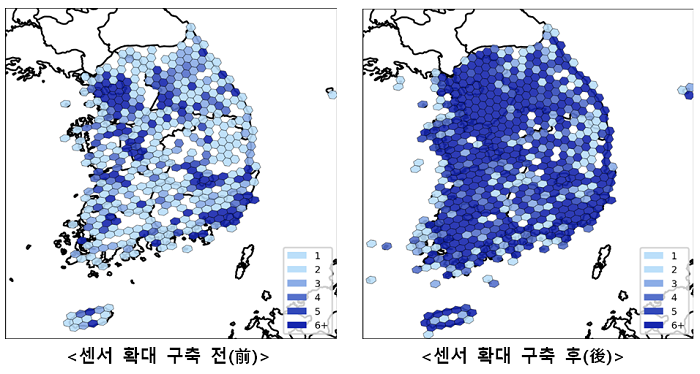
SK Telecom revealed that through cooperation with Korea Post, which already has nationwide facilities, and the Korea Coast Guard, which oversees South Korea's coastline, small earthquake detection sensors have already been installed at more than 2,200 of the additional 5,000 planned locations. Korea Post installed about 1,900 sensors at approximately 1,600 post offices, including city-level general offices and neighborhood-level branch offices nationwide, while the Korea Coast Guard installed sensors at about 330 coastal police stations and branch offices.
Additionally, an agreement was reached to install small earthquake sensors at about 2,600 locations, including 119 Safety Centers and regional units located throughout the country under the National Fire Agency. SK Telecom stated that thanks to the National Fire Agency's evenly distributed locations nationwide, a dense and balanced earthquake observation research network across the country can be completed.
Meanwhile, KMA expects that with the enhanced observation data from the expanded earthquake detection sensors, not only will seismic intensity information become more detailed, but it will also aid research to shorten earthquake early warning times. KMA is verifying the earthquake analysis performance by comparing vibration data obtained from small earthquake detection sensors with observation data from its 338 nationwide precision seismic observation stations and is reviewing whether this data can be utilized for earthquake information services.
Park Myung-soon, Head of SK Telecom's Infrastructure Value Innovation Group, said, "We are pleased to be able to join forces with the government, public institutions, and Kyungpook National University in activities to keep South Korea safe from earthquakes," adding, "We will continue to actively utilize the infrastructure owned by the telecommunications company to promote sustainable and diverse ESG management activities."
© The Asia Business Daily(www.asiae.co.kr). All rights reserved.


















