Self-Employed Business Emergency Committee Holds 'Night Vehicle Protests' Nationwide
Gatherings in 9 Cities Including Seoul, Busan, Daejeon... Ends Without Major Clashes
Some Locations Saw Entry Blocked, Loud Exchanges Occurred
Self-Employed Say "We Came Out Grasping at Straws"
[Asia Economy Reporter Song Seung-yoon] Self-employed workers opposing the government's quarantine policies held a nationwide vehicle protest as originally announced. While vehicle protests had previously taken place separately in Seoul, Busan, and Gyeongnam, this was the first time a vehicle protest was held simultaneously across the entire country.
The "National Emergency Countermeasures Committee of Self-Employed Workers Responding to COVID-19 (Countermeasures Committee)," which consists of self-employed groups from various industries, began vehicle protests in nine regions nationwide from 11 p.m. on the 8th.
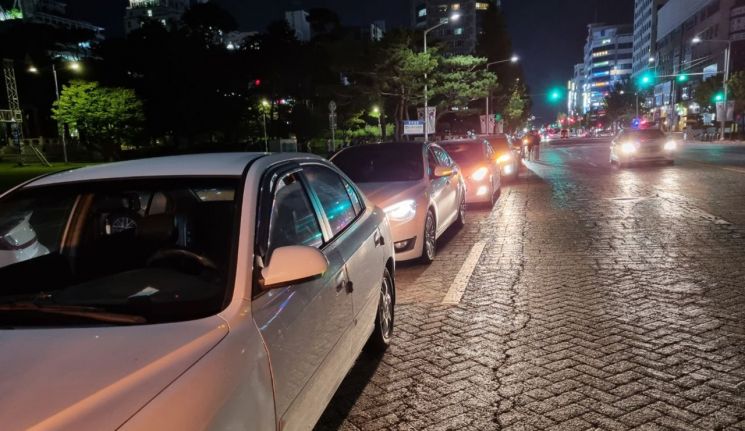
Self-employed participants in the Seoul vehicle protest gathered at the northern end of Yanghwa Bridge and moved along Gangbyeonbuk-ro and Hannam Bridge to Yeouido. Due to police control causing congestion in some sections, they sounded their horns with an "SOS signal" to symbolize a call for help for self-employed workers. As in previous protests, the Countermeasures Committee conducted the vehicle protest by forming a procession centered around the lead vehicle with hazard lights on. Guidance on protest methods and routes was provided in real-time via YouTube live broadcasts and KakaoTalk group chats.
The Countermeasures Committee initially planned to issue a statement at a location in Yeouido at the scheduled end of the vehicle protest, but as gathering was blocked, they changed the assembly points multiple times to places such as The Hyundai Seoul, Yeouido Park, and the National Assembly riverside parking lot. However, even near the final assembly point at the National Assembly riverside parking lot, roads were blocked, and the area became congested for over an hour with police vehicles, press vehicles, and participants' cars all tangled together.
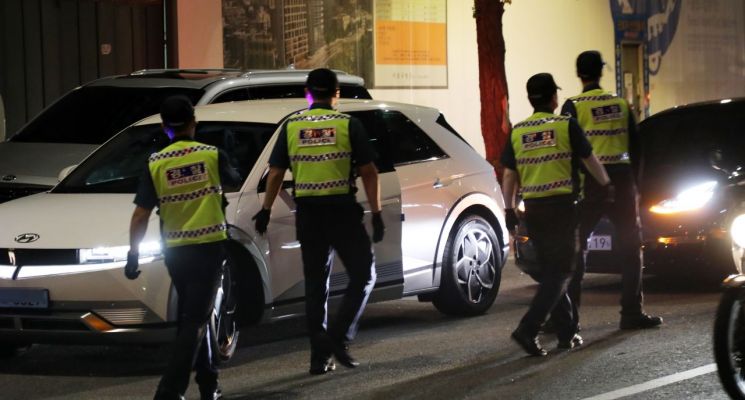
The police considered this rally illegal as well and deployed forces to block participants from gathering at various protest sites. The Seoul Metropolitan Police Agency set up temporary checkpoints throughout downtown Seoul and deployed 21 units to encourage dispersal. Security checks were also conducted in preparation for any emergencies.
Although there were no major clashes during the protest, verbal disputes between police and some participants and the issuance of fines were observed. Ultimately, the Countermeasures Committee ended the protest around 2:50 a.m., well past the scheduled end time, after performing a horn-sounding demonstration near the National Assembly without issuing a statement. Initially, protests were planned to be held separately in Seoul, Incheon, and northern and southern Gyeonggi Province, but the Countermeasures Committee changed the plan to hold the vehicle protest only in Seoul, judging that it would be difficult to avoid police control even if the locations were disclosed just before the protest.
At the Seoul vehicle protest site that day, Lee Jun-seok, leader of the People Power Party, presidential candidate Won Hee-ryong, former governor of Jeju Province, and Choi Jae-hyung, former head of the Board of Audit and Inspection, appeared and held picket protests supporting the self-employed workers.
Outside the metropolitan area, vehicle protests were held in nine locations including Chungbuk, Daejeon, Gyeongnam, Busan, Ulsan, Jeonbuk, Gwangju, and Chuncheon. Protests in non-metropolitan areas proceeded without major friction, and participants dispersed earlier compared to the metropolitan area.
Before the protest, the Countermeasures Committee issued a statement saying, "Those participating in today's vehicle protest are citizens who can no longer endure being thrown into a quagmire from economic death," and strongly demanded, "Immediately abolish the self-employed regulation-focused approach and establish a with-COVID policy centered on individual quarantine rather than facility-based measures, reflecting the opinions of self-employed workers."
The Countermeasures Committee previously held vehicle protests in downtown Seoul on July 14-15, gathering about 750 and 300 vehicles respectively over two days. Then, on August 25-26, vehicle protests were held over two days in Busan and Gyeongnam.
They are demanding ▲a shift to quarantine rules based on fatality rates ▲abolition of the one-strike-out system ▲restructuring quarantine standards from facility-centered to individual-centered ▲prompt compensation for losses ▲participation of self-employed workers in the loss compensation committee.
© The Asia Business Daily(www.asiae.co.kr). All rights reserved.


















