World's No.1 Moisture Control Device, Stack (Electric Generator) Equipped with Core Materials PEM and MEA
[Asia Economy Reporter Hwang Yoon-joo] Kolon Group is embarking on a full-scale hydrogen business based on its core technological capabilities in the hydrogen industry’s materials and components sector.
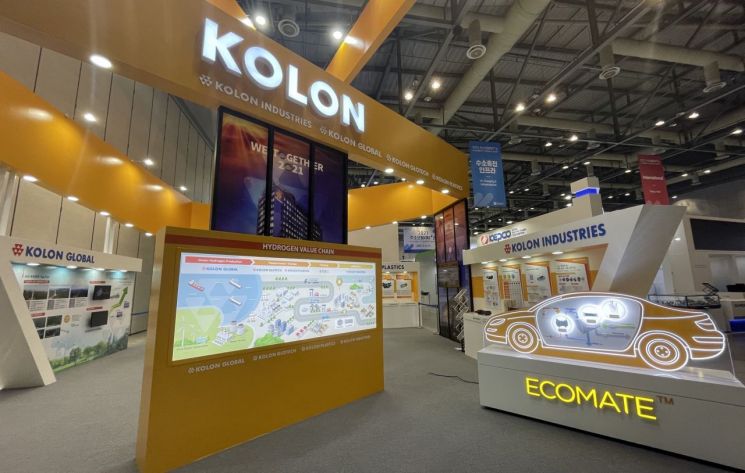
Kolon Group announced on the 8th that it participated in the "KOREA H2 Business Summit," aimed at establishing the hydrogen industry ecosystem in South Korea.
Kolon Group’s participation in this event included Kolon Industries at the center, along with Kolon Global, Kolon Glotech, and Kolon Plastics.
Kolon Industries plays a pivotal role in the group’s hydrogen business by providing comprehensive solutions based on its long-standing technological expertise in the hydrogen fuel cell field. Kolon Global is conducting a business that directly produces and supplies green hydrogen using water electrolysis technology based on hydrogen fuel cells, leveraging its wind power business. Kolon Glotech is promoting a hydrogen pressure vessel business utilizing carbon fiber and epoxy, while Kolon Plastics produces and supplies housing parts that enhance the efficiency of hydrogen fuel cells based on its vehicle engineering plastics technology.
Lee Kyu-ho, Vice President in charge of Kolon Group’s future business, said, "Since the early 2000s, Kolon has been steadily preparing to expand the foundation of the hydrogen economy and develop core materials, anticipating the future of South Korea’s hydrogen industry. We will focus our capabilities on building the entire value chain of the hydrogen economy and becoming a hydrogen solution provider with our One&Only material technology."
Kolon Industries has continuously expanded its business based on its technological expertise in hydrogen fuel cells since it began research on membrane technology for hydrogen fuel cells in 2006. The main hydrogen business products of Kolon Industries are moisture control devices for hydrogen fuel cells, polymer electrolyte membranes (PEM), and membrane electrode assemblies (MEA). The moisture control device, a component that regulates humidity to ensure efficient electricity generation in hydrogen fuel cells, was mass-produced for the first time domestically by Kolon Industries. It currently holds the global market share No. 1 and is supplied to Hyundai Motor’s hydrogen electric vehicle Nexo, with large-scale expansion underway.
The polymer electrolyte membrane (PEM), the most critical component in hydrogen fuel cells, established domestic mass production facilities earlier this year and is expanding its business. The membrane electrode assembly (MEA), a component combining PEM and electrodes, accounts for 40% of the cost of hydrogen fuel cell stacks (electricity generation devices). Kolon Industries plans to establish a mass production system by 2023 and actively pursue market expansion.
Kolon Global is accelerating its green hydrogen production business using renewable energy generated from onshore and offshore wind power plants. The company is promoting a business that produces green hydrogen by electrolyzing water using water electrolysis technology powered by nighttime electricity from wind power plants. In particular, it plans to create synergy among group companies by configuring an energy storage system (ESS) using hydrogen fuel cells equipped with moisture control devices and membrane electrode assemblies produced by Kolon Industries.
Kolon Glotech is advancing its pressure vessel business necessary for hydrogen storage and transportation. Based on essential towpreg and dry winding technologies for hydrogen pressure vessels, it is striving to establish itself as a key player in the hydrogen mobility industry. Kolon Plastics is focusing on developing materials for housing parts that maximize the efficiency of fuel cells mainly used in hydrogen electric vehicles and for the localization of hydrogen pressure vessels.
Jang Hee-gu, President of Kolon Industries, said, "Along with responding to climate change and carbon neutrality, the hydrogen economy has already become a reality before us. Leading with hydrogen fuel cells, we plan to achieve sales of 1 trillion KRW across the entire hydrogen business?including hydrogen production using water electrolysis technology, storage, and transportation?by 2030, solidifying our status as a core materials and components company."
© The Asia Business Daily(www.asiae.co.kr). All rights reserved.

















