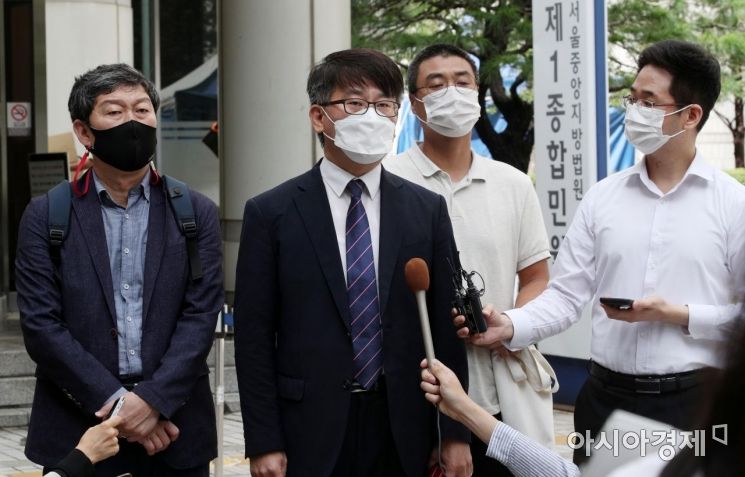
 Attorney Jeon Beom-jin (center) and Kim Young-hwan, Director of External Cooperation at the Institute for Research in Collaborationist Activities (left), among others, are answering reporters' questions after the verdict hearing of the lawsuit filed by the bereaved families of forced labor victims against Nippon Steel at the Seoul Central District Court in Seocho-gu on the 8th. The court ruled in favor of the defendant, stating, "The plaintiff's claim is dismissed." Photo by Kim Hyun-min kimhyun81@
[Asia Economy Reporter Kim Daehyun] The court once again did not recognize the liability of Japanese companies for compensation to victims of forced labor during the Japanese colonial period. This is analyzed to be in the same vein as the dismissal of the victims' claims in a similar lawsuit last month on the grounds of 'statute of limitations completion.'
At 10 a.m. on the 8th, Judge Park Seong-in of Civil Division 25 at the Seoul Central District Court ruled against the plaintiffs, four bereaved family members including the son of forced labor victim Jeong, in a lawsuit seeking about 200 million KRW in damages against Nippon Steel.
This case is one of several lawsuits filed by victims of forced labor during the Japanese colonial period. Previously, Jeong was forcibly mobilized to the Kamaishi Steelworks in Japan around 1940-1942 during the Japanese colonial era. Jeong's son and others filed a lawsuit against Nippon Steel Corporation in April 2019, claiming "the defendant's illegal acts caused the victims great mental suffering."
Nippon Steel initially remained unresponsive but later appointed a representative and participated in the trial after the court's public notice delivery (a system where the court publishes the content in the official gazette, considered as delivery to the parties involved).
The main basis for the ruling on this day is interpreted as 'statute of limitations completion.' This court previously dismissed a damages claim filed in February 2017 by other bereaved family members of forced labor victims on the grounds of the statute of limitations, ruling in favor of the defendant. The hearing date for this lawsuit was set just three weeks after the last oral argument, leading many to expect the court's stance to be maintained.
Under current civil law, victims of illegal acts are limited to filing lawsuits within three years from the date they become aware of the damage, and within ten years from the date the illegal act occurred. However, if there is a recognized 'disability reason' preventing the exercise of rights, these conditions do not apply. In forced labor lawsuits, there has been controversy as courts differ on whether the disability reason was resolved in 2012 or 2018.
The victims argue that the statute of limitations should be calculated based on the 2018 Supreme Court full bench ruling that confirmed compensation liability, while the Japanese companies counter that the starting point should be 2012, when the Supreme Court remanded the case with a ruling favoring the plaintiffs' compensation claims. The Supreme Court has never ruled on which ruling date should be the starting point for the statute of limitations. The Seoul Central District Court in this case judged 2012 as the starting point, whereas the Gwangju High Court Civil Division 2 (Presiding Judge Choi In-gyu) set 2018 as the starting point and ruled in favor of the forced labor victims at the end of 2018.
After the ruling, Jeon Beom-jin, attorney at law firm Saesol representing the victims, said outside the courtroom, "Since it is the same court that dismissed the lawsuit last month, it seems they dismissed it due to the expiration of the statute of limitations. There is a conflicting precedent from the Gwangju High Court, so there is room to contest this. We will discuss with the parties involved and decide whether to appeal."
© The Asia Business Daily(www.asiae.co.kr). All rights reserved.