Vice Minister Jo Kyung-sik Meets 5G Private Network Industry
KEPCO, Naver Labs, HFR, and Others
Demand Companies Say "eSIM Adoption Needed for Smartphone Use in 5G Private Networks"
One-Stop Support and Public-Private Information Exchange Also Discussed
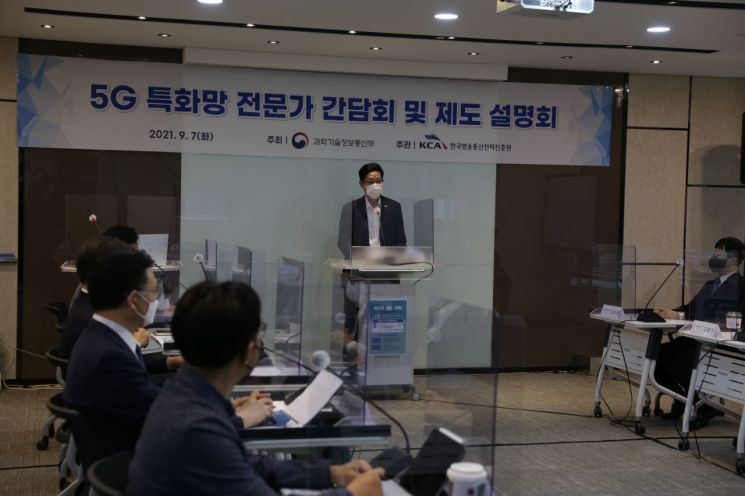 Cho Kyung-sik, the 2nd Vice Minister of the Ministry of Science and ICT, met with industry representatives on the 7th at the 5G Specialized Network Support Center in Sejong City during the '5G Specialized Network Experts Meeting and System Briefing' to listen to their difficulties. The photo shows Vice Minister Cho Kyung-sik (center) speaking. Photo by Ministry of Science and ICT
[Asia Economy Reporter Cha Min-young] Cho Kyung-sik, Vice Minister of the Ministry of Science and ICT, responded on the 7th to the eSIM adoption demands from 5G private network demand companies such as Naver Labs by saying, "We will reach a conclusion within the year."
Vice Minister Cho made this statement during the '5G Private Network Expert Meeting and System Briefing' held at the 5G Private Network Support Center in Sejong City, where he met with industry representatives including Korea Electric Power Corporation (KEPCO), Naver Labs, and HFR.
eSIM is a function that installs a digital card in the form of an electronic code without using a physical SIM card. Instead of a physical card, it enables free mobility without carrier restrictions through an electronic certificate.
Vice Minister Cho said, "We will strive to build more labs and testbeds for research and development (R&D) demonstrations," adding, "There are high expectations for Naver and KEPCO, and I hope they will set a good precedent."
He continued, "Regarding the opinion that the burden of frequency costs needs to be alleviated, we are reviewing it practically, and we plan to actively consider the continuous supply of frequencies," adding, "We will secure the budget and personnel for the 5G Private Network Support Center to make it a one-stop service and a channel for public-private consultation."
Earlier, industry players such as Naver Labs, KEPCO, and HFR pointed out difficulties that act as obstacles to the introduction of 5G private networks from the perspective of demand companies.
Kang Sang-cheol, Lead at Naver Labs, emphasized, "The introduction of eSIM is necessary to enable smartphone use even in 5G private networks." Jeong Hae-gwan, Group Leader at HFR, agreed, saying, "The utilization of existing smartphones is important for the activation of 5G private networks."
Kim Young-kwan, Head of ICT Planning at KEPCO, stressed, "When building large-scale infrastructure at about 1,000 sites nationwide, the frequency cost is a burden in addition to investment costs," and added, "Continuous consultation with the government is necessary to reduce frequency costs."
Group Leader Jeong and Head Kim shared the common argument that "a system for the continuous supply of 5G private network frequencies is necessary." This means that institutional improvements are needed so that demand organizations can apply for and receive frequency supply at any time. The need for continuous information exchange through one-stop support services and technical consultative bodies was also raised.
Kim Dong-gu, Executive Chairman of the 5G Forum and professor at Yonsei University, emphasized, "To activate 5G private networks, it is important to create representative service models for 5G private networks," and added, "A cooperative system between the Private Network Support Center and private cooperative organizations must be established."
Professor Kim Seong-ryun of Yonsei University pointed out the need for technical and institutional arrangements regarding interference issues between 5G private networks, while Professor Lee Moon-gyu of the University of Seoul proposed the need to establish a platform for R&D verification of wireless communication innovation technologies researched at universities.
Meanwhile, the Ministry of Science and ICT explained the following at the 5G Private Network System Briefing to help demand companies understand: ▲ joint use plans for 5G private network frequencies ▲ key contents of technical standards ▲ frequency allocation and designation procedures ▲ guidelines (draft) for building and using 5G private networks.
To enable 5G private network operators in adjacent areas to jointly use private network frequencies without interference, the scope of protected service communication zones requiring protection was pre-established for use, and in cases where some areas overlap, mutual coordination measures were proposed.
© The Asia Business Daily(www.asiae.co.kr). All rights reserved.
![User Who Sold Erroneously Deposited Bitcoins to Repay Debt and Fund Entertainment... What Did the Supreme Court Decide in 2021? [Legal Issue Check]](https://cwcontent.asiae.co.kr/asiaresize/183/2026020910431234020_1770601391.png)















