Government Subsidies at 50% of Monthly Wages
Job Changes and Side Jobs Increase Due to Livelihood Threats
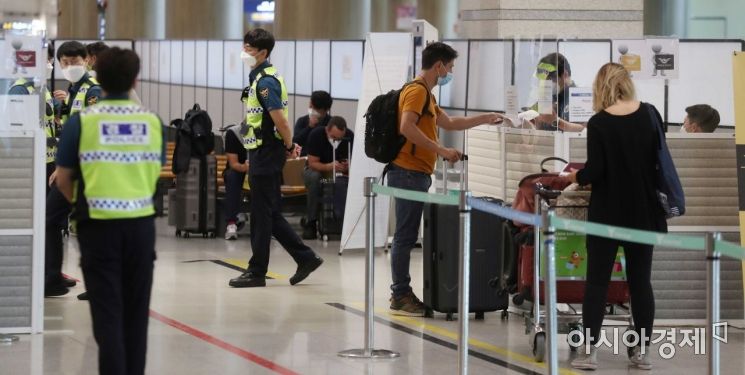 On the 6th, as tension continues over the COVID-19 situation with the first domestic case of the Mu variant confirmed, overseas arrivals are moving through Terminal 1 arrivals at Incheon International Airport. Photo by Moon Honam munonam@
[Asia Economy Reporter Dongwoo Lee] As the government's paid employment retention subsidy ends at the end of this month, major domestic low-cost carriers (LCCs) in Korea will enter an unpaid leave system starting next month. The industry expects that employees' job insecurity will worsen as the average monthly wage will decrease from the current 70% to 50% upon switching to unpaid leave.
According to the aviation industry on the 7th, major listed domestic LCCs such as Jeju Air, Jin Air, T'way Air, and Air Busan each submitted applications for unpaid leave in October to the Ministry of Employment and Labor from the end of last month to early this month. To receive the government's unpaid leave subsidy, the application must be submitted one month prior to the leave.
Jeju Air and Jin Air obtained employee consent and submitted department-wise leave applications from mid to late last month to transition to unpaid leave. T'way Air has also recently completed adjustments to its leave personnel. Air Busan has finalized a four-month unpaid leave plan from early next month to early February next year and plans to implement department-wise rotational work.
When switching to unpaid leave, the support fund that workers can receive from the government is capped at 50% of the monthly wage, with a maximum amount of 1.98 million KRW. For an average wage of 3 million KRW, the actual amount supported would be 1.5 million KRW, which is below this year's monthly minimum wage (1,822,480 KRW based on 209 working hours).
The industry expects that the idle workforce due to unpaid leave will be at a similar level to the approximately 50% before the paid employment retention subsidy was implemented. However, there are concerns that the number of employees resigning or changing jobs to make a living is increasing due to the support amount being below the minimum wage. This phenomenon is known to be concentrated among low-tenure employees and IT personnel. An aviation industry official said, "Cases of IT personnel managing passenger check-in and cargo operation computer systems moving to related large corporations are increasing."
The paid employment retention subsidy can be reapplied for starting January next year, but even then, it does not reach normal wages, so it is expected that the outflow of key personnel will continue as COVID-19 prolongs.
According to the Financial Supervisory Service, the number of employees in listed LCCs in the first half of this year decreased by an average of 6-7% compared to the first half of 2019 before COVID-19. Jeju Air's workforce decreased by 6.7% from 3,260 to 3,041 during this period, Jin Air by 7.5%, and Air Busan by 6.1%. An industry official said, "When switching to unpaid leave, the number of people considering job changes or second jobs due to immediate livelihood concerns is also expected to increase."
© The Asia Business Daily(www.asiae.co.kr). All rights reserved.

















