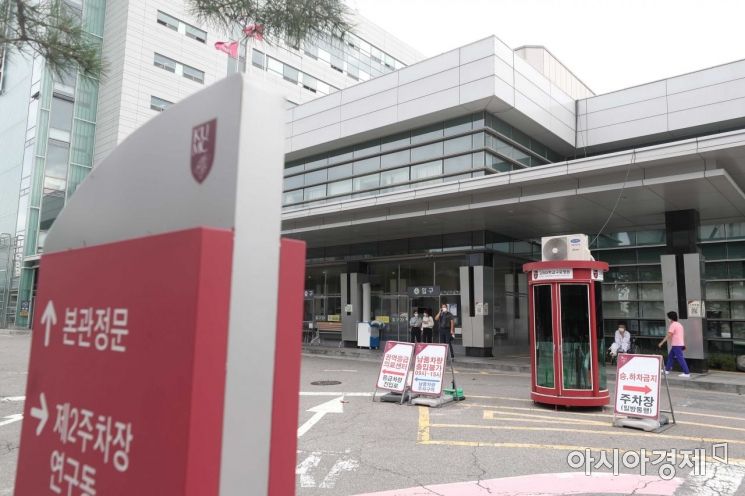
 At Korea University Guro Hospital in Seoul, around 140 people were vaccinated with COVID-19 vaccines that were close to or past the recommended administration period after thawing on the 26th and 27th of last month. The Korea Disease Control and Prevention Agency will decide on re-vaccination after review by an expert advisory committee. Photo by Mun Honam, May 5, Korea University Guro Hospital, Guro-gu, Seoul.
[Asia Economy Reporter Seo So-jeong] As cases of administering expired COVID-19 vaccines have been occurring recently, the government has decided to conduct a full inspection of the expiration dates of vaccines held by each vaccination institution and strengthen management.
The COVID-19 Vaccination Response Promotion Team announced on the 6th, "To prevent the administration of expired vaccines, warning labels indicating First-In-First-Out (used in order of arrival date) will be attached to vaccine transport boxes, and a full inspection of the expiration dates of vaccines held by each vaccination institution will be conducted."
According to the Promotion Team, as of the 6th, there have been 431 cases (13 incidents) of administering expired vaccines.
Messenger RNA (mRNA) vaccines such as Pfizer and Moderna must be administered within 31 and 30 days respectively from the start of refrigerated thawing, separate from their own expiration dates. However, due to inadequate management and supervision, cases of administering expired vaccines have occurred at Seoul Korea University Guro Hospital, Pyeongtaek St. Mary's Hospital, Incheon Sejong Hospital, and others.
The Promotion Team emphasized, "mRNA vaccines must be administered after confirming the refrigerated expiration date attached to the vaccine transport box, separate from the vaccine's own expiration date."
They added, "We will improve the computerized system so that vaccination institutions can recognize and verify the refrigerated expiration dates for each vaccine, and continuously share major cases of misadministration with local governments and the medical community. We also plan to actively discover and disseminate best practices for preventing misadministration at each vaccination institution."
According to the Promotion Team, the total number of reported misadministrations so far is 1,386 out of 46.47 million vaccinations, accounting for 0.003%. Errors related to vaccine type and storage were the most common at 806 cases (58.1%), followed by dosage errors at 282 cases (20.3%), timing errors at 141 cases (10.2%), and recipient errors at 108 cases (7.8%).
© The Asia Business Daily(www.asiae.co.kr). All rights reserved.
!["The Woman Who Threw Herself into the Water Clutching a Stolen Dior Bag"...A Grotesque Success Story That Shakes the Korean Psyche [Slate]](https://cwcontent.asiae.co.kr/asiaresize/183/2026021902243444107_1771435474.jpg)
















