Fact of involvement in gene expression also identified... "Clue to developing new drugs for preventing genetic and congenital diseases"
[Asia Economy Reporter Kim Bong-su] Domestic researchers have discovered a new form of DNA structure, different from the previously known 'double helix structure.'
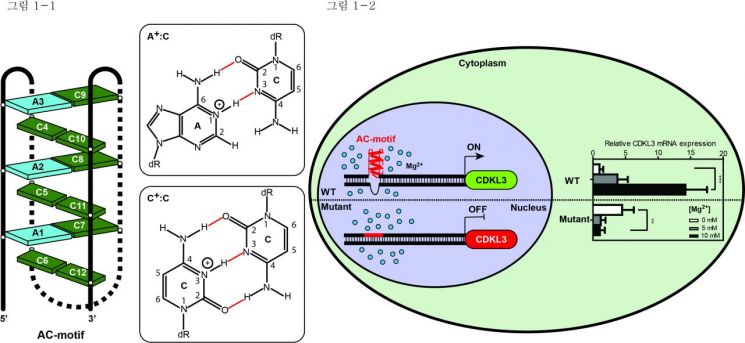
The National Research Foundation of Korea announced on the 5th that Professor Kim Kyung-kyu's research team at the Department of Medicine, Sungkyunkwan University, identified the existence of a new DNA structure called the AC-motif within cells and revealed that this structure regulates gene expression.
DNA, which makes up the human genome consisting of 6 billion base pairs, is predicted to have various structures beyond the double helix depending on the surrounding environment, cellular activities, and base sequences. However, only a few structures have been identified, and their functions have not been extensively studied. James Watson and Francis Crick were awarded the 1962 Nobel Prize in Physiology or Medicine for discovering in 1953 that DNA storing genetic information in cells is a B-form double helix.
The research team discovered that sequences with repeating adenine and cytosine bases form a quadruple helix structure in the presence of magnesium and named it the AC-motif. They synthesized various oligonucleotides with repeating adenine and cytosine bases and studied their tertiary structure formation and the influence of metal ions, confirming that the AC-motif has a quadruple helix structure composed of two pairs of double helices intertwined. Techniques such as Circular Dichroism (CD) spectroscopy, Nuclear Magnetic Resonance (NMR) spectroscopy, Fluorescence spectroscopy, and molecular dynamics calculations were employed.
Furthermore, the team found that gene expression is regulated by this quadruple helix structure. Using cell experiments and genome editing technology, they confirmed that the AC-motif regulates the expression of the oncogene CDKL3. The shape, characteristics, and functions of cells are determined by which genes are expressed in each cell. Therefore, gene expression is precisely regulated by intracellular and extracellular signals and various factors. However, the mechanisms regulating gene expression are not yet fully understood, and especially the effects of nucleic acid structures and base sequences on gene expression remain largely unknown.
In this context, by demonstrating that DNA structures like the AC-motif regulate gene expression, the research team proposed a new principle of gene expression regulation. This is also expected to provide a clue for drug discovery research targeting the control of disease-related gene expression.
The research results were published online on the 1st in the international nucleic acid journal Nucleic Acids Research.
© The Asia Business Daily(www.asiae.co.kr). All rights reserved.

















