From 2024, Two VLGCs to Transport Ammonia and LPG
[Asia Economy Reporter Dongwoo Lee] Hyundai Glovis is making a full-scale entry into the gas maritime transportation market by deploying ultra-large gas carriers (VLGCs).
While expanding its shipping business focused on automobile carriers, the company plans to accelerate the establishment of a hydrogen value chain to realize the upcoming global hydrogen society.
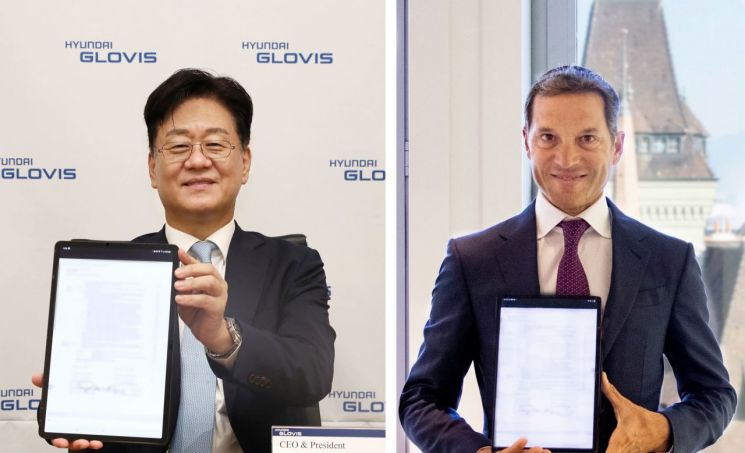
Global SCM specialist Hyundai Glovis announced on the 5th that it has signed a transportation contract with Trafigura, one of the world's top three raw material trading companies, and will begin maritime transportation of ammonia and liquefied petroleum gas (LPG) starting in 2024.
With this contract as a milestone, Hyundai Glovis, which is officially entering the gas transportation business, plans to focus its capabilities on building a hydrogen value chain by transporting ammonia and LPG to global demand centers for up to 10 years.
For this business, Hyundai Glovis plans to invest approximately 200 billion KRW to build two VLGCs and deploy them in the global maritime transportation market. The new vessels will be ultra-large with a cargo capacity of 86,000 cubic meters, expected to be among the largest in the global gas carrier fleet.
Unlike existing gas carriers that mainly transport LPG, Hyundai Glovis’s VLGCs have cargo tanks made of special materials enabling the transportation of ammonia. Globally, only about 20 VLGCs (less than 10% of the total VLGC fleet) are known to be capable of carrying ammonia.
Currently, ammonia is mainly used for fertilizers and petrochemical purposes and is transported by small to medium-sized gas carriers with a cargo capacity of less than 35,000 cubic meters. When the era of large-scale ammonia transportation arrives, Hyundai Glovis’s VLGCs are expected to be the vessels optimized for ammonia maritime transport.
The vessels will be built as state-of-the-art eco-friendly ships in line with ESG management. They will be equipped with LPG dual-fuel (DF) engines and shaft generators that reduce carbon dioxide emissions. Shaft generators produce the electricity needed for ship propulsion by utilizing the rotational power of the engine shaft, thereby reducing reliance on the generator itself and lowering sulfur oxide emissions, making it a representative eco-friendly new technology.
In the future, if engines using ammonia as fuel that emit zero carbon are developed, the vessels are designed to be convertible to ammonia propulsion engines. Hyundai Glovis plans to stably transport gases such as ammonia and LPG to global demand centers for up to 10 years starting from the delivery of the vessels in 2024.
The company is particularly focusing on ammonia as the most efficient hydrogen storage and transportation medium at the current technological level.
For hydrogen transportation and storage, gaseous hydrogen must be liquefied. Gaseous hydrogen has limited transport capacity, and liquefied hydrogen (hydrogen in liquid state at -253 degrees Celsius cryogenic conditions) has low storage density and is not yet commercialized, posing limitations.
Ammonia has emerged as a practical alternative. By combining hydrogen with nitrogen, ammonia is formed. This ammonia is transported by sea and hydrogen is extracted from ammonia at the demand site. Unlike liquefied hydrogen, ammonia liquefies relatively easily at room temperature and can store 1.7 times more hydrogen per unit volume, making large-scale transportation easier.
Ammonia is already widely used globally as a raw material in fertilizer and chemical industries, and most countries have infrastructure for its transportation and storage, which is an advantage.
As countries such as Japan and Australia focus on commercializing green ammonia, it is expected that the Korean government will also accelerate ammonia adoption. According to the hydrogen economy activation roadmap, the government plans to increase hydrogen supply to 1.94 million tons by 2030 and 5.26 million tons by 2040.
Hyundai Glovis, which joined the ‘Green Ammonia Council’ launched jointly by the public and private sectors in July, plans to actively communicate with related organizations and provide optimal services to build a hydrogen value chain covering all areas from hydrogen production, transportation, to extraction.
© The Asia Business Daily(www.asiae.co.kr). All rights reserved.

















