Ministry of Education Announces Final Results of the '2021 University Basic Competency Diagnosis'
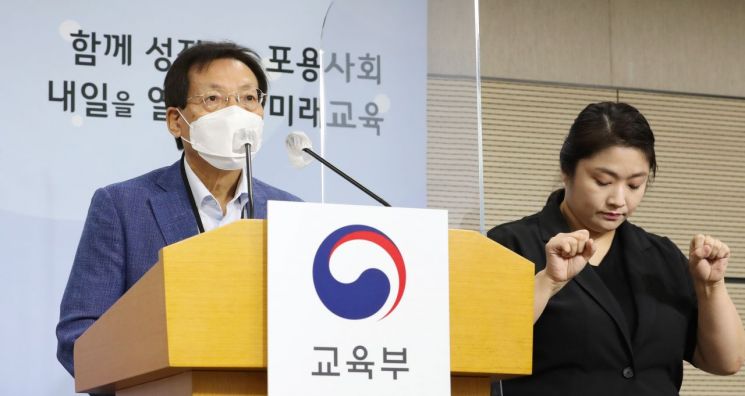
[Asia Economy Reporter Lim Cheol-young] A total of 52 universities nationwide, including Seongshin Women's University and Inha University, which failed the preliminary results of the Ministry of Education's University Basic Competency Diagnosis, have ultimately been excluded from the government's general financial support target universities. As the Ministry of Education dismissed all previously submitted appeals, these universities will not receive a total of 14 billion KRW in innovation support project funds over the next three years.
On the 3rd, the Ministry of Education and the Korea Educational Development Institute announced the final results of the '2021 University Basic Competency Diagnosis,' which excluded these 52 universities from general financial support. The Ministry of Education selected 233 universities (136 general universities and 97 vocational colleges) as financial support targets, the same as the preliminary results announced on the 17th of last month. Ninety percent of the selected universities were allocated by regional distribution, and the remaining 10% were selected on a nationwide basis.
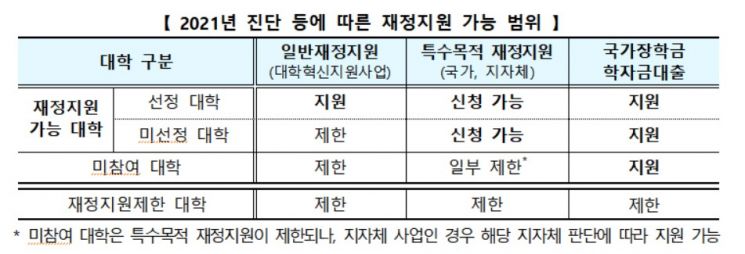
The 52 universities that failed include 11 metropolitan area universities such as Inha University, Seongshin Women's University, and Sungkonghoe University, which were also on the preliminary results list. Among local universities, 14 schools including Sangji University and Gunsan University were excluded. Of these 52 universities, 47 submitted a total of 218 appeals after the preliminary results announcement, but the Ministry of Education dismissed all of them.
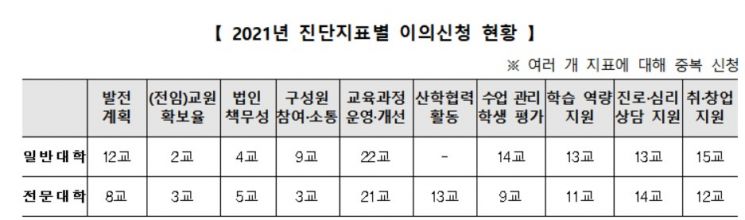
According to the Ministry of Education, 45 universities (24 general universities and 21 vocational colleges) submitted a total of 203 appeals regarding the diagnosis results by indicators, and 2 universities (both general universities) raised a total of 2 objections concerning deductions due to fraud, corruption, and failure to comply with recommended enrollment reductions. Additionally, 13 universities submitted one miscellaneous opinion each.
Kim Gyu-won, chairman of the University Structural Reform Committee, explained, "Whether to accept the appeals submitted by each university was finalized after a three-stage review process involving the Appeal Processing Subcommittee, the University Diagnosis Management Committee, and the University Structural Reform Committee," adding, "On the 1st, the University Diagnosis Management Committee reviewed the Appeal Processing Subcommittee's findings and decided to dismiss all appeals raised by the universities." However, the Ministry of Education stated that universities excluded from the general financial support target have no restrictions on applying for other financial support projects, including national scholarships and student loans.
The 233 universities selected for general financial support must autonomously innovate, including appropriate enrollment reductions, from next year through 2024. In March next year, universities will establish autonomous innovation plans based on conditions, capabilities, and development strategies, and the Ministry of Education will provide benefits in general financial support to universities excelling in appropriate scaling.
Chairman Kim said, "In the second half of the year, we will check the maintenance enrollment rate of universities receiving general financial support and recommend differential enrollment reductions according to the scale of non-fulfillment, and if not implemented, measures such as suspension of general financial support will be taken," adding, "Specific details will be announced in the second half of this year through the '2022-2024 (Vocational) University Innovation Support Project Basic Direction.'"
© The Asia Business Daily(www.asiae.co.kr). All rights reserved.



















