Second Audit of the 21st National Assembly from Next Month 1st
Intense Criticism Expected from Ruling and Opposition Lawmakers over Poor Household Debt Management
Poor Supervision of Virtual Currency Also Expected to Become a Key Issue
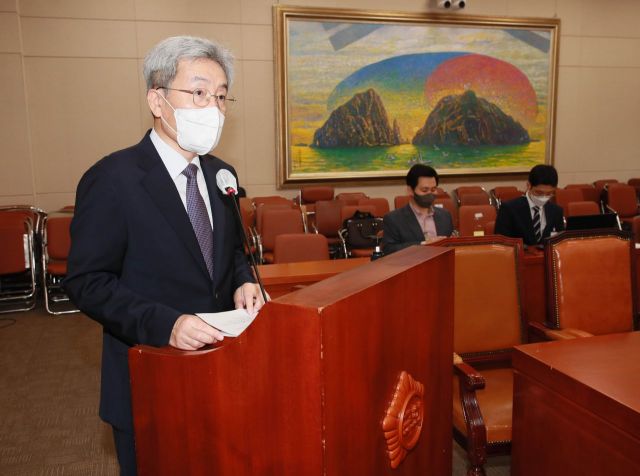 Ko Seung-beom, the nominee for the Chairman of the Financial Services Commission, is delivering an opening statement at the confirmation hearing held at the National Assembly on the 27th. Photo by Yoon Dong-joo doso7@
[Asia Economy Reporter Jin-ho Kim] In the upcoming National Assembly’s Political Affairs Committee audit starting early next month, the key issues are expected to be the ‘household debt issue’ and the ‘management and supervision of virtual currencies.’ Additionally, the financial authorities are likely to face intense scrutiny over their management failures related to the court’s ruling on overseas interest rate-linked derivative-linked funds (DLF) and the Merge Point incident, which triggered a massive refund crisis. The two heads of the financial authorities are the main targets of both ruling and opposition party lawmakers.
According to political and financial circles on the 3rd, the ‘second audit of the 21st National Assembly’ will be held over three weeks from the 1st to the 21st of next month.
The undeniable hot topic of this year’s audit is household debt. Despite the government’s successive regulatory measures, it has surpassed 1,800 trillion won, becoming the biggest time bomb for the Korean economy. In particular, the Bank of Korea has emphasized the need to normalize monetary policy, raising concerns about potential defaults higher than ever before.
Accordingly, lawmakers from both ruling and opposition parties are expected to focus their questioning on the two heads of the financial authorities regarding solutions for household debt. Especially since the Financial Services Commission emphasized last year during the audit that ‘household debt is at a manageable level,’ Financial Services Commission Chairman Ko Seung-beom is expected to face strong criticism.
Explanations regarding various controversies related to loan regulations aimed at curbing household debt are also expected to be demanded. In fact, the National Assembly Legislative Research Office recently pointed out in its ‘2021 Audit Issue Analysis’ report that the current method of regulating mortgage loans "restricts the freedom of financial companies and consumers."
The current mortgage loan regulations are implemented through internal administrative rules of the Financial Services Commission, which may cause legal instability. Suh-hwan Lee, a legislative researcher at the National Assembly Legislative Research Office, said, "In the long term, lending institutions should be encouraged to autonomously strengthen loan screening and risk management to maximize the positive functions of housing finance."
The controversy over inadequate management and supervision of virtual currency exchanges is also expected to be a major issue. Both ruling and opposition parties have emphasized the responsibility of the financial authorities for the significant market turmoil that began in the first half of this year. Their argument is that the government’s stance of not considering virtual currencies as financial assets caused many investors to suffer losses.
Especially since most of the approximately 200 exchanges are likely to have been closed by the time the audit begins, responsibility issues are expected to arise. Chairman Ko also expressed an unwillingness to accept calls from the political circles and virtual currency exchanges to extend the reporting deadline under the Act on Reporting and Using Specified Financial Transaction Information (Special Financial Transactions Act) during his confirmation hearing, stating that "principles must be upheld."
The Merge Point incident, which caused a large-scale refund crisis, is also expected to be a topic of discussion. Lawmakers point out that the management and supervision of unregistered prepaid service providers like Merge Point were negligent, resulting in significant damage to consumers and small business owners. Therefore, measures to address the blind spots in the management of prepaid electronic payment service providers under the financial authorities are expected to be demanded.
According to the DLF lawsuit results, the responsibility of the financial authorities is also expected to be reemphasized. While last year’s audit targeted financial companies, this year the Financial Services Commission and the Financial Supervisory Service are expected to be the main targets. In particular, lawmakers are anticipated to focus their questioning on the Financial Supervisory Service’s disciplinary practices against financial companies.
This is because the court recently ruled in favor of Woo Tae-seung, chairman of Woori Financial Group, in an administrative lawsuit against the Financial Supervisory Service. The court judged that the Financial Supervisory Service imposed excessive disciplinary measures without legal grounds to sanction compliance with internal controls. Currently, the Financial Supervisory Service and the Financial Services Commission are reviewing whether to appeal.
A financial industry official said, "In recent years, the audit has targeted individual financial company CEOs, but this year the two heads of the financial authorities will be the main targets," adding, "From household debt and virtual currency management failures to the responsibility issues in the DLF lawsuit, the financial authorities’ mindset ahead of the audit is complicated."
© The Asia Business Daily(www.asiae.co.kr). All rights reserved.

















