The 132nd National Issues Inspection and Coordination Meeting
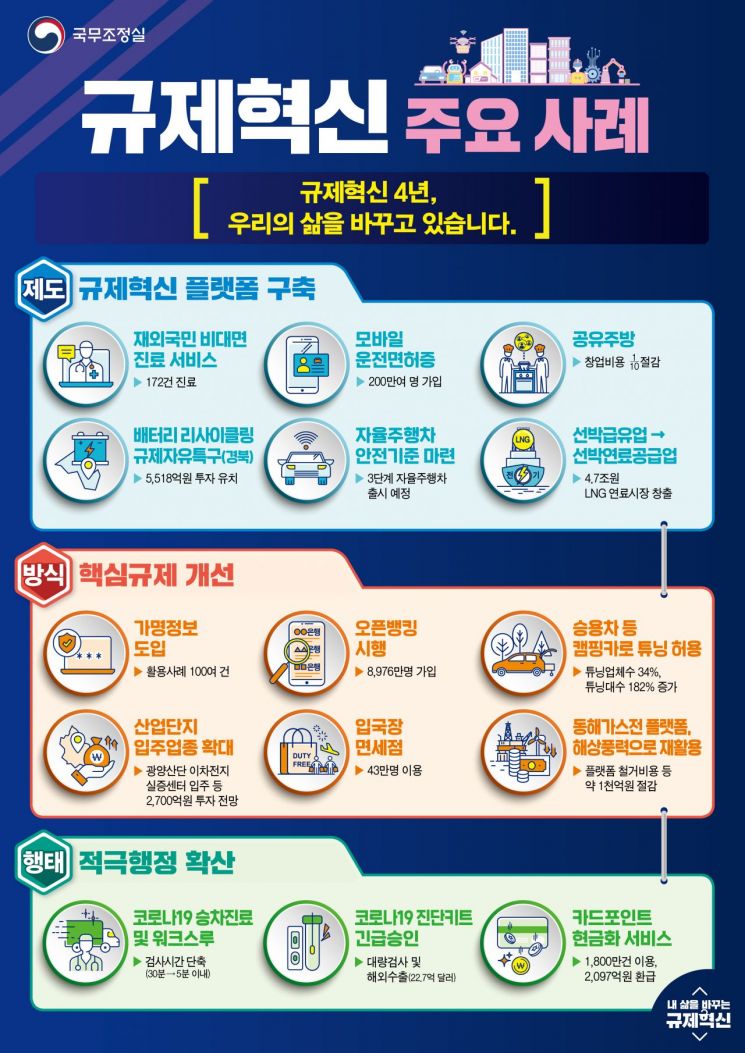
[Sejong=Asia Economy Reporter Son Seon-hee] The government announced on the 2nd that it has improved a total of 8,600 regulations over the past four years in line with the Fourth Industrial Revolution era, including the introduction of mobile driver's licenses and allowing camping car tuning. These include regulations closely related to businesses and citizens' lives in new industries and new technologies.
Prime Minister Kim Boo-kyum held the 132nd National Affairs Inspection and Coordination Meeting at the Government Seoul Office that morning to review the 'Regulatory Innovation Achievements' with such content. According to the Office for Government Policy Coordination, over the past four years, 1,295 regulatory improvements related to the regulatory innovation platform and 7,328 related to business activities and citizens' lives have been made.
According to government analysis, the regulatory sandbox system introduced in January 2019 attracted investments worth 1.9 trillion won and created employment for about 3,800 people. In the case of 'non-face-to-face medical treatment' between medical personnel and patients, which was previously completely prohibited, it was allowed for overseas Koreans worldwide, and 172 cases of non-face-to-face medical treatment were actually conducted. Also, the mobile driver's license, temporarily approved on the premise of a personal information leakage prevention system, was found to have more than 2 million subscribers using it.
In the new industry and new technology sectors, a total of 3,089 unreasonable regulations were improved to support business activities. In the data field, the door was opened to use pseudonymous information, and regulations such as allowing camping car tuning, which is in high demand among small and medium-sized enterprises, small business owners, and startups, establishing small-amount insurance businesses, expanding industrial complex resident business types, and easing regulations on small-scale beer manufacturing and distribution were implemented.
Regarding citizens' lives, 4,239 regulations were eased across daily life areas such as administration, welfare, medical care, housing, and culture, including the creation of the first duty-free shop in the arrival hall and enabling birth registration online, which previously required a direct visit to the community service center.
Furthermore, in the public sector, related exemption standards were relaxed so that active regulatory improvements could be made without concerns about disciplinary actions or audits. As a result, the government explained that urgent policies such as the emergency approval of COVID-19 diagnostic kits, the development of COVID-19 drive-through treatment and walk-through methods could be implemented swiftly.
The government stated, "We will continue to expand the regulatory innovation platform, core regulation improvements, and proactive administration to continuously create regulatory innovation achievements," and added, "For regulations with significant value and conflict of interest, we will derive social consensus through the regulatory innovation platform and public-private consultative bodies involving various stakeholders."
© The Asia Business Daily(www.asiae.co.kr). All rights reserved.

















