2019 South Korea's Per Capita Single-Use Plastic Waste Volume Ranked 3rd Among G20 Countries
[Asia Economy Reporter Jeong Hyunjin] Although the importance of the white bioindustry is being highlighted as a global eco-friendly trend, it has been claimed that Korea's related technology level lags behind the United States by more than three years, and the qualitative competitiveness of patents and papers is also low.
The white bioindustry is cited as an alternative to solve environmental pollution caused by the ecological harmfulness of petroleum-based products and the increase in plastic use. The decomposition period of biodegradable bioplastics, a representative product of the white bioindustry, is within 5 years, decomposing faster after disposal than PET bottles (450 years) or vinyl (20 years), and carbon emissions during the production process are about half compared to petroleum-based products.
On the 2nd, the Federation of Korean Industries analyzed the "Current Status and Tasks of the White Bioindustry" and stated that it is necessary to expand government budget and policy support to secure a leading position in the global white bioindustry market and enhance Korea's competitiveness. In the situation where the use of disposable products is increasing due to the prolonged COVID-19 pandemic, it is argued that the white bioindustry should be actively fostered to respond to strengthened environmental regulations in major countries including the European Union (EU) and to secure the eco-friendly product market.
According to the "Plastic Waste Manufacturer Index" announced in May by Minderu Foundation, a non-profit organization in Australia, Korea's per capita disposable plastic waste in 2019 approached 44 kg. This amount ranks third among the Group of Twenty (G20) countries, following Australia (59 kg) and the United States (53 kg), and Korea was found to have generated 2.3 million tons of disposable plastic waste nationwide.
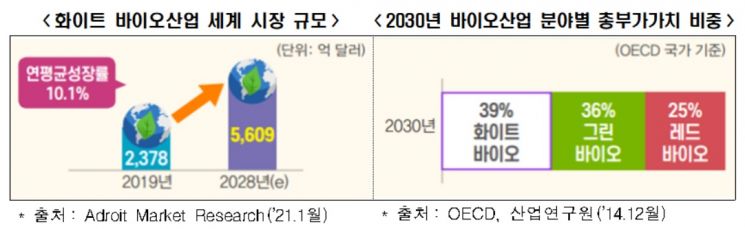
The global white bioindustry market is expected to grow at an average annual rate of 10.1%, expanding from $237.8 billion (approximately 281 trillion KRW) in 2019 to about $560.9 billion, according to market research firm Adroit Market Research. This exceeds the expected global semiconductor sales revenue of $550.9 billion this year. The Organisation for Economic Co-operation and Development (OECD) also forecasts that by 2030, the total added value share of the white bioindustry (39%) in the global bioeconomy will surpass that of red bio (pharmaceuticals and medical) and green bio (food, agriculture, and resources) sectors to become the largest.
A Federation of Korean Industries official said, "Korea still has a long way to go. According to the '2020 Technology Level Assessment' by the Korea Institute of Science and Technology Planning and Evaluation, the competitiveness of core technologies related to the white bioindustry, such as eco-friendly bio-materials and bio and waste resource energy conversion, lags behind the United States by three and four years, respectively," adding, "It is also at a lower level compared to the EU and Japan, and when the U.S. competitiveness is set at 100, Korea scores only 78 to 85%."
The influence index calculated from the number of citations of patents and papers related to white bio technology was also found to be low. In the case of eco-friendly bio-material technology, Korea's patent influence from 2013 to 2017 was 0.7, less than half of the U.S. (2.0), and the paper influence from 2014 to 2019 (7.9) was also lower than that of the EU (10.3) and the U.S. (10.2).
The Federation of Korean Industries pointed out that although the Korean government announced the "White Bioindustry Activation Strategy" last December and is seeking support measures, the industry is still in its early formation stage with high uncertainty, so it is necessary to design incentives including tax support for private white bio R&D and to prepare plans for practical application and expanded use of products. They also added that the government’s support budget for the white bio sector needs to be increased. This year, government R&D investment in the white bio sector is expected to be only 83.1 billion KRW, which is 2.8% of the total bio budget.
Yoo Hwan-ik, head of the Corporate Policy Office at the Federation of Korean Industries, said, "The white bioindustry is important as a foundation for national eco-friendly competitiveness, but the technology level is weak and R&D uncertainty is high, so expanded government policy support is absolutely necessary," adding, "It is also necessary to cultivate convergence talents in bio and chemical fields, ease regulations for the rapid practical application of new white bio technologies, and specify measures to revitalize the domestic market."
© The Asia Business Daily(www.asiae.co.kr). All rights reserved.

















