Earthin Company Valuation 38 Billion KRW... Domestic Market Estimated at 20 Billion KRW
Supported by MZ Generation and Environmentally Conscious Consumers... ESG Management Also Contributes
Slow-Growing Cultured Meat Gains Momentum... VC Investment Expected to Accelerate

[Asia Economy Reporter Lee Junhyung] As the alternative meat market rapidly grows, investors are increasingly interested in related startups. Not only startups attracting investments worth tens of billions of won but also those evaluated at hundreds of billions of won in corporate value have emerged. It is analyzed that investments from venture capital (VC) and others in the alternative meat industry, which has entered a growth trajectory, will also accelerate. Overseas, there have already been cases where alternative meat startups have become decacorns (unlisted companies valued at over 10 trillion won).
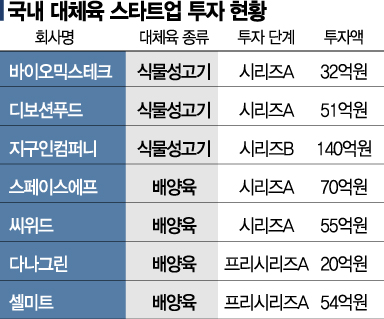
According to the industry on the 2nd, alternative meat startup Jiguin Company raised 10 billion won in Series B funding this February, receiving a corporate valuation of about 38 billion won. Considering that the domestic alternative meat market size is estimated at about 20 billion won, the corporate value is twice the market size. The accumulated investment amount is 14 billion won, the largest scale among domestic alternative meat startups.
Aligned with MZ Generation’s ‘Value Consumption’... Consumption Volume to Reach 24 Million Tons by 2025
The background of such corporate value lies in the growth potential of the alternative meat market. Alternative meat can reduce carbon emissions generated during livestock farming, so it has begun to rise prominently alongside ESG (Environmental, Social, and Governance) management. It is also free from animal rights issues arising during the slaughter process. This is why it inevitably gains support from the MZ generation (Millennials + Generation Z), who pursue value consumption, as well as environmentally conscious consumers. Thanks to the demand from the MZ generation and others, global alternative meat consumption is expected to increase from 13 million tons last year to 24 million tons in 2025 and 65 million tons in 2030. The Korea International Trade Association also predicted that alternative meat will account for 60% of the global meat market by 2040 and emphasized the need to strengthen the competitiveness of domestic companies in alternative meat.
Jiguin Company is a leader in the domestic alternative meat market. The company first attracted attention in 2019 by developing the country’s first plant-based alternative meat, ‘Unlimit.’ Currently, Unlimit is supplied to sandwich brand Subway, CU convenience stores, Domino’s Pizza, and others. The company is also building a dedicated plant-based meat production facility covering 8,910㎡ (about 2,695 pyeong) in Jecheon, Chungbuk. A Jiguin Company official said, “Both demand and client companies are increasing, so performance is steadily rising,” adding, “We expect this year’s sales to increase by more than 300% compared to the previous year.”
‘Lab-grown Meat’ Cultured Meat Also Rising... "An Attractive Item for VCs"
Following plant-based alternative meat, startups developing cultured meat are also drawing industry attention. Cultured meat is alternative meat artificially grown from animal embryonic stem cells in a culture medium. Unlike plant-based alternative meat, it has the advantage of almost perfectly replicating the ‘meat taste,’ but due to technological barriers and high production costs, development speed has been slow domestically. However, as investments in alternative meat have begun to increase, cultured meat startups are also securing funds for research and development (R&D) one after another.
Startup SpaceF raised 7 billion won in Series A funding last month. This was thanks to securing patents and core technologies necessary for cultured meat production, giving them a technological edge. The company also showcased a prototype made by culturing pig stem cells for the first time in Korea in March this year. Accordingly, mid-sized food company Daesang selected SpaceF as a partner to grow cultured meat as a new business and participated as a strategic investor (SI). A SpaceF official said, “More than half of the technology development needed for commercialization has been completed,” adding, “We also conducted joint research on culture medium with Daesang before the investment.”
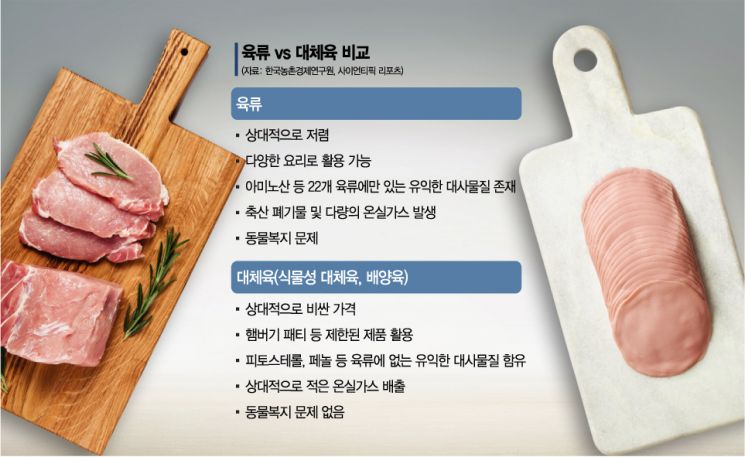
A VC industry insider explained, “Investment reviews for domestic alternative meat startups seem to have started about two years ago,” adding, “Alternative meat, which literally presents ‘future food’ to VC analysts aiming to capture new markets, is an attractive item.”
Overseas ‘big players’ have already made investments in alternative meat startups early on. The U.S. alternative meat venture Impossible Foods is famous for being invested in by Microsoft founder Bill Gates and Hong Kong’s Li Ka-shing, chairman of Cheung Kong Group. Mirae Asset Group recently attracted attention by investing an additional 300 billion won in this company. Another alternative meat venture, Beyond Meat, reached a market capitalization of 10 trillion won after listing on NASDAQ in 2019. Impossible Foods, which is scheduled to go public next year, is also recognized with a corporate valuation of about 11 trillion won.
© The Asia Business Daily(www.asiae.co.kr). All rights reserved.

![Clutching a Stolen Dior Bag, Saying "I Hate Being Poor but Real"... The Grotesque Con of a "Human Knockoff" [Slate]](https://cwcontent.asiae.co.kr/asiaresize/183/2026021902243444107_1771435474.jpg)

















