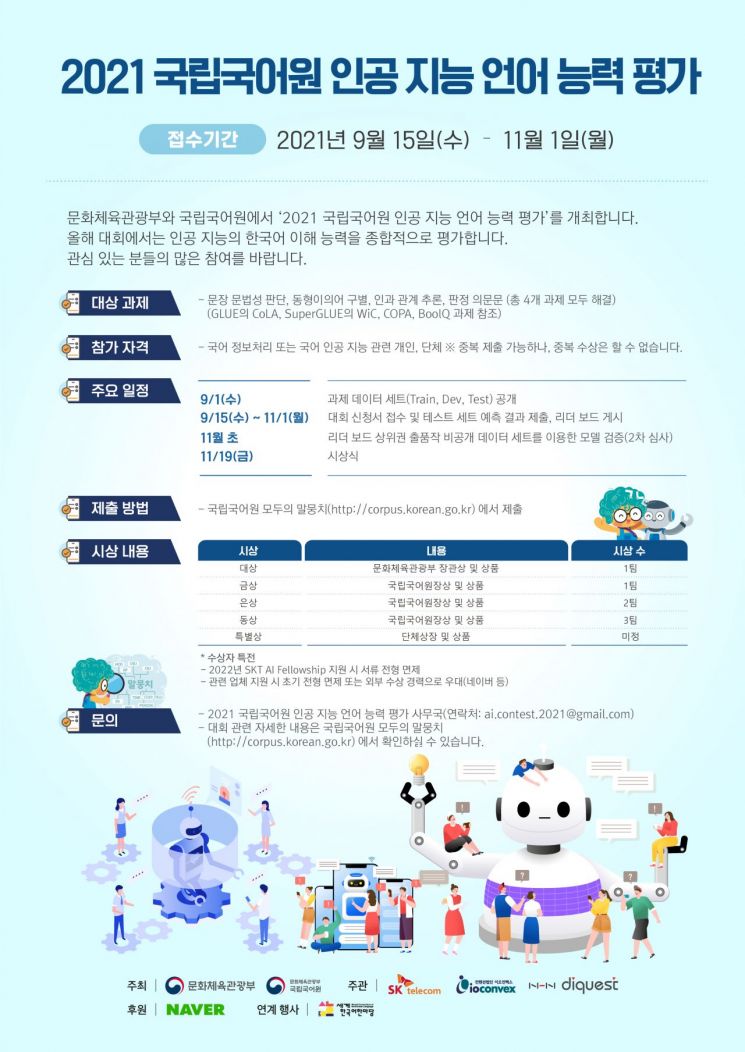
[Asia Economy Reporter Eunmo Koo] SK Telecom announced on the 1st that it will hold an ‘Artificial Intelligence Language Ability Evaluation Contest’ together with the Ministry of Culture, Sports and Tourism and the National Institute of the Korean Language to enhance the development capabilities of Korean AI language models and expand the base of Korean language informatization.
The contest begins today with the release of SK Telecom’s base AI language model and the National Institute of the Korean Language’s evaluation dataset. Participants can update and submit their results anytime from the 15th until November 1st.
Anyone can participate individually or as a team. Among the participants, grand prizes (Minister of Culture, Sports and Tourism Award), gold, silver, bronze, and special awards will be selected. All awardees will also be granted exemption from document screening for the AI Fellowship held annually by SK Telecom.
Participants will develop their own AI language model programs based on the provided language models and will be evaluated on their ability to understand and analyze the Korean language. Detailed event information can be found at the National Institute of the Korean Language’s Everyone’s Corpus.
The evaluation tasks for the submitted language models consist of four categories: judging grammatical errors in sentences (sentence legality judgment), distinguishing word meanings by context (homonym disambiguation), reading sentences and inferring causes (causal inference), and reading passages and answering yes/no questions (judgment interrogatives). This evaluation is composed of somewhat more difficult content than previously released datasets for Korean AI model evaluation.
The language model provided by SK Telecom has 1.2 billion parameters, about eight times larger than the KoGPT2 model released last year. This is an initial output of the Korean General Language Model (GLM) research project conducted by SK Telecom and the National Institute of the Korean Language. Following the previously developed and announced KoBERT, KoGPT2, and KoBART models, it is expected to be helpful for those who want to develop and utilize Korean AI models.
Eric Davis, head of SK Telecom’s Language Superintelligence Lab, said, “We hope this contest, prepared in collaboration between SK Telecom and the National Institute of the Korean Language, will be a stage to fully demonstrate capabilities in language and AI,” adding, “Furthermore, we hope that this healthy competition will contribute to the advancement of Korean language models, including general language models, and the spread of Korean language informatization.”
© The Asia Business Daily(www.asiae.co.kr). All rights reserved.


















