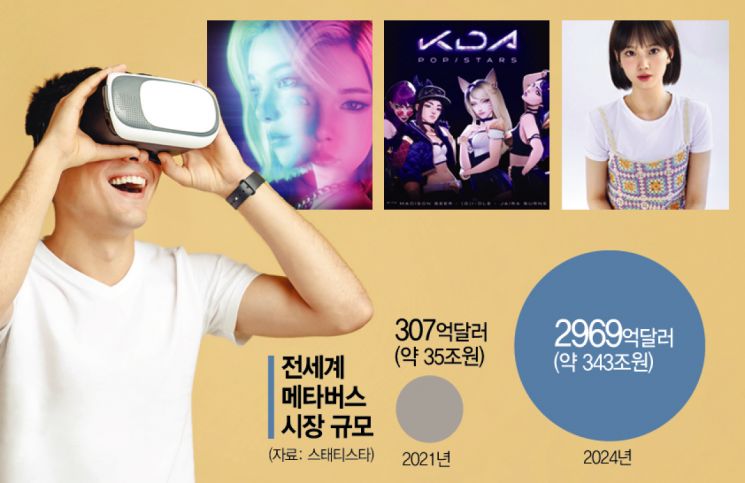
[Asia Economy, Kang Nahum and Boo Aeri] SM Entertainment's girl group 'aespa' consists of four real-life members and four virtual avatar members called ae-aespa, who exist in a virtual reality. This girl group, which has established a metaverse (3D virtual world) universe, is actively promoting and gaining popularity among teenagers and people in their twenties. The virtual girl group 'K/DA' from Riot Games has surpassed 450 million views on its music video. As the metaverse becomes established as a new business model, investment from the IT and gaming industries is accelerating.
Game Companies Nurture 'Virtual Idols'
According to the gaming industry on September 1, Netmarble has established Metaverse Entertainment through its subsidiary and has officially entered the virtual idol business. Virtual idols are virtual humans created by combining artificial intelligence (AI) technology and augmented reality (AR), who release albums, hold concerts, and communicate with fans through social networking services (SNS). Seo Woowon, CEO of Metaverse Entertainment, said, "We will create a metaverse world with various content such as meta idols and meta worlds linked to games."
Smilegate has turned Han YuA, a character from its game 'Focus on You,' into a virtual human and has launched her full-scale activities. The company has created an Instagram account for Han YuA and announced plans to nurture her as a 'celebrity.' Smilegate has partnered with Giantstep, the company that produced aespa's avatars. Han YuA has been brought to life with a realistic appearance using Giantstep's AI solutions. She is scheduled for various activities, including acting and album releases, by the end of this year. The company explained, "Virtual characters can transcend time and space, which is advantageous for increasing touchpoints with the public."
Global game company Riot Games has already found success with a virtual girl group. K/DA is a virtual girl group that debuted in 2018, composed of characters Ahri, Akali, Kai'Sa, and Evelynn from the game 'League of Legends (LoL).' Their album reached number one on the Billboard World Digital Song chart. They also used AR technology to create the opening stage for the LoL World Championship.
The reason the industry is jumping into the virtual idol business is that, with the advent of the metaverse era, it is seen as the best item for business expansion. If nurtured well, global success is possible. Wi Jung Hyun, president of the Korea Game Society and professor at Chung-Ang University, said, "Virtual idols are easy for game companies to create using their graphic technology, and they serve as a good entry point for expanding into the entertainment business."
Investment Competition Heats Up
As the metaverse rapidly emerges as a future growth engine for the IT and gaming industries, investment activity is also intensifying. The most aggressive investor in the metaverse space recently has been Wemade. On August 5, Wemade invested in Metascale, a metaverse service developer, through its subsidiary Wemade Tree. Metascale is preparing a new type of metaverse service, aiming for a launch early next year. The company plans to provide users worldwide with a unique experience by utilizing gamification, a mechanism that enhances human interaction.
Wemade Tree has also made a strategic investment in UtiPlus Interactive, a company that both develops and operates metaverse services. UtiPlus Interactive has launched 'Ditoland,' a UCC (User Created Contents) metaverse platform that allows users to freely create and share content without requiring specialized knowledge. The beta version is currently available, and the official version will support play across devices, including mobile and console, as well as cross-platform play.
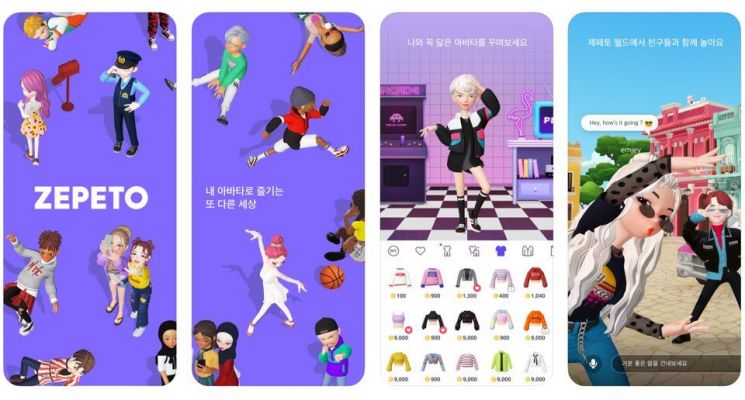
Naver, which operates the 'metaverse' platform Zepeto, is also busy nurturing new metaverse developers. In July, Naver's startup accelerator D2SF made new investments in two metaverse technology startups: VirtualFlow and Pixelity Games. VirtualFlow is developing a solution that allows users to easily create high-quality 3D content based on the Unreal Engine, even without specialized development knowledge. Pixelity Games possesses core technology that enables real-time multi-user interaction in VR environments.
This surge in investment is driven by the rapid growth of the metaverse market. According to global market research firm Statista, the global metaverse market is expected to grow from $30.7 billion (about 35 trillion won) this year to $296.9 billion (about 343 trillion won) next year. The National Assembly Research Service, in its report 'The Current Status and Future Challenges of the Metaverse,' stated, "As non-face-to-face interactions become more widespread, traditional face-to-face and densely connected relationships are being absorbed into the metaverse format." The report also analyzed, "Ultimately, the metaverse could become the dominant platform that replaces the existing online ecosystem and creates immense economic value."
© The Asia Business Daily(www.asiae.co.kr). All rights reserved.


















