[Fake Meat is Coming Part 2]
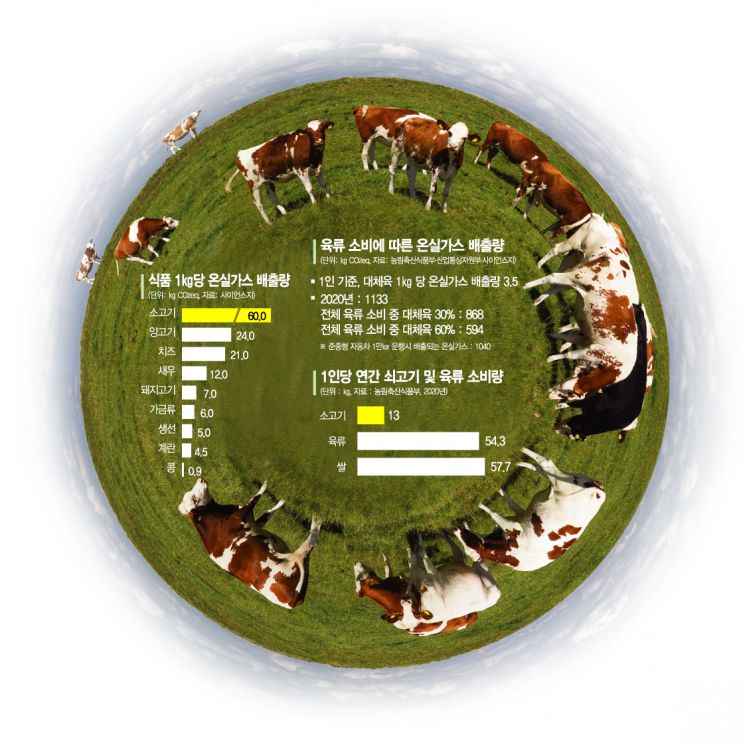
Per Capita Meat Consumption 54.3 kg
Greenhouse Gas Emissions 1133 kg
If 60% Replaced with Alternative Meat
More Than Half Reduction
[Asia Economy Reporter Seungjin Lee] Interest in alternative meat is heating up to the extent that it is predicted to account for 60% of total meat consumption by 2030. In particular, alternative meat is rapidly emerging as a solution to environmental issues and is expected to contribute to solving humanity's food problems, strengthening the outlook that the alternative meat market could surpass traditional meat.
If Alternative Meat Increases, Equivalent to Five Round Trips Between Seoul and Busan
The biggest advantage of alternative meat is that it can significantly reduce greenhouse gases emitted from livestock farms.
According to the United Nations Food and Agriculture Organization (FAO), greenhouse gases emitted from livestock farming account for about 16.5% of global greenhouse gas emissions. This is more than the carbon emissions from all transportation worldwide. Over 61% of this is related to meat products because vast amounts of grain and water are consumed to raise livestock after clearing forests, and until slaughter. When adding the processes of packaging, refrigerated transportation, and delivery to the table, the greenhouse gas emissions caused by meat consumption are considerable.
In particular, beef emits four times more methane gas than automobiles and is the highest emitter of greenhouse gases among animal products. According to a 2018 paper published in Science by Professor Joseph Poore's research team at Oxford University, producing 1 kg of beef generates 60 kg CO₂eq of greenhouse gases. This was followed by lamb (24.0), pork (7.0), and poultry (6.0). Beef had over 60 times more negative impact compared to plant-based proteins such as tomatoes (1.4) and corn (1.0).
Last year, Koreans consumed 54.3 kg of meat, including 13 kg of beef. When converted, it is estimated that each person emitted 1,133 kg of greenhouse gases from meat consumption alone. If 30% of this is replaced with alternative meat, greenhouse gas emissions decrease to 868 kg, and if increased to 60%, emissions drop to 594 kg, reducing by more than half. This amount is equivalent to the emissions generated by driving a compact car five round trips between Seoul and Busan.
Needs Improvement but Market Will Grow
Experts say that although there are areas to improve such as insufficient related legislation and differences in taste and texture compared to meat, alternative meat is expected to eventually become mainstream in the meat market. Mi-seong Park, a research fellow at the Korea Rural Economic Institute, explained, "For it to be considered a substitute, it must be exactly like meat, but it is still difficult to completely replace meat. However, with rapid market growth and technological advancement, alternative meat is quickly catching up to meat in taste, texture, and price."
Research fellow Park viewed cultured meat, which is produced by cultivating animal cells without slaughter, positively among alternative meats. He said, "As the global population increases, the current form of meat could see significant price increases. Cultured meat, produced hygienically and on a large scale, could become a common food."
Professor Ki-hyung Ryu of Kongju National University’s Alternative Meat Research Center emphasized, "Alternative meat has the drawback of lower palatability, but through manufacturing technology called extrusion molding, it is possible to enhance health benefits, safety, and reduce production costs, strengthening its advantages over meat. Although various studies are still needed, it is time to recognize alternative meat as a new food source."
© The Asia Business Daily(www.asiae.co.kr). All rights reserved.

















