UNIST Professor Youngsik Kim's Team Develops Seawater Sterilization and Neutralization Technology Based on Seawater Battery
Published in ACS ES&T Water, 200L-Class Product Launch with Dongsung San-gi Imminent
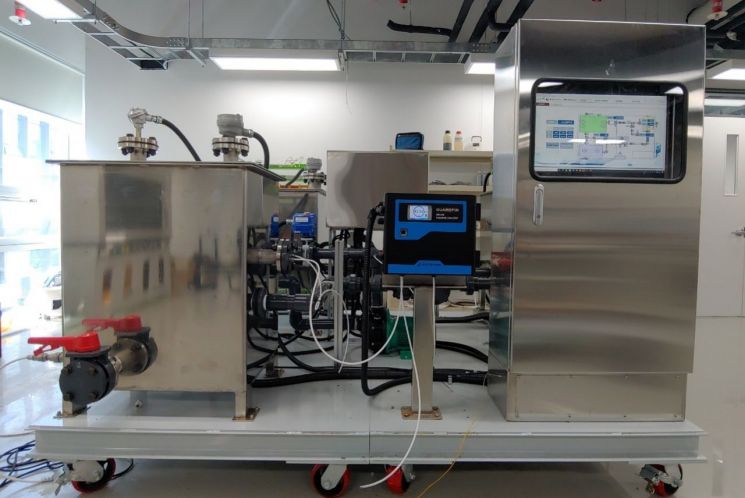
[Asia Economy Yeongnam Reporting Headquarters, Reporter Kim Yong-woo] The challenge of treating seawater using electricity generated from the sea is bearing fruit.
A technology for sterilizing and neutralizing seawater has been developed, and a new product launch is imminent. The era of efficiently using eco-friendly electricity storage has arrived.
Seawater batteries, known as marine-specialized batteries, are eco-friendly energy storage devices that utilize seawater.
There is growing interest in the sterilization and neutralization of seawater as a new application of this device. Companies that have proven the technology in laboratories are already planning product launches.
On the 31st, the research team led by Professor Kim Young-sik of the Department of Energy and Chemical Engineering at Ulsan National Institute of Science and Technology (UNIST) announced that they have developed seawater sterilization and neutralization technology using seawater batteries.
The research team utilized the generation of sterilizing substances during the charging and discharging process by using sodium ions in seawater.
When the seawater battery is charged, sodium ions (Na?) from the salt (NaCl) in seawater move, producing chlorine.
This chlorine acts as a sterilizing agent to eliminate bacteria and pathogens. Conversely, during discharge, the sterilizing substances meet sodium ions and are neutralized, turning back into salt.
This technology features the natural ability to sterilize and neutralize during the process of storing and releasing electricity in the battery.
Although sterilization technology using electrolysis existed before, it required installing separate neutralization equipment or using chemical agents for neutralization, which was inconvenient.
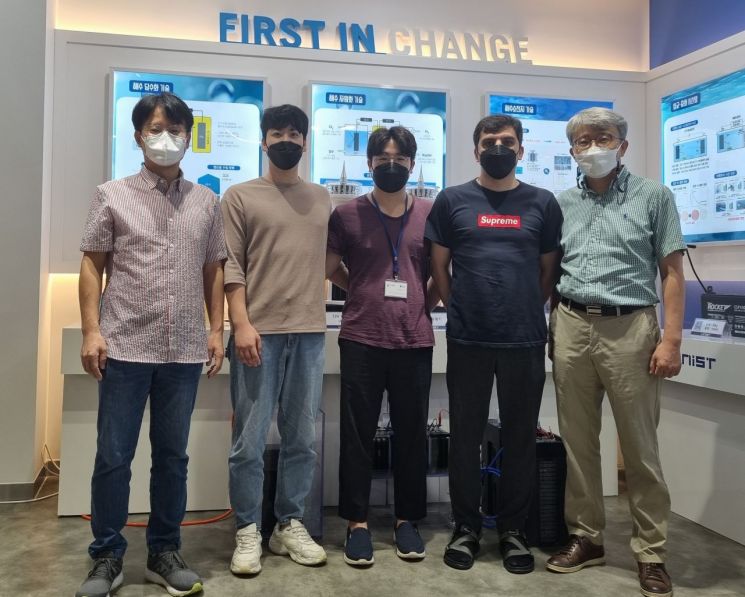 UNIST research team conducting research on seawater battery sterilization system. From the left, Professor Youngsik Kim, Seohae Kim, Jungseon Park, researcher Ahmad M. Harzandi, and Professor Yunseok Choi.
Professor Kim Young-sik explained, “Seawater sterilization is essential for disinfecting land-based aquaculture farms and treating ship ballast water. Using seawater batteries is more economical and eco-friendly than existing technologies that require additional neutralization facilities or the use of chemical agents with toxic byproducts.”
The research results were published on August 5 in the international journal ‘ACS ES&T Water,’ which covers water environment studies.
Professor Kim’s team has accelerated product development in collaboration with a company in Ulsan that recognized this technology’s potential.
‘Dongsung Sanki,’ a ship equipment manufacturer in Ulsan, succeeded in developing a 200L-class hybrid sterilization and neutralization device based on seawater batteries through a regional revitalization project led by UNIST and the Korea Institute of Ocean Science and Technology (KIOST).
The developed product adds a new concept neutralization device using seawater batteries to the existing chlorine disinfectant generation device based on electrolysis technology.
The method disinfects seawater by electrolysis and neutralizes the disinfectant into harmless substances using electricity stored in the seawater battery.
A Dongsung Sanki official said, “We are developing the device to comply with the International Maritime Organization (IMO) convention standards for ship ballast water treatment, and the goal is to scale up for application in large ships.”
He added, “Ultimately, we expect to develop a sterilization and neutralization device that uses only seawater batteries, not the current hybrid type, which will reduce power consumption.”
Dongsung Sanki has been conducting joint research and development while residing at the UNIST Seawater Resource Technology Research Center, recently completing prototype production and accelerating product development for sales.
The seawater batteries for marine equipment demonstration were produced and supplied by ‘Fortyone’ using the seawater battery manufacturing pilot established through the regional revitalization project.
Professor Choi Yoon-seok of the Department of Energy and Chemical Engineering at UNIST, who led the regional revitalization project, said, “This project is an example of how eco-friendly energy technology developed at universities is breathing new possibilities into regional industries. We will continue to collaborate with local companies for the growth of new industries that can be utilized in marine environments.”
An official from Ulsan City welcomed the project, saying, “Although the local economy has been stagnant due to COVID-19, this support project, which utilizes the infrastructure of industry-academia-research cooperation to commercialize prototypes into commercial products, will play a significant role in job creation and revitalizing the local economy.”
The regional revitalization project is promoted by the Ministry of Trade, Industry and Energy to boost the vitality of local manufacturing companies and support their transition to new industries.
UNIST, together with KIOST, has been promoting cooperation with local industries to advance the marine equipment industry based on eco-friendly energy using marine-specialized battery technology.
© The Asia Business Daily(www.asiae.co.kr). All rights reserved.


















