DGIST Professor Jang Yoon-hee and Joint Research Team "Can Also Contribute to mRNA Vaccine Development"
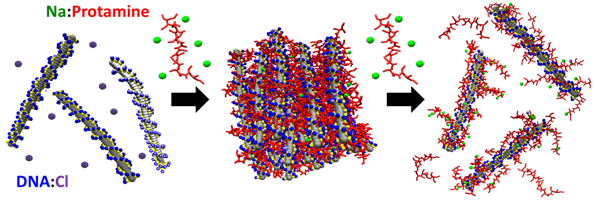 Reversible DNA condensation and decondensation molecular dynamics simulation regulated by protamine protein.
[Asia Economy Reporter Kim Bong-su] Domestic researchers have succeeded in observing the DNA condensation-decondensation phenomenon regulated by proteins at the molecular level using a supercomputer.
The Daegu Gyeongbuk Institute of Science and Technology (DGIST) announced on the 31st that Professor Jang Yoon-hee of the Department of Energy Engineering, in collaboration with Professor Ibransac from the University of Tours, France, observed the DNA condensation-decondensation phenomenon regulated by proteins at the molecular level using a supercomputer. This virtual experiment is expected to greatly aid in fundamentally understanding various phenomena within living organisms as an alternative to conventional experimental research.
DNA, which contains genetic information, carries a negative charge and strongly repels itself, yet it condenses tightly to fit into the small space within the cell nucleus. Moreover, in germ cells, DNA is condensed even more strongly by a small protein called protamine, which safely protects genetic information, facilitates smooth transmission, and then decondenses again. However, it is difficult to observe this mysterious phenomenon, fundamental to life, at the molecular level through actual experiments.
The research team conducted large-scale molecular dynamics virtual experiments using a supercomputer to observe the DNA condensation-decondensation phenomenon regulated by protamine protein at the molecular level. As a result, they discovered that the condensation and decondensation of DNA are reversibly regulated depending on the relative concentration between protamine, a positively charged basic protein, and negatively charged DNA. This confirmed that electrostatic interactions predominantly govern even the most complex biological phenomena. It is expected to contribute to fundamentally understanding essential life phenomena such as self-replication and heredity by expanding this research.
Professor Jang said, "There is increasing evidence that the formation of condensates of proteins and DNA/RNA regulates numerous physiological functions, so it is highly likely that the results and methods of this study will be utilized in future related research." He added, "Since protamine acts as a reversible adhesive molecule not only in DNA condensation but also in RNA self-assembly, I hope to expand this research to contribute to mRNA vaccine development and biomimetic energy conversion technology development."
The results of this study were officially published on the 24th in the international nanotechnology journal ‘ACS Nano.’
© The Asia Business Daily(www.asiae.co.kr). All rights reserved.
![Clutching a Stolen Dior Bag, Saying "I Hate Being Poor but Real"... The Grotesque Con of a "Human Knockoff" [Slate]](https://cwcontent.asiae.co.kr/asiaresize/183/2026021902243444107_1771435474.jpg)
















