Jerome Powell, Fed Chair, Signals Tapering Within the Year
Urges Not to Interpret Tapering as a Rate Hike Signal... Market Focuses on Benchmark Interest Rate
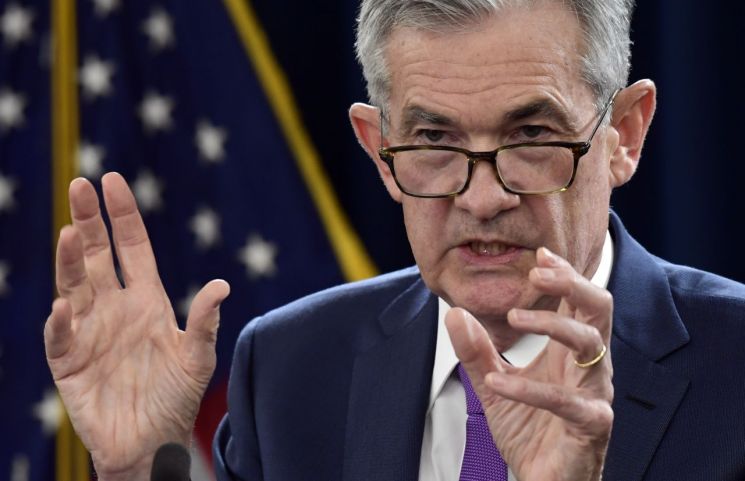
[Asia Economy Reporter Gong Byung-sun] As Jerome Powell, Chairman of the U.S. Federal Reserve (Fed), hinted at asset purchase tapering within this year, market attention is shifting to the pace of tapering and the timing of interest rate hikes.
On the 27th (local time), Chairman Powell said at the Jackson Hole annual symposium hosted by the Federal Reserve Bank of Kansas City, "If the economy develops broadly as expected, it may be appropriate to start tapering within this year." However, he added, "Although there was further progress in the July employment report, the spread of the COVID-19 Delta variant has also increased, so we will carefully evaluate future economic indicators and ongoing risks."
The start timing of tapering is expected to be determined by employment data. According to KB Securities on the 28th, the August employment data will be released on September 3rd. If the employment data continues the strong trend of June and July, the market may effectively interpret it as a tapering announcement. If the August to September employment data is not significantly weak, tapering is expected to be announced at the November FOMC.
Forecasts on the pace are divided. If the August employment data is neither clearly strong nor weak, uncertainty about the tapering pace will inevitably remain. Voices are already emerging that even if tapering starts late, the pace must be accelerated. Robert Kaplan, President of the Federal Reserve Bank of Dallas, prefers reducing the current quantitative easing scale of $80 billion in Treasury securities (about 93.6 trillion KRW) and $40 billion in mortgage-backed securities (MBS) monthly by $10 billion in Treasuries and $5 billion in MBS each month. This means tapering over eight months and completing it by mid-next year. On the other hand, James Bullard, President of the Federal Reserve Bank of St. Louis, argues that tapering should end by the end of March next year.
Chairman Powell also sought to dispel concerns about interest rate hikes. He said, "Even if the Fed begins tapering, it should not be interpreted as a signal for interest rate hikes," adding, "The timing and pace of future asset purchase tapering do not directly signal the timing of interest rate hikes." This means that interest rate hikes will be considered under stricter criteria than tapering.
According to the minutes of the July Federal Open Market Committee (FOMC), many Fed members agreed to start raising the benchmark interest rate after completing tapering. This means that interest rate hikes will not occur during tapering. The July FOMC minutes also included a phrase stating, "It should be made clear that there is no mechanical link between the start of tapering and the timing of interest rate hikes." This is consistent with the previous monetary policy normalization period and method, such as tapering from January to October 2014 and interest rate hikes starting in December 2015.
However, contrary to Chairman Powell's wishes, market attention seems to be moving toward the Fed's benchmark interest rate policy. Kim Il-hyuk, a researcher at KB Securities, explained, "The market will naturally think that the pace of tapering and the timing of interest rate hikes are connected, and finishing tapering early means that interest rate hikes can proceed quickly," adding, "It is important to understand the mood regarding the timing and pace of the Fed's interest rate hikes."
© The Asia Business Daily(www.asiae.co.kr). All rights reserved.
![User Who Sold Erroneously Deposited Bitcoins to Repay Debt and Fund Entertainment... What Did the Supreme Court Decide in 2021? [Legal Issue Check]](https://cwcontent.asiae.co.kr/asiaresize/183/2026020910431234020_1770601391.png)
















