Afghan Collaborators Granted 90-Day Visa as 'Special Contributors'... Ministry of Justice Revises Law for Long-Term Stay
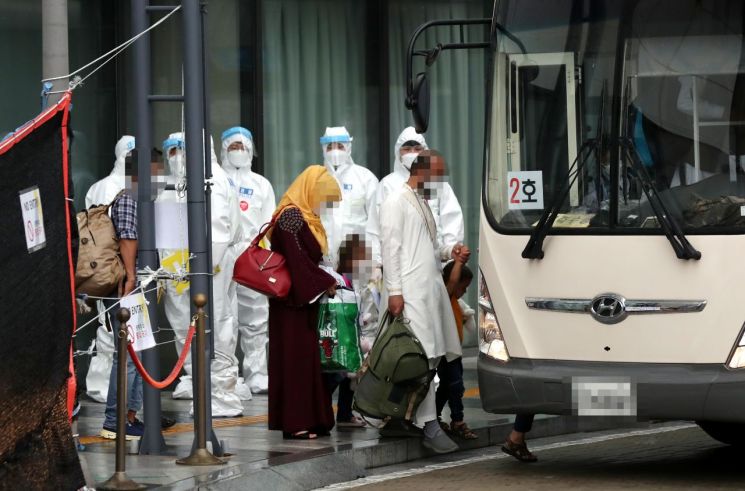
[Asia Economy Reporter Baek Kyunghwan] With the arrival of 13 remaining local collaborators and their families who supported our government’s activities in Afghanistan at Incheon International Airport on the 27th, the so-called 'Miracle Evacuation Operation' for a total of 390 people has been completed. All of them tested negative for COVID-19 and began living at the National Human Resources Development Institute in Jincheon, Chungbuk.
On the first day of admission to the Human Resources Development Institute, the two-year-old child of a special contributor from Afghanistan showed symptoms of vomiting and diarrhea and received treatment at an external hospital, but was diagnosed with no particular health issues and symptoms due to long travel. This child also tested negative in the COVID-19 polymerase chain reaction (PCR) test.
They are local residents and families who assisted our government’s work at the Korean Embassy, hospitals, vocational training centers, and other places in Afghanistan, and will spend the next 6 to 8 weeks here. Among them, 2 weeks will be a quarantine period. Although all tested negative for COVID-19, considering variables such as the incubation period, they will be quarantined for 2 weeks to monitor symptoms. To this end, 40 Ministry of Justice staff members specializing in foreign affairs, as well as medical personnel to conduct tests and monitor their health, have been dispatched to the Human Resources Development Institute.
After 2 weeks, settlement education prepared by the Ministry of Justice will be conducted. This includes social adaptation education such as Korean language, culture, and legal order necessary for settling into Korean society.
Basic living support is provided by the government’s 'Facility Operation Team,' consisting of 59 members in total. Ten medical personnel, including 2 doctors and 3 nurses from the Ministry of Justice Correction Headquarters, as well as military doctors and nursing officers from the Ministry of National Defense, will be stationed at the facility 24 hours a day to monitor the health of the residents and conduct two rounds of PCR tests.
Accommodations have been arranged with 3- or 4-person rooms considering children under 12 years old who require guardians and people with disabilities among the families. One interpreter is stationed at the facility, and there is a pool of 9 interpreters available for telephone interpretation. In addition, support necessary for initial settlement, such as living expenses, medical expenses, and housing support, will be planned in consultation with related ministries.
Their status will also change soon. The Afghans who entered the country yesterday at the airport with short-term visit (C-3) arrival visas will have their status changed to residence status (F-1), which allows long-term stay, thereby securing stable residency. After completing education, they will be issued residence (F-2) visas that allow free employment. The 'F-2' visa is issued to those who wish to stay long-term in Korea to obtain permanent residency and allows a stay of up to 5 years per issuance without employment restrictions.
However, under current laws, it is impossible to issue residence visas to Afghan collaborators and their families. Accordingly, the Ministry of Justice has begun revising the 'Immigration Control Act Enforcement Decree' to allow issuance of residence visas to foreigners who have made special contributions to the Republic of Korea or contributed to public interest.
The Ministry of Justice also intends to consider additional support measures for Afghans. Proactively, humanitarian special stay measures have been implemented for Afghans currently residing in Korea. This applies to 434 Afghans with long- and short-term stays who are legally residing but have difficulty extending their stay period and wish to remain in Korea, granting them special stay status.
They can also work after screening. However, those without domestic guarantors or connections, or serious criminals such as violent offenders, will be subject to protective measures. The 72 individuals whose stay period has expired and who have been handed over to police and related agencies will be allowed to voluntarily depart once the situation in Afghanistan stabilizes.
© The Asia Business Daily(www.asiae.co.kr). All rights reserved.












