2020 Birth Statistics
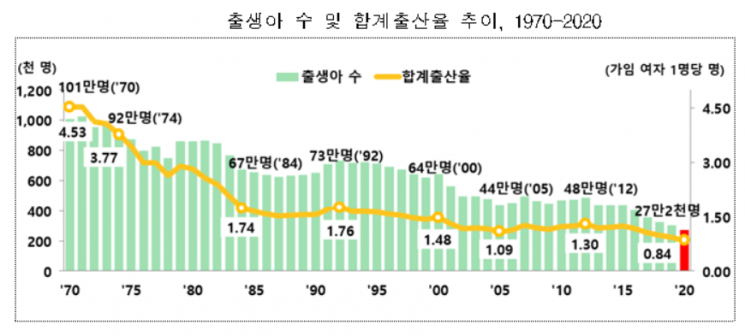
[Sejong=Asia Economy Reporter Son Seon-hee] Last year, the number of newborns fell into the 200,000 range, marking an all-time low. The total fertility rate also stood at 0.84, bringing the dishonor of ranking last among the Organization for Economic Cooperation and Development (OECD) member countries.
According to Statistics Korea's '2020 Birth Statistics' released on the 28th, the number of newborns last year was 272,300, a decrease of 30,300 (-10.0%) compared to 2019. This is the first time since related statistics began in 1970 that the annual number of newborns has recorded in the 200,000 range.
The total fertility rate, which refers to the average number of children a Korean woman is expected to have in her lifetime, also hit a record low of 0.84. The total fertility rate had remained in the 1% range until 2017 but has been rapidly declining every year since 2018. It falls far short of the OECD member countries' average total fertility rate of 1.61.
The crude birth rate, which indicates the number of births per 1,000 people, was 5.3 last year, down 0.6 from the previous year.
Looking at fertility rates by female age group, it was found that the rate decreased in all age groups except for women in their early 40s (40-44 years old). In particular, the fertility rate significantly declined in the late 20s to early 30s age group, which has a relatively high birth proportion. The fertility rate for women in their late 20s (25-29 years old) dropped by 14.2%, from 35.7 in 2019 to 30.6 last year, and for women in their early 30s (30-34 years old), it decreased by 8.4%, from 86.2 to 78.9 during the same period.
By region, Sejong had the highest total fertility rate nationwide at 1.28. It was followed by Jeonnam (1.15), Gangwon (1.04), and Chungnam (1.03). On the other hand, Seoul showed the lowest total fertility rate in the country at 0.64, only half of Sejong's rate. It was followed by Busan (0.75), Daejeon, Daegu, Gwangju (0.81), and Incheon (0.83), all recording total fertility rates below the national average.
© The Asia Business Daily(www.asiae.co.kr). All rights reserved.

















