Hong Jun-pyo Shows Noticeable Rise in Recent Polls
22% Support Among 20s... Highest Across All Age Groups
Why Does He Gain Youth Support Despite 'Kkondae' Image?
Yoon Seok-yeol's Decline? Swing Voter Shift? Various Factors
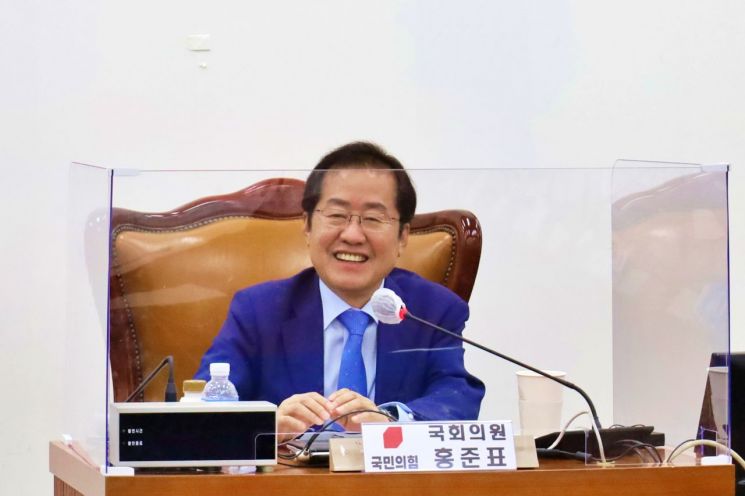
A common feature observed in many polls released since August is the rising trend of Rep. Hong Joon-pyo of the People Power Party. However, when people say to acquaintances, "Hong Joon-pyo's approval rating is rising," the typical response is disbelief. Many ask, "Who on earth supports Hong Joon-pyo?" So, who exactly is 'suddenly' supporting Rep. Hong in large numbers? The detailed poll reports provide a simple answer. Much of Hong's rising trend can be explained by the 'voting intentions of people in their 20s.' Among many candidates in the current presidential race, Hong is relatively older and even has an image of being a traditionalist, so many might find it surprising that young people support him so much. First, let's look at how much people in their 20s support Hong. For simplicity, we will omit titles of presidential candidates and refer to them by name only. We ask for your understanding as this is to aid comprehension.
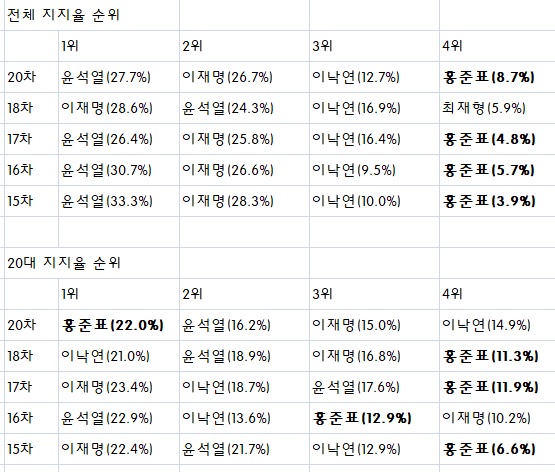
The table above shows the results when 12 presidential candidates from both ruling and opposition parties were presented in no particular order, and respondents chose one. The 19th poll did not include this question, so it was excluded. Yoon Seok-youl and Lee Jae-myung comfortably alternate between first and second place. Lee Nak-yeon appears fixed in third place. Hong Joon-pyo ranks within the top four but with a significantly lower approval rating. Of course, his support rose from a mere 3.9% in the 15th poll to 8.7% in the 20th poll, so there has been an increase.
However, the pattern is different when looking only at people in their 20s. Starting at a relatively high 6.6% in the 15th poll, it doubled to 12.9% in the 16th poll. It doubled again to 22.0% in the 20th poll, making him the top candidate among all presidential contenders in this age group. One in five young people in their 20s supports Hong Joon-pyo! The 20s are the only age group where Hong ranks first in approval ratings. It is also notable that Yoon Seok-youl and Lee Jae-myung have lower approval ratings among people in their 20s compared to the overall average. Hong himself interprets this as "voting intentions disappointed with Yoon Seok-youl moving to me." However, this analysis is half right and half wrong.
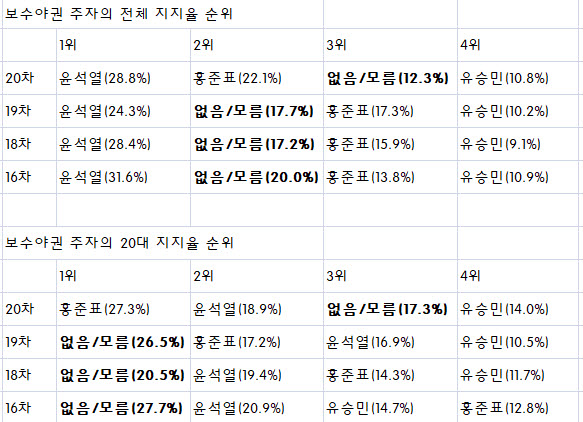
The table above shows results focusing only on conservative opposition candidates. Yoon Seok-youl maintains first place across all age groups. Hong Joon-pyo moved up from third to second place. This time, the category of 'no preferred candidate or don't know' was included in the analysis. That is, when conservative voters were asked which conservative candidate they support, 17-20% answered none or don't know. This figure dropped significantly to the 12% range in the 20th poll, indicating that many decided on a candidate during this period.
However, among people in their 20s, the top response from the 16th to 18th polls was 'none/don't know,' with a high rate of 20-27%. This dropped to 17% in the 20th poll. The decrease in 'none/don't know' and the rise of Hong Joon-pyo are phenomena observed both in the overall and 20s voter groups.
It is also observed that Hong's rise in the conservative opposition does not come at the expense of Yoon Seok-youl. Yoon's approval rating remains almost unchanged. This data somewhat contradicts Hong's own interpretation that "Yoon's votes came to me." However, since both Hong's rise and Yoon's decline occurred simultaneously among people in their 20s (unlike the overall age groups), the analysis that "disappointed 20s voters moved from Yoon to Hong" seems plausible. Nevertheless, it is more reasonable to conclude that Hong's rise among people in their 20s is largely due to the decrease in 'none/don't know' responses rather than Yoon's decline.
Below is data showing how the 20s approval ratings of conservative opposition presidential candidates changed during the 16th and 20th polls, when Hong Joon-pyo's support surged.
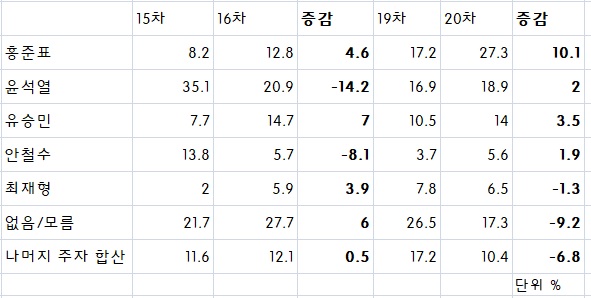
Looking at the table above, in the 16th poll when Hong's approval rating rose significantly, Yoon Seok-youl and Ahn Cheol-soo's ratings dropped sharply. The combined decline of Yoon and Ahn mostly shifted to Yoo Seung-min (+7 percentage points), while Hong only gained 4.6 percentage points. Additionally, the 'none/don't know' responses increased by 6 percentage points. This suggests that Hong's rise in the 16th poll partly came from Yoon and Ahn's decline, but the lost support did not flow solely to Hong.
However, the story changes in the 20th poll. Hong's approval rating jumped by a whopping 10.1 percentage points, but neither Yoon nor Ahn lost support; in fact, they slightly increased. This means it cannot be definitively said that Hong and Yoon are in a zero-sum relationship regarding support. Meanwhile, the 'none/don't know' category decreased by 9.2 percentage points, and the combined support for minor candidates dropped by 6.8 percentage points. This indicates that young voters who previously supported minor candidates or had no preferred candidate shifted to Hong Joon-pyo. This supports the assessment that Hong's own analysis is 'half right and half wrong.'
Here, it is important to note that several candidates in the current presidential race emphasize 'youth' and 'freshness' as their strengths. Do people in their 20s prefer these young candidates or not? This question relates to why people in their 20s support Hong Joon-pyo.
In conclusion, people in their 20s do not seem particularly interested in relatively young and fresh candidates like Park Yong-jin from the ruling party or Ha Tae-kyung and Yoon Hee-sook from the opposition. Their approval ratings hover around 1%, similar to the overall average. Being young does not necessarily mean supporting youth. Also, what about support for newcomers to politics like Yoon Seok-youl, Choi Jae-hyung, and Kim Dong-yeon? People in their 20s do not give special treatment to new politicians compared to other age groups. Yoon is actually 'less supported,' while Choi and Kim have approval ratings similar to the overall average.
Returning to Hong Joon-pyo, if his approval rating is high among people in their 20s, what about those in their 30s? The conclusion is that it is also high but not as much as in the 20s. Support for Hong clearly divides between the 20s and 30s and the other age groups. For example, in the 20th poll, Hong's approval rating among people in their 20s was 22.0%, but only 11.4% among those in their 30s. From age 40 and above, it drops sharply to 4.5%, 5.3%, 2.3%, and 6.0%. An interesting point is the movement among people in their 30s. They began supporting Hong above average only from the 20th poll; before that, their support was low, similar to those aged 40 and above. In summary, people in their 20s were the only age group that initially supported Hong heavily and have increasingly concentrated their support on him over time, while people in their 30s showed little interest until August, when they started to support him, and support among other age groups remains minimal. Thus, the sharp rise in Hong's approval rating in the 20th poll can be interpreted as a phenomenon of 'concentration among the 20s + sympathy from the 30s.'
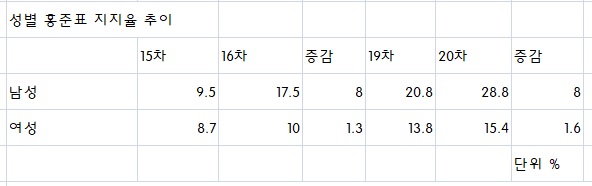
Another distinctive feature of Hong Joon-pyo's support compared to other opposition candidates is not only his high approval rating among people in their 20s but also his popularity among supporters of the Democratic Party. Additionally, he has a peculiar characteristic of having much higher support among men than women.
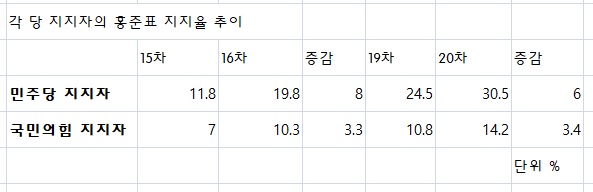
Among People Power Party supporters, only 7% chose Hong (15th poll), as most of them support Yoon Seok-youl. In contrast, 11.8% of Democratic Party supporters said they support Hong. In the most recent 20th poll, 30% of Democratic Party supporters and 14% of People Power Party supporters responded that they support Hong.
Meanwhile, from the 15th to 16th poll, the already high male support increased further (+8 percentage points), widening the gender gap. The same pattern occurred from the 19th to 20th poll. The above party-based and below gender-based approval ratings are based on all respondents, not just those in their 20s. This is because analyzing only People Power Party supporters in their 20s or only males in their 20s would result in too small a sample size to be meaningful.
Now, let's draw conclusions. Hong himself analyzes that his approval ratings are rising sharply not only among people in their 20s but also in their 30s and 40s, but at least according to the polls commissioned by this newspaper, it seems more accurate to limit this to the 20s. Hong also self-assesses that since he is popular among the vulnerable 20-40 age group within the People Power Party, his 'expandability' is increasing. He says that the 50s, 60s, and older age groups are 'home rabbits' who will return to him once he becomes the candidate. This is a classic election strategy of securing the home base first before chasing the mountain rabbits, but he claims to be taking the opposite approach. However, this is somewhat a 'post hoc' interpretation, as there is little evidence that Hong has employed specific tactics to attract youth support.
We asked a political reporter covering Hong for their opinion. "Rather than presenting any logical analysis or momentum behind the rise in approval ratings, the campaign analyzes it as 'our active movement has increased attention' and 'as Yoon Seok-youl's problems become apparent, votes are shifting to us.'"
Here is another reporter's analysis based on the atmosphere within the People Power Party regarding Hong's rise. "It is possible that Hong's high approval among people in their 20s is thanks to Representative Lee Jun-seok. Hong sided with Lee during the conflict between Lee and Yoon, so supporters of Lee (who is popular among men in their 20s and 30s) may have rallied behind Hong."
If this analysis is somewhat close to the truth, then the campaign's own assessment that Hong's rise 'originated from Yoon Seok-youl' is, in any case, somewhat validated.
© The Asia Business Daily(www.asiae.co.kr). All rights reserved.
![Clutching a Stolen Dior Bag, Saying "I Hate Being Poor but Real"... The Grotesque Con of a "Human Knockoff" [Slate]](https://cwcontent.asiae.co.kr/asiaresize/183/2026021902243444107_1771435474.jpg)













