Strengthening Salt-Affected Farmland Approval Standards Amid Farmer Opposition
Contradictory to Government's Carbon Neutrality and Energy Transition Policies
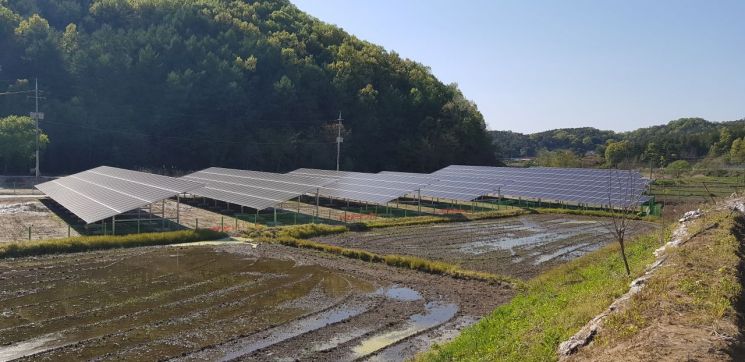
[Sejong=Asia Economy Reporter Moon Chaeseok] The Ministry of Agriculture, Food and Rural Affairs is pushing to strengthen the standards for installing solar power facilities on salinized farmland. Land newly created by reclaiming the sea has high salinity, so instead of cultivation, solar panels are installed for power generation. The ministry plans to raise the salinity standards to use the land as farmland. In a situation where expanding the share of eco-friendly power generation is urgent for carbon neutrality, even the power generation sites seem to be a stumbling block.
According to the Ministry of Agriculture, Food and Rural Affairs on the 27th, the ministry recently announced a plan to commission a research project on "Improvement Measures for the Criteria to Judge Salinized Reclaimed Farmland Where Solar Power Facilities Can Be Installed" on the Public Procurement Service's Nara Market.
According to the Enforcement Rules of the Farmland Act, currently, solar power facilities can be installed for up to 20 years on salinized farmland with soil salinity of 5.5 decisiemens (dS) per meter or higher. Decisiemens is a unit measuring electrical conductivity. Farmers in regions such as Yeongam, Jeollanam-do, where there are many reclaimed lands, urged for stricter regulations, prompting the ministry to prepare improvement measures to raise the standards.
An official from the Ministry of Agriculture, Food and Rural Affairs explained, "Most of the farmers requesting stricter regulations are tenants, not farmland owners," adding, "They oppose because the more solar power facility capacity increases, the less farmland is available for cultivation." The official added, "We will review raising the standards through the research project."
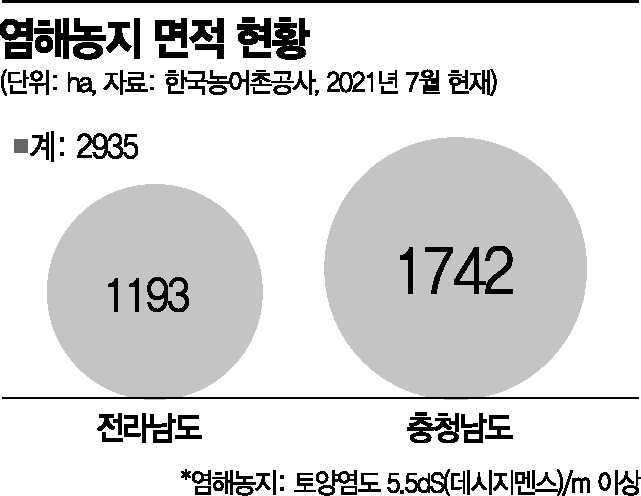
Last year, the power generation capacity on salinized farmland was 96 MW, accounting for only 0.5% of total solar power generation. However, considering the government's efforts to increase the share of renewable energy to achieve carbon neutrality by 2050, securing space for panel installation is an important task. Especially last summer, typhoons and floods swept away solar panels in mountainous areas, further reducing the available sites for solar power installation.
Experts point out the need to reconsider the criteria for selecting sites for renewable energy such as solar power. Professor Jeong Dongwook of the Department of Energy Systems Engineering at Chung-Ang University said, "Since crop yields are low on salinized farmland, it is necessary to weigh which is more efficient between cultivation and installing power generation facilities," but added, "Considering Korea's geographical characteristics with many reclaimed lands, deciding how far to regulate for renewable energy facility installation is not a decision that one ministry can easily make."
© The Asia Business Daily(www.asiae.co.kr). All rights reserved.
!["The Woman Who Threw Herself into the Water Clutching a Stolen Dior Bag"...A Grotesque Success Story That Shakes the Korean Psyche [Slate]](https://cwcontent.asiae.co.kr/asiaresize/183/2026021902243444107_1771435474.jpg)

















