Housing Cost Assistance Increases Demand for Monthly Rent, Driving Up Rental Prices
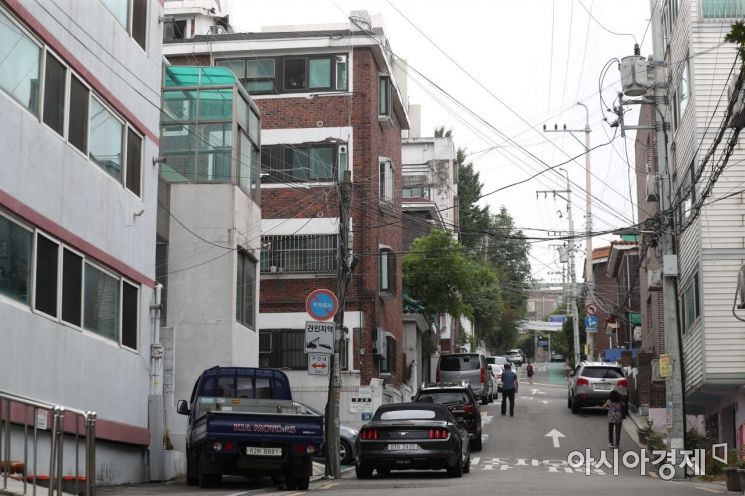 The appearance of a villa village in Yangcheon-gu, Seoul, on the 11th. / Photo by Mun Ho-nam munonam@
The government and ruling party have decided to provide cash support for monthly rent and interest-free monthly rent loans to low-income youth, raising expectations among villa neighborhood landlords. Generally, housing cost assistance policies such as monthly rent support tend to increase demand while also driving up rents. Areas with low monthly rents, such as one-room neighborhoods near universities, have been severely impacted by prolonged vacancies due to COVID-19, and there is growing interest in whether the government’s monthly rent support will help recover demand for villas.
According to the youth special measures announced by the government on the 27th, from the first half of next year, youth with a monthly income of 1.2 million KRW or less will be able to receive up to 200,000 KRW per month in rent support for 12 months on a temporary basis. The Ministry of Land, Infrastructure and Transport expects about 152,000 households to be eligible for monthly rent support. Youth with higher incomes (annual income below 50 million KRW) can borrow up to 200,000 KRW per month in rent interest-free. If the monthly rent exceeds 200,000 KRW, additional loans with a low interest rate of 1% are available.
Upon hearing this news, landlords, rather than the direct policy beneficiaries?the youth?are showing more enthusiasm. University area one-room neighborhoods have suffered serious vacancies due to COVID-19. While one-year contracts are generally standard for university area one-room units, short-term monthly leases of three months have appeared as students stopped coming due to remote classes. Real estate communities are sensing an atmosphere of expectation for a recovery in monthly rent demand due to this policy.
Professor Chang-Moo Lee of Hanyang University’s Department of Urban Engineering said, "If those who could not receive subsidies lived in one-room units, receiving subsidies might enable them to move to two-room units or larger," adding, "In any case, demand-side subsidies increase overall demand in society."
Generally, housing cost assistance in the form of vouchers not only drives housing demand but also tends to raise rents. Subsidies make both recipients and landlords more tolerant of price increases.
The Seoul Institute stated in its April report, "Seoul-type Housing Voucher Operation Status and Improvement Measures," that "theoretically, housing cost assistance raises rents." The institute cited overseas cases, noting, "(As housing cost assistance increased) landlords raised rents, rendering the policy ineffective in some cases."
In France, between 1992 and 1994, rent subsidies were provided to all low-income households. As a result, rents for subsidized housing rose compared to those for non-subsidized households.
Associate Professor Jun-Seok Ko of Dongguk University Law School said, "Especially since youth housing difficulties are severe, housing support for low-income youth is necessary," but added, "Such measures can stimulate the monthly rent market." He said, "Support through a kind of voucher system cannot be a long-term solution," emphasizing, "Only price reductions through increased housing supply are the fundamental solution."
© The Asia Business Daily(www.asiae.co.kr). All rights reserved.

















