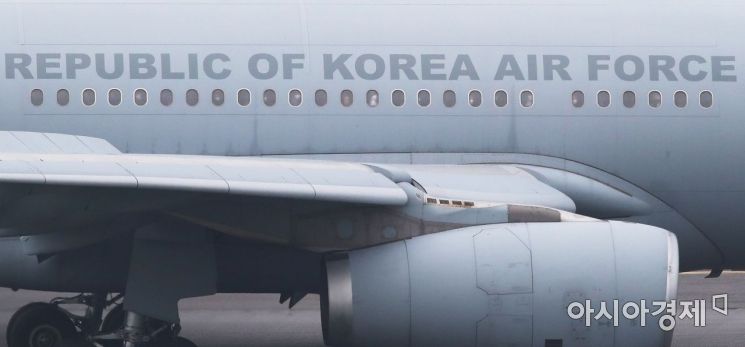
 A military transport plane carrying Afghan collaborators who helped Korea and their families arrived at Incheon Airport on the 26th. They underwent COVID-19 testing at the airport and are scheduled to stay at a temporary living facility until the results are available. Photo by Moon Honam munonam@
[Asia Economy Yang Nak-gyu, Military Specialist Reporter] It is known that the safe arrival of Afghan collaborators in Korea was made possible due to cooperation from the U.S. side.
On the 26th, the Ministry of National Defense explained that the success of the operation named 'Miracle' was "possible because of the full cooperation of the allied country, the United States," and added, "Support from allies such as the UK and Canada in securing Kabul Airport, cooperation from the Pakistani government in allowing airport use for the Korean Special Mission Unit, and active cooperation from India, Malaysia, Cambodia, Thailand, Vietnam, and the Philippines in granting rapid airspace passage approvals were also key factors in the operation's success."
The Afghan collaborators who arrived in Korea that day numbered 378 individuals from 73 households. To transport them, the Korean military urgently formed a Special Mission Unit consisting of 66 personnel, deploying one multipurpose aerial refueling transport aircraft (KC-330) and two military transport aircraft (C-130J) to the site in the early morning of the 23rd. This included special forces prepared for local contingencies and Combat Control Team (CCT) personnel.
The moment the three Korean military transport aircraft arrived at Kabul Airport, the U.S. Central Command frequently issued prior flight approvals (PPR) for airport takeoff and landing, accepting urgent PPR requests without a single denial.
The U.S. military directly negotiated with the Taliban to ensure the safe entry of the Afghans arriving in Korea into Kabul Airport, securing safety by allowing them to enter the airport using buses.
The transport operation was conducted in three stages.
The first stage involved landing the military transport aircraft at the intermediate stop, Islamabad Airport in Pakistan. Through urgent phone calls between the Chiefs of Air Staff of Korea and Pakistan, and full activation of channels including the Pakistani military attach? offices in Korea and Pakistan, approval from the Pakistani government for the use of Islamabad Airport was secured on the 22nd. The Pakistani government facilitated the use of Islamabad Airport, and the local Korean community reopened lodging facilities that had been closed due to the COVID-19 pandemic.
In the first operation of the second stage, military transport aircraft were deployed to Kabul Airport to first transfer six families totaling 26 people to Islamabad. During this process, the Ministry of National Defense officers dispatched as part of the U.S. Central Command Korean military cooperation team closely coordinated to ensure timely deployment of the transport aircraft. The second operation of the second stage involved safely transporting a large number of remaining personnel to Islamabad. Embassy staff in Afghanistan and the Ministry of National Defense Special Mission Unit, who were first deployed to Kabul Airport, succeeded in bringing 365 collaborators into Kabul Airport on the afternoon of the 25th with the help of local U.S. and allied forces. One C-130J carried 190 people, and the second carried 175, arriving in Islamabad the same day.
The final third stage was the operation to transport a total of 391 collaborators to Korea. Considering that about 100 children under the age of five were among them and the collaborators’ anxiety about being separated from their families, all were boarded onto the KC-330. When there were not enough seats, the Special Mission Unit soldiers gave up their seats to the Afghan collaborators.
Following this boarding plan, the KC-330 carrying 378 collaborators and 66 military Special Mission Unit members departed Islamabad in the early morning of the 26th.
The Ministry of National Defense added, "Even after this Miracle operation, we will continue to provide necessary transportation means and military medical personnel support as needed to ensure the stable settlement of Afghan collaborators in Korea."
© The Asia Business Daily(www.asiae.co.kr). All rights reserved.
![From Bar Hostess to Organ Seller to High Society... The Grotesque Con of a "Human Counterfeit" [Slate]](https://cwcontent.asiae.co.kr/asiaresize/183/2026021902243444107_1771435474.jpg)
















