[Asia Economy Reporter Moon Hyewon] As more people prioritize their health due to COVID-19, the demand for decaffeinated coffee has surged, prompting coffee franchises to elevate their offerings to dispel the prejudice that "decaf coffee tastes bad." Consumers are opening their wallets for decaffeinated coffee that retains the original aroma and flavor of coffee while removing only the caffeine.
◆ Rapid Growth of the Decaffeinated Market = According to Starbucks Korea on the 24th, last year’s sales of decaffeinated coffee exceeded 10 million cups. Sales from January to July this year increased by 20% compared to last year, continuing the upward trend. Starbucks’ own survey found that the age group with the highest demand for decaf coffee was people in their 30s, accounting for 54% of the total. This was followed by those in their 20s at 23%, and those in their 40s at 17%. Notably, women showed a higher preference for decaf coffee, making up 81% of total decaf coffee sales, which is four times higher than men.
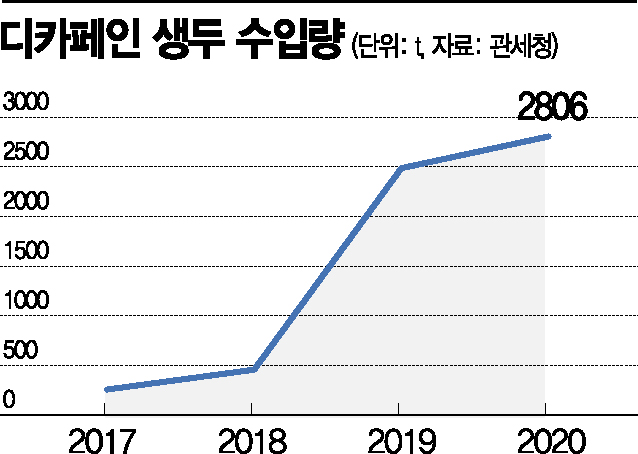
According to the Korea Customs Service, the import volume of decaffeinated green coffee beans, which was only 258 tons in 2017, surged to 2,487 tons in 2019. Last year, 2,806 tons were imported. This year, it is expected to exceed 3,000 tons.
A coffee industry insider said, "As consumers who are sensitive to caffeine or prioritize well-being increase, sales of decaffeinated beverages are steadily rising," adding, "Unlike before, the use of premium beans has eliminated differences in taste and aroma."
◆ Competition for Premiumization = It was a common belief that decaffeinated coffee "tastes worse than caffeinated coffee." Because fewer people sought it, cheap beans treated chemically to remove caffeine were used. However, the market changed rapidly after Starbucks emphasized that there was "no difference in taste" by using beans processed with carbon dioxide instead of chemical treatment. Coffee franchises are now competing by applying specialized technologies that remove caffeine while preserving flavor.
‘Nocturne,’ a decaffeinated coffee launched last year by Coffee at Works, a specialty coffee brand operated by SPC Group, is characterized by a rich texture, smooth acidity, and sweet chocolate flavor. It uses coffee beans grown in the Huehuetenango region of Guatemala and removes 99.9% of caffeine through the ‘Mountain Water Process,’ which involves soaking the beans in water to extract only the caffeine.
Coffee Bean’s Espresso Roast Blend is created by harmonizing several individually roasted beans to achieve a perfect taste. The decaffeinated beans use the ‘Swiss Water Process’ (a 100% chemical-free, eco-friendly method) that removes 99.9% of the caffeine from Coffee Bean’s espresso beans. Coffee Bay’s recently introduced ‘Decaf Cold Brew’ uses Brazilian beans and removes caffeine by soaking them in clean water without chemical additives.
© The Asia Business Daily(www.asiae.co.kr). All rights reserved.

















