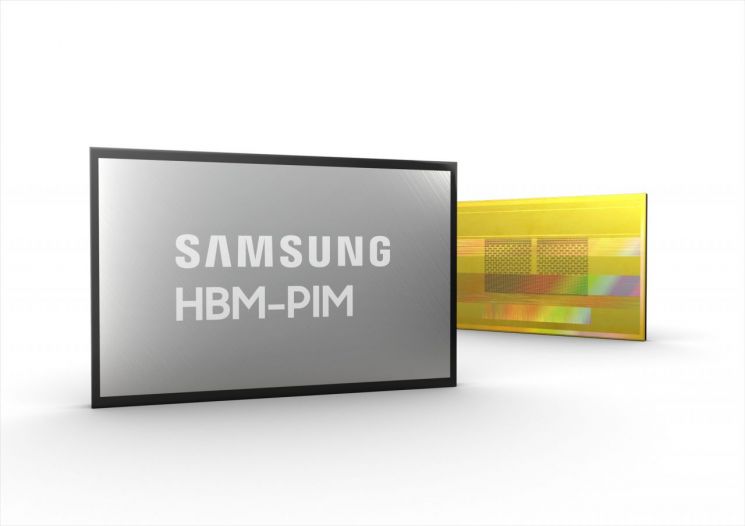
 Samsung Electronics has developed the world's first memory semiconductor-artificial intelligence (AI) processor combined product 'HBM-PIM'
 [Photo by Samsung Electronics]
[Asia Economy Reporters Kim Heung-soon and Jung Hyun-jin] Samsung Electronics is accelerating its efforts to become a leading comprehensive semiconductor company. While solidifying its nearly 30-year market share leadership in its core memory semiconductor business, the company is intensifying its technological capabilities by leading the convergence with the system semiconductor sector through next-generation products integrated with artificial intelligence (AI) engines.
On the 24th, at the international semiconductor industry conference 'Hot Chips' held online, Samsung Electronics introduced the 'HBM-PIM (Processing-in-Memory)' developed for the first time in the world in February, along with various application cases of products applying PIM technology. HBM-PIM is an intelligent memory semiconductor characterized by PIM technology that adds an AI engine responsible for computation to the memory responsible for storage. Utilizing this semiconductor reduces data movement between the traditional computer central processing unit (CPU), memory, and processing processors, thereby improving performance and increasing power efficiency. This makes it advantageous for ultra-high-speed data analysis and processing in supercomputers and AI systems.
AI Semiconductors Expand Product Lineup to Mobile
At the conference, Samsung Electronics also revealed performance test results of 'AXDIMM,' a DRAM module equipped with an AI engine. According to evaluations conducted with global customers, using intelligent memory approximately doubles server performance while reducing power consumption by more than 40%.
Samsung has also completed development of 'LPDDR5-PIM,' which extends this technology to mobile DRAM. When PIM technology is combined with mobile DRAM, smartphones can independently collect information and perform AI computations without connecting to data centers. Samsung explained that performance evaluations of this technology confirmed more than double the performance improvement and over 60% energy reduction in applications such as voice recognition, translation, and chatbots.
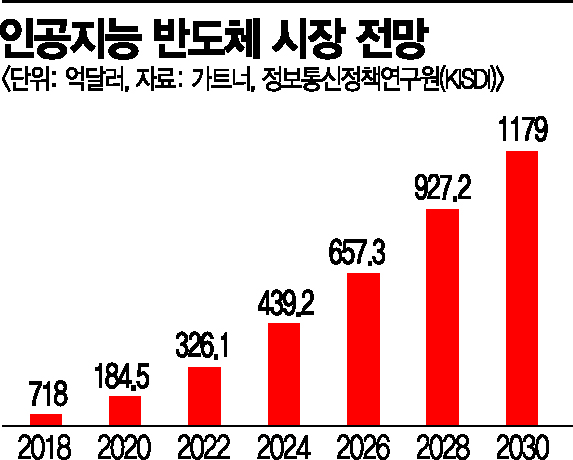
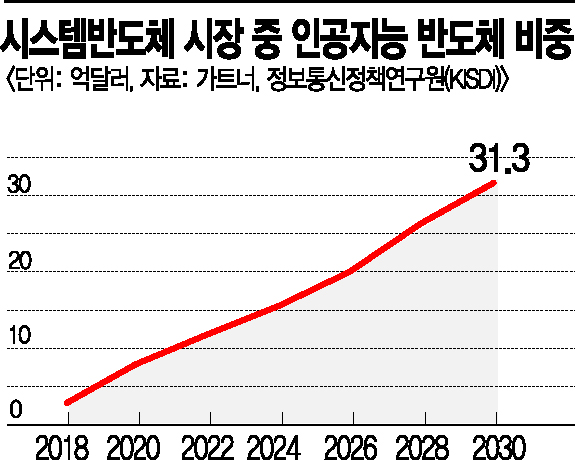
According to market research firms Gartner and the Korea Information Society Development Institute, the AI semiconductor market, regarded as a core of system semiconductors, is expected to grow significantly from $7 billion in 2018 to $117.9 billion by 2030. During the same period, the share of AI semiconductors within the overall system semiconductor market is projected to increase from 2.8% to 31.3%.
Nam-seung Kim, Executive Vice President of DRAM Development at Samsung Electronics' Memory Business Division, emphasized, "We plan to standardize the PIM technology platform and complete ecosystem construction by the first half of next year to expand the AI memory market," adding, "PIM technology will become a new memory paradigm in the big data era."
Strengthening Both Memory and System Semiconductors
Earlier, Samsung Electronics announced a revised 'System Semiconductor Vision 2030' plan in May, committing to invest 171 trillion KRW in system semiconductors by 2030 to enhance competitiveness in design, manufacturing, and new technology across the system semiconductor sector while maintaining its memory semiconductor lead. The company is steadily implementing this plan.
According to market research firm TrendForce, Samsung Electronics' revenue in the global DRAM market for the second quarter of this year reached $10.51 billion, a 30.2% increase from the first quarter. Its market share rose by 1.6 percentage points to 43.6%. Samsung has held the number one market share position for nearly 30 years since 1992. Operating profit margin improved from 34% in the first quarter to 46% in the second quarter. Considering steady DRAM demand and rising prices, TrendForce forecasts the margin to exceed 50% in the third quarter.
Samsung is also achieving results in next-generation memory technologies such as AI semiconductors. Representative examples include the 'Compute Express Link (CXL) DRAM,' which can dramatically improve data center performance for AI, machine learning, and big data, and server storage devices (SSDs) applying Zoned Namespace (ZNS) technology that classifies and stores similar data by zones.
In manufacturing, Samsung is negotiating with local authorities in Texas, Arizona, and New York for tax incentives and other benefits to invest in new and expanded foundry (semiconductor contract manufacturing) plants worth $17 billion in the U.S. The Texas Comptroller's Office has informed Samsung that the Taylor Independent School District (ISD), where Samsung recently submitted an application for tax relief benefits, qualifies under the Chapter 313 tax incentive program, potentially providing tax reductions worth $314 million over 15 years.
Samsung previously received a favorable ruling indicating that investment in the Manor Independent School District in Texas could also yield nearly $300 million in tax benefits. Based on this, Samsung is negotiating with local authorities to review and decide on the investment location.
© The Asia Business Daily(www.asiae.co.kr). All rights reserved.

![Clutching a Stolen Dior Bag, Saying "I Hate Being Poor but Real"... The Grotesque Con of a "Human Knockoff" [Slate]](https://cwcontent.asiae.co.kr/asiaresize/183/2026021902243444107_1771435474.jpg)

















