KAIST Professor Hong Seungbeom's Team Develops Simulation-Based New Material Data Analysis AI Through International Collaboration
[Asia Economy Reporter Kim Bong-su] The Korea Advanced Institute of Science and Technology (KAIST) announced on the 24th that Professor Hong Seung-beom's research team from the Department of Materials Science and Engineering has developed an artificial intelligence for new material data analysis based on simulation.
Recently, as computing power has increased exponentially, various applications utilizing artificial intelligence are being applied in real life. Accordingly, research on technologies that use artificial intelligence to rapidly analyze new material data and reverse-engineer materials is also accelerating.
Based on recent research to improve the efficiency and accuracy of artificial intelligence, its use is increasing in fields such as autonomous vehicles, database-driven marketing, and logistics system support. In particular, considering the long time required for new material development, artificial intelligence methodologies that can rapidly analyze correlations between various structural and physical property data by applying AI to material and process development are attracting attention for their potential to drastically reduce the time needed for new material development.
However, in the case of new materials, it is difficult to obtain a large amount of meaningful experimental data. Since companies treat important data as confidential, applying artificial intelligence to the material data domain is quite challenging in reality. Issues related to the diversity, size, and accessibility of such data must be resolved, and research on generative models and appropriate data synthesis is underway to complement this. The data generated to improve AI performance must also follow the physical constraints of actual materials, and technologies capable of understanding the material characteristics of material data are necessary.
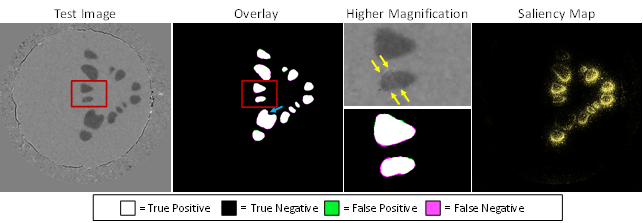
The AI training methodology developed by Professor Hong Seung-beom's research team this time forms basic data using phase-field simulation so that the generated data for training shares physical constraints. It simulates various noise occurring in the actual measurement process of material data, particle distribution information, and particle boundaries, overcoming the limitations of small-sized material data. The team compared the phase separation performance with AI trained on manually created material data and identified the influence of simulated elements of the generated data on phase separation.
Furthermore, the AI training method using material data generation proposed in this study can significantly reduce the time required to prepare training data manually. It has the advantage of being quickly applicable to various material data based on transfer learning of AI and phase-field simulation utilizing various physical constraints.
Professor Hong Seung-beom stated, "Artificial intelligence is being utilized across various fields regardless of domain, and the material field will also welcome a world where new material development can be completed faster with the help of AI." He added, "Although further reinforcement is still needed in terms of data synthesis to directly apply this research to new material development, the significance of this study lies in shortening the long time required to prepare training data, which was a major obstacle in utilizing material data, thereby opening the possibility of high-speed analysis of material data."
The results of this research were published in the international journal 'Acta Materialia.'
© The Asia Business Daily(www.asiae.co.kr). All rights reserved.
![Clutching a Stolen Dior Bag, Saying "I Hate Being Poor but Real"... The Grotesque Con of a "Human Knockoff" [Slate]](https://cwcontent.asiae.co.kr/asiaresize/183/2026021902243444107_1771435474.jpg)











