Daegu "Robots and Next-Generation Batteries Are All Ours"
Pohang "Overlapping Projects Between Cities and Provinces Are a Deadly Disaster"
Communication Needed to Prevent Overheating Competition Like in the Southeast Region
[Asia Economy Yeongnam Reporting Headquarters Reporter Dong-guk Lee] Pohang City, striving to break away from its image as a steel city and create future industrial growth as a self-sufficient city, has been pushed into an unfair position amid discussions on national projects cooperation between Daegu and Gyeongbuk Province.
In particular, after recently conceding the 300 billion won national project 'National Robot Test Field' to Daegu City through Gyeongbuk Province's mediation, there is growing backlash in the Pohang area as Daegu City is now actively pursuing the 'secondary battery industry,' which Pohang had been promoting as a key project.
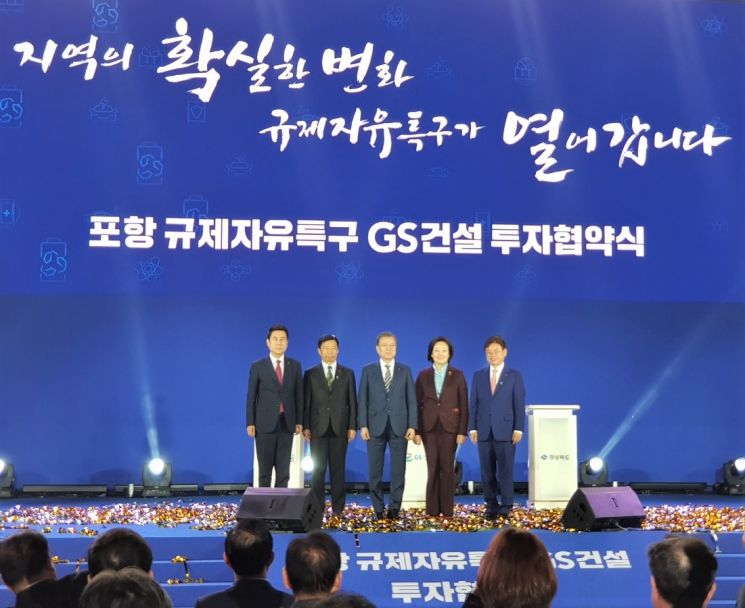 At the GS Construction investment agreement ceremony for the Pohang Regulatory Free Zone held on January 9 last year, President Moon Jae-in (center), Pohang Mayor Lee Kang-deok (far left), GS Construction CEO Lim Byung-yong (second from left), Minister of SMEs and Startups Park Young-sun, and Gyeongbuk Governor Lee Cheol-woo are attending a commemorative photo. [Image source=Yonhap News]
According to Gyeongbuk Province and Daegu City on the 24th, Daegu City was selected for the government's 'National Robot Test Field' innovation project on the 13th, emerging as the center of the domestic robot industry.
Daegu City expects the number of local robot companies to increase to 662 by 2030, with total sales reaching about 4.1 trillion won. Employment creation is expected to reach 11,800 people, and the city is excited about transforming into a 'robot city where people and robots coexist.'
The decisive factor in Daegu City's success in this large-scale national project competition, which involved fierce competition among six metropolitan cities and provinces, is widely acknowledged to be the active cooperation of Gyeongbuk Province, which deliberately did not participate in the competition.
Hong Eui-rak, Daegu's Deputy Mayor for Economic Affairs, expressed special thanks at a press conference on the 13th regarding the project, saying, "I am especially grateful for the active support of Governor Lee Cheol-woo and Gyeongbuk Province."
In fact, Governor Lee produced a 30 to 40-second video supporting Daegu's robot test field project, which Daegu City used. It is also reported that an official letter expressing strong support for Daegu's bid was sent to Daegu City in line with on-site inspections and presentation evaluations.
This 'perfect cooperation' was based on a promise between Daegu City and Gyeongbuk Province to mutually support national projects within the larger framework of administrative integration. However, this came at the expense of Pohang City in Gyeongbuk, home to the Korea Institute of Robot Convergence (KIRO), the only domestic robot-specialized research institute, and POSTECH.
In this situation, Daegu City's move to attract the secondary battery industry, a large-scale project under the Ministry of Trade, Industry and Energy, has complicated Pohang City's position, which has been regarded as a 'domestic leading city' in the secondary battery field. A Pohang city official bluntly said, "We were stabbed in the back by Daegu."
Pohang City was designated in July 2019 by the Ministry of SMEs and Startups as the country's first 'Next-Generation Battery Recycling Regulatory Free Zone' and is building a comprehensive secondary battery cluster across two zones?Yeongilman Industrial Complex and Blue Valley Industrial Complex?covering 561,000 square meters (170,000 pyeong).
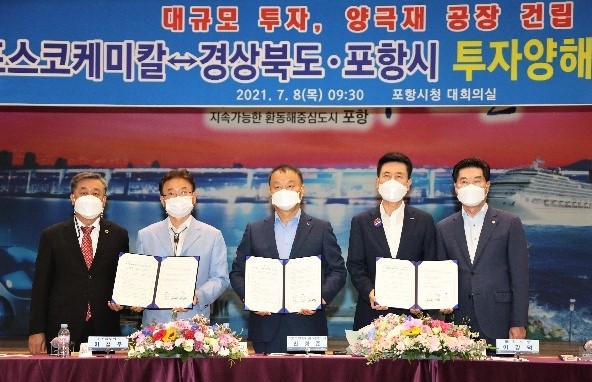 Gyeongbuk Province and Pohang City signed a memorandum of understanding for a large-scale investment and the construction of an anode material factory with POSCO Chemical at Pohang City Hall on July 8.
Related industries in Pohang foresee the global market for battery reuse and recycling industries rapidly growing to 600 trillion won by 2050, filling them with hope.
The '2030 Secondary Battery Industry Development Strategy' recently announced by the Ministry of Trade, Industry and Energy initially sounded like a blessing to Pohang City. The strategy includes investments totaling 40 trillion won centered on three battery companies by 2030, along with large-scale support in R&D, taxation, and finance.
However, Daegu City's sudden announcement on the 15th of its 'Next-Generation Battery Industry Promotion Strategy' poured cold water on Pohang, which had been planning to position itself as the 'Mecca of Secondary Batteries' instead of robots. Pohang's industrial sector is expressing strong dissatisfaction as Daegu pushes forward with its battery industry strategy.
Among Pohang's senior officials, the word 'betrayal' is openly expressed. There is a sense of crisis that Daegu might also take away the Ministry of Trade, Industry and Energy's 'Next-Generation Secondary Battery Commercialization Support Center' project competition next year.
A Pohang city official recalled the saying, "A heart startled by a frog is startled by a snake," indirectly expressing worries about losing not only 'robots' but also 'secondary batteries.'
Regarding this, a Gyeongbuk Province official emphasized, "While Daegu City appears to have a relative advantage in the robot test field, Pohang is not behind Daegu in the secondary battery business, so it is an issue that cannot be conceded."
A Pohang Chamber of Commerce official stated, "Unlike robots, Pohang City clearly has a relative advantage in secondary batteries, so Daegu City should yield to Pohang in national projects related to secondary batteries, and Gyeongbuk Province should actively support this."
© The Asia Business Daily(www.asiae.co.kr). All rights reserved.


















