[With Corona Task - Part 1]
Government "Review by late September or early October"
Herd immunity failure if vaccine supply disrupted
MSD and Pfizer develop oral treatments
COVID-19 fear must disappear
Experts "Change in perception is crucial"
Improvement needed in confirmed case reporting
Perception should shift like chickenpox and measles
[Asia Economy Reporter Seo So-jeong] As the first dose COVID-19 vaccination rate in South Korea surpasses 50%, discussions on transitioning the quarantine system to ‘With COVID’?focusing more on managing severe cases rather than suppressing confirmed cases?are gaining momentum. With the prolonged COVID-19 situation causing significant public fatigue and the scale of confirmed cases not easily controlled despite the government’s stringent social distancing measures, there are growing concerns that the ‘tightening’ style of quarantine has reached its limits. Experts unanimously agree that after achieving the goal of vaccinating 70% of the population by October, the quarantine response strategy should also be restructured. However, they emphasize that resolving issues related to unstable vaccine supply and securing, as well as developing therapeutics that could serve as game changers in the future, will be crucial.
Will the transition to ‘With COVID’ happen after Chuseok? Smooth vaccine supply is key
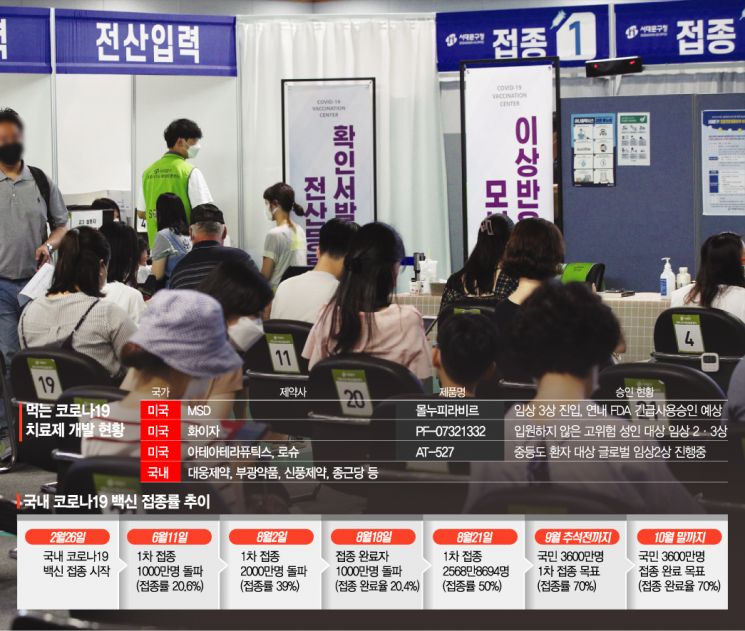
According to the COVID-19 Vaccination Response Promotion Team, as of midnight on the 23rd, a total of 25,910,685 people have received their first dose, marking a vaccination rate of 50.5% of the population. This means that within half a year of vaccination rollout, one in two citizens has completed their first dose. COVID-19 vaccination in South Korea began on February 26, but it was only on June 11 that the first dose count surpassed 10 million, due to vaccine supply issues in May and June causing a ‘vaccine cliff.’ Subsequently, on August 2, the number of first-dose recipients exceeded 20 million, and on the 21st, the vaccination rate broke through 50%. The government’s primary goal is to complete the first dose for 70% of the population?36 million people?by September 19, just before the Chuseok holiday, and to achieve full vaccination for 70% of the population by the end of October, six weeks later, thereby attaining herd immunity.
The government is considering transitioning to With COVID in line with the vaccination pace. Lee Ki-il, the first controller of the Central Disaster and Safety Countermeasures Headquarters, stated, “We are preparing for the transition to With COVID,” adding, “It could be reviewed around late September or early October.” The challenge lies in the smooth supply of vaccines. The day before, the government announced that Moderna would supply 7.01 million doses by the first week of September. However, even if deliveries proceed as planned, the total Moderna supply of 9.465 million doses falls far short of the total contracted 40 million doses scheduled to arrive by year-end. If the planned deliveries are not met, achieving herd immunity will inevitably face setbacks. Professor Jung Jae-hoon of Gachon University College of Medicine said, “A stable implementation of the government’s target vaccination rate is a prerequisite for transitioning to a With COVID system.”
Pharmaceutical companies accelerate oral therapeutic development... Public 'perception shift' is crucial
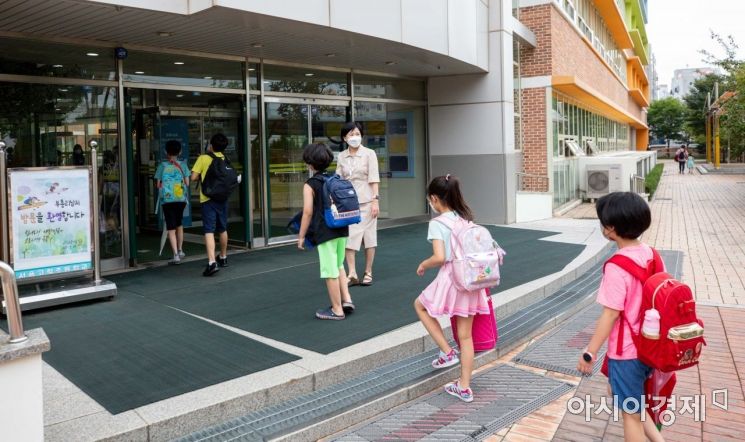 On the 23rd, when the second semester of elementary school began, students were heading to school at Gocheok Elementary School in Guro-gu, Seoul. Photo by Jinhyung Kang aymsdream@
Global pharmaceutical companies are actively developing not only vaccines but also oral therapeutics. The emergence of treatments like ‘Tamiflu,’ which evolved from the treatment for H1N1 flu, could rapidly alleviate COVID-19-related fears. Currently, the oral therapeutic ‘Molnupiravir’ by the U.S. company MSD, expected to receive the fastest approval, is undergoing Phase 3 clinical trials with the goal of applying for Emergency Use Authorization from the U.S. Food and Drug Administration (FDA) within this year. Pfizer, which succeeded in developing mRNA vaccines, is conducting Phase 2/3 clinical trials of an oral medication targeting high-risk adults who are not hospitalized. Roche, the developer of Tamiflu, is also conducting clinical trials for an oral COVID-19 therapeutic. In South Korea, Daewoong Pharmaceutical, Bukwang Pharmaceutical, and Shinpoong Pharmaceutical are developing oral therapeutics.
Experts emphasize that while vaccine and therapeutic development is important, ultimately, a perception shift is key to With COVID. Professor Kim Yoon of the Department of Healthcare Management at Seoul National University College of Medicine stated, “The government still insists on strict social distancing, which has caused damage to self-employed individuals, interruptions in caregiving, and situations where patients ‘displaced’ from public hospitals cannot receive treatment,” adding, “The quarantine system should transition to one that comprehensively considers the overall life satisfaction of the public.”
There are also calls to improve the quarantine approach that focuses on counting confirmed cases. Professor Kim argued, “Given the judgment that complete eradication of COVID-19 is difficult, some countries have stopped reporting confirmed cases,” and “It is necessary to improve the daily confirmed case statistics announcements that create a fearful atmosphere.” Professor Jung also said, “Diseases like chickenpox and measles have high transmissibility but coexist with humanity; the government should help the public recognize that COVID-19 is not a special infectious disease.”
© The Asia Business Daily(www.asiae.co.kr). All rights reserved.


















