MSCI China Index and Others Plunge
'Expedition Ants' Who Bought Big Tech Stocks Cheap Get Stuck
Government Regulation Risk Is the Main Factor
Xi Jinping's 'Common Prosperity' Policy Leads to Investment Avoidance... Concerns Over Prolonged Impact
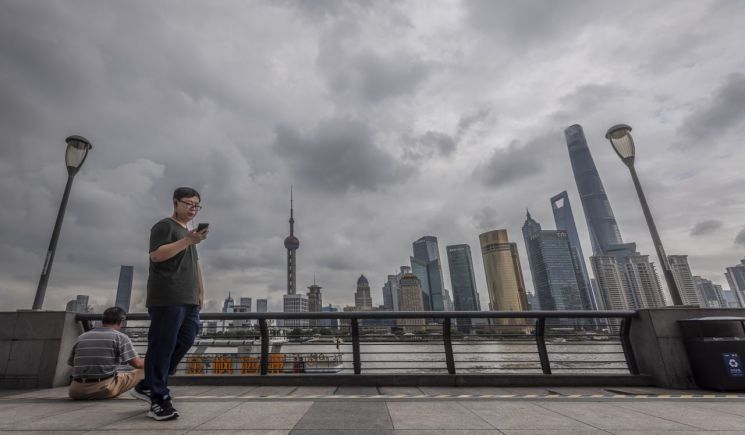
[Asia Economy Reporters Song Hwajeong and Kim Suhwan] "I lost 30% of my investment in the blink of an eye."
Lee (27), who invested in Alibaba Group stocks earlier this year, recently said that his losses have snowballed due to the sharp plunge in Alibaba's stock price. He said, "In January, when Alibaba Group seemed to be undergoing a correction, I saw it as a buying opportunity at a low price and invested. Because of this, my overall returns have dropped by nearly 20%."
On the 19th (local time), Bloomberg reported that over the past month, the market capitalization of Chinese companies in stock markets worldwide has disappeared by about $1 trillion (approximately 1,180 trillion KRW), stating that "the decline of China's major tech companies is deepening."
Chinese Companies Plunge One After Another
Various stock indices tracking Chinese companies have also not been able to avoid sharp declines. The MSCI China Index, which tracks Chinese companies listed on the Chinese stock market, has fallen nearly 30% from its peak in February. The Nasdaq Golden Dragon China Index, which tracks 98 Chinese companies listed in the U.S., has plummeted 52% over the past six months, hitting its lowest point since May last year.
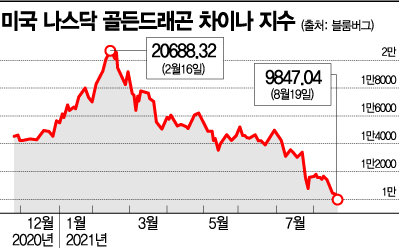
Accordingly, domestic investors who have recently invested in China are also understood to be experiencing significant losses.
According to the Korea Securities Depository's securities information portal, SEIBRO, the net purchase amount of the top 50 Chinese stocks by domestic investors reaches $102.55 million. The net purchase amount of the top 50 Hong Kong stocks is $76.09 million.
Government Regulation Risks Lead Even 'Donnamu Unni' to Cut Losses
Experts predict that the impact of Chinese government regulations will not subside easily.
As the Chinese regulatory authorities' all-out pressure intensifies, the stock prices of Chinese companies are falling relentlessly, and experts are concerned that government regulations will be prolonged. Global major investors are also reducing their investment proportions in China one after another, requiring cautious investment from domestic investors. Some even predict that China's series of measures, carried out as part of structural reforms, could improve the investment environment in the long term.
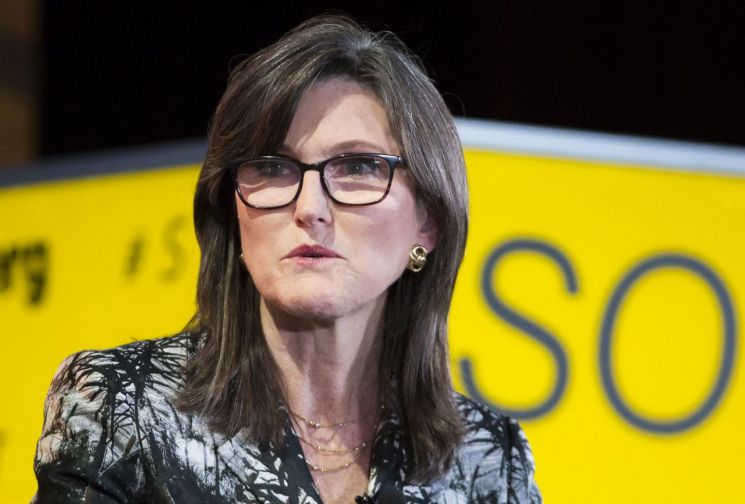
Recently, global major investors have been reducing their investment proportions in China one after another. Famous billionaire investor George Soros recently drastically reduced his investment in Chinese assets, and Cathie Wood, known as 'Donnamu Unni' and noted for her successful investments in tech stocks like Tesla, has sold all her Chinese stocks in her ETFs (Exchange-Traded Funds).
Bank of America recently reported in a survey of U.S. fund managers that "short selling of Chinese stocks ranked third among the most popular stocks."
The biggest reason is the regulatory risk from Chinese authorities. In securities markets where investment is based on trust, the Chinese government itself has broken that trust, further encouraging foreign investors to avoid investing.
Manuel Muel, an analyst at Germany's DZ Bank, cited the case of Didi Chuxing, saying, "The authorities angered numerous investors. It dealt a significant blow to the trust in Chinese ADRs (American Depositary Receipts) traded on the U.S. stock market." He added, "For Chinese companies' stock prices to rebound, the government must first restore the trust it has destroyed."
The 'China risk' in global stock markets is expected to continue for the time being. Europe's largest asset management company, Amundi, stated in a report on the 10th, "In the short term, the government's regulatory stance will continue and may even strengthen," diagnosing that "(investment in Chinese companies) has increased external risks."
Possibility of Strengthened Regulations Following Xi Jinping's Declaration of 'Common Prosperity'...Counterarguments Predicting Stock Price Rebound
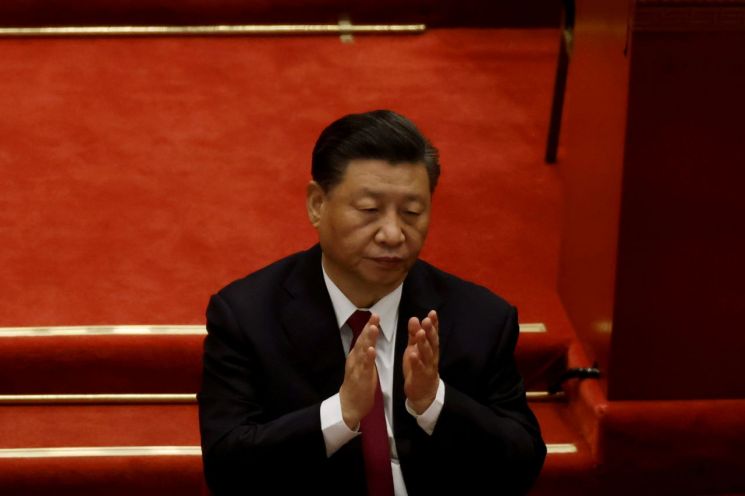
Recently, President Xi Jinping declared 'Common Prosperity' as a new policy task, leading to analyses that China's corporate regulations may continue for a considerable period.
Common Prosperity is interpreted as the Chinese government, which previously declared the achievement of a 'Xiaokang (moderately prosperous) society' where everyone lives a wealthy life, now signaling that it will undertake social structural reforms based on the distribution of assets, a core ideology of communism, from a long-term perspective.
Some argue that now is rather the right time to invest in Chinese companies, claiming "the bottom has been reached and a rebound will follow."
JPMorgan stated, "Adjustments have already occurred mainly among regulated companies. The risks seem to be sufficiently reflected in current stock prices," and predicted, "They will start to rebound again."
© The Asia Business Daily(www.asiae.co.kr). All rights reserved.
![Clutching a Stolen Dior Bag, Saying "I Hate Being Poor but Real"... The Grotesque Con of a "Human Knockoff" [Slate]](https://cwcontent.asiae.co.kr/asiaresize/183/2026021902243444107_1771435474.jpg)


















