One in Three Apartment Sales in Gyeonggi in July Exceeds 600 Million Won
The Last Stronghold for Homeless in the Capital Area Disappears
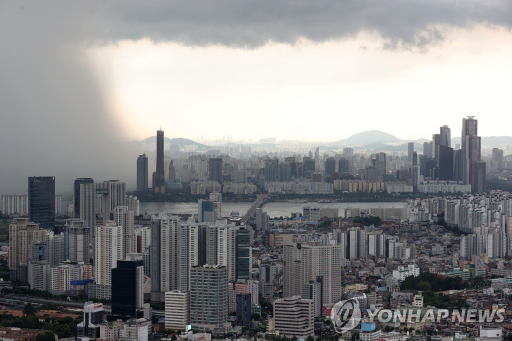
"I'm packing up and leaving Seoul. Expecting to own a home in Seoul is nothing but cruel hope. Now, even the jeonse prices are hard to afford." (Newlywed couple A)
Concerns are rising that the ongoing exodus from Seoul due to soaring housing prices is triggering a domino effect of price increases in the Gyeonggi-do area. As demand continues for relatively cheaper homes, the cumulative housing price increase rate in Gyeonggi-do this year has surpassed 10%. Due to the price surge, apartments priced over 600 million KRW now account for more than 30% of all transactions in Gyeonggi-do.
According to the Korea Real Estate Board on the 19th, the comprehensive housing sale price index in Gyeonggi-do rose by 10.08% from the beginning of this year through July. This figure is double the 5.49% cumulative increase during the same period last year. Housing prices in Gyeonggi-do jumped 1.52% in July alone, marking the highest increase since April 2008 (1.59%).
The explosive rise in Gyeonggi-do housing prices is closely linked to the 'insurmountable wall' of Seoul's housing and jeonse prices. Purchasing a small apartment under 60㎡ (exclusive area) in Seoul requires an average of 805.7 million KRW. As real demand shifts to Gyeonggi-do, where prices are relatively lower, a chain reaction of price increases has been triggered.
In fact, the net migration out of Seoul in the first half of this year was 52,406 people, about five times the 9,911 people during the same period last year. Conversely, the net migration into Gyeonggi-do was 99,617 people, of whom approximately 75%, or 66,827 people, came from Seoul.
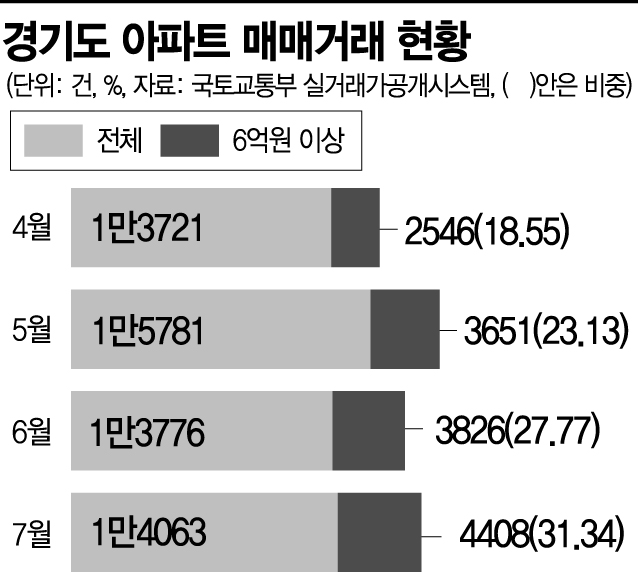
The problem is that with housing prices rising sharply even in Gyeonggi-do, the exit options for cash-strapped non-homeowners in the metropolitan area are becoming increasingly limited. According to an analysis by Asia Economy, the proportion of apartment sales transactions over 600 million KRW in Gyeonggi-do surged from 18.55% in April to 23.13% in May, 27.77% in June, and 31.34% in July. This means that one in three transactions is for 600 million KRW or more.
A representative from real estate agency B in Dongtan New Town, Hwaseong, explained, "Newlywed couples who have almost no chance of winning housing subscriptions are giving up living in Seoul and moving to Gyeonggi-do. Recently, with the easing of loan regulations, many complexes have seen prices rise by over 100 million KRW this year alone." For example, a 74㎡ unit in Dongtan Park Prugio, which was traded for 648 million KRW last month, changed hands for 700 million KRW on the 12th. The actual transaction price rose by 52 million KRW in less than a month.
The rise in housing prices in Gyeonggi-do is spreading not only to areas with excellent access to Seoul but also to the outskirts. According to Economy Man Lab, the area in Gyeonggi-do with the highest increase in average apartment sale price per 3.3㎡ up to July this year was Dongducheon (35.4%). Hwang Hansol, a research analyst at Economy Man Lab, said, "As the housing supply shortage continues and metropolitan area apartment prices rise, more people are trying to secure their own homes before it gets any later. Therefore, the price increase trend for apartments in the outskirts of Gyeonggi-do is expected to continue."
© The Asia Business Daily(www.asiae.co.kr). All rights reserved.

![Clutching a Stolen Dior Bag, Saying "I Hate Being Poor but Real"... The Grotesque Con of a "Human Knockoff" [Slate]](https://cwcontent.asiae.co.kr/asiaresize/183/2026021902243444107_1771435474.jpg)















