Korea Research Institute of Chemical Technology Transfers Perovskite Solar Cell Precursor Manufacturing Technology to Private Companies
Patents Obtained in Korea, the US, Japan, and More
Market Expected to Reach 3 Trillion Won by 2026, Enabling Domestic Companies to Take the Lead
[Asia Economy Reporter Kim Bong-su] The next-generation solar cell mass production technology developed by Korean researchers has been transferred to private companies, enabling them to capture the market estimated to reach around 3 trillion KRW by 2026.
The Korea Research Institute of Chemical Technology announced on the 17th that it has transferred the manufacturing technology to companies that combines multiple materials needed to produce the next-generation technology known as "Perovskite Solar Cells" into a ready-made product for sale.
Perovskite solar cells are attracting attention as next-generation solar cells because they can be mass-produced relatively easily and inexpensively by coating a solution onto a substrate. To manufacture perovskite solar cells, a process of dissolving two or more types of materials in a solvent is required. However, directly mixing and dissolving multiple materials is cumbersome and can cause measurement errors, requiring careful attention. Additionally, the resulting solution often contains impurities, which can degrade the performance of perovskite solar cells.
Dr. Jeon Nam-jung's research team at the Korea Research Institute of Chemical Technology developed a precursor material, a perovskite pre-stage material, that simplifies and shortens the process to easily produce perovskite solar cells. This precursor material is not only easy to use but also undergoes a purification process that removes impurities, helping to improve the performance of perovskite solar cells.
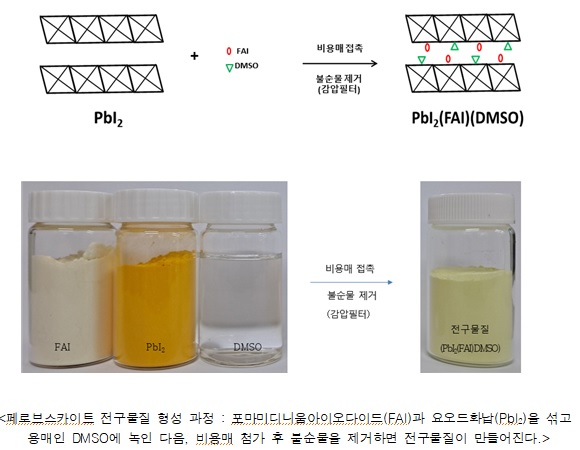
The research team discovered that adding a solvent to the perovskite solution forms a solid-state complex. When the solid-state complex is formed, impurities contained in the solvent can be removed using a filter. The purified perovskite precursor material has high purity, which can enhance the efficiency and stability of solar cells. The team filed a patent for this technology in 2014 and published it in the international journal Nature Materials (IF=43.841), gaining international recognition.
Although anyone can manufacture perovskite solar cells without using the precursor material, utilizing the patented precursor material developed by the research team allows for easier production and improved performance. This is similar to how having a "ready-made sauce" sold for cooking enables anyone to easily create delicious flavors.
The research team completed patent registrations in Japan, the United States, and China by 2019, and in July transferred the technology to LK Chem Co., Ltd., a domestic semiconductor precursor material production company. After developing mass production technology, commercialization will begin.
The market related to perovskite solar cells is expected to grow to 3 trillion KRW by 2026, and the mass-produced precursor materials are anticipated to be exclusively commercialized and distributed not only in Korea but also in Japan, the United States, and China.
Dr. Jeon said, "We plan to devote ourselves to follow-up research so that Korea's precursor material products can capture the market in the field of perovskite solar cells, which are gaining attention as next-generation solar cells," adding, "It is also expected to contribute to strengthening the competitiveness of the domestic materials industry in response to Japan's restrictions on the import of materials, parts, and equipment."
© The Asia Business Daily(www.asiae.co.kr). All rights reserved.

















