[Asia Economy Reporter Changhwan Lee] As the United States announced an eco-friendly vehicle promotion policy centered on increasing the share of eco-friendly vehicles to 50% by 2030, an analysis has emerged that South Korea must also seek countermeasures.
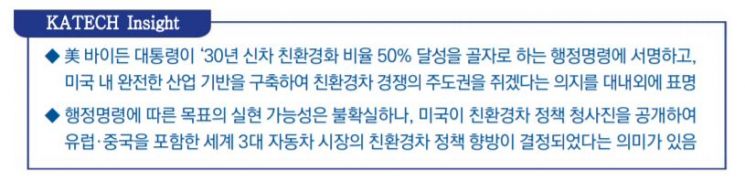
The Korea Automotive Technology Institute stated in an industrial trend report released on the 16th that the U.S. has unveiled its eco-friendly vehicle policy blueprint, determining the direction of eco-friendly vehicle policies in the world's three major automobile markets, including Europe and China.
U.S. President Joe Biden signed an executive order on the 5th of this month to secure leadership in the eco-friendly vehicle industry.
This includes a goal to raise the proportion of zero-emission vehicles (ZEVs), including electric vehicles, plug-in hybrid vehicles, and hydrogen fuel cell vehicles, to 50% of new passenger cars and light trucks in the U.S. by 2030.
The report viewed this as a clear intention to establish a complete industrial base within the U.S. and seize dominance in eco-friendly vehicles.
The report analyzed, "The 50% zero-emission vehicle target exceeds the forecasts presented by major institutions so far, and considering the characteristics of the U.S. automobile market, it is a challenging figure. It will be achievable only if corporate will and strong regulations on internal combustion engine vehicles are supported."
The report emphasized that with the U.S. unveiling its blueprint, the direction of eco-friendly vehicle policies in the world's three major automobile markets?Europe, China, and the U.S.?has been determined.
The U.S. policy direction, which focuses on fostering a domestic eco-friendly vehicle industry base, suggests the emergence of a new economic bloc in the eco-friendly vehicle sector alongside the European Union (EU), which is strengthening non-tariff barriers under the pretext of climate change response, and China, which is concentrating on revitalizing domestic demand amid external conflicts.
Accordingly, it was argued that South Korea must devise a response strategy at the national level. Lee Hojung, senior researcher at the Korea Automotive Technology Institute, said, "The paradigm of the Korean automobile industry centered on 'domestic and offshore production followed by export' has become inevitably subject to change, and policy authorities must seek entry strategies for our companies into the new economic bloc in the automobile sector."
© The Asia Business Daily(www.asiae.co.kr). All rights reserved.
![Clutching a Stolen Dior Bag, Saying "I Hate Being Poor but Real"... The Grotesque Con of a "Human Knockoff" [Slate]](https://cwcontent.asiae.co.kr/asiaresize/183/2026021902243444107_1771435474.jpg)
















