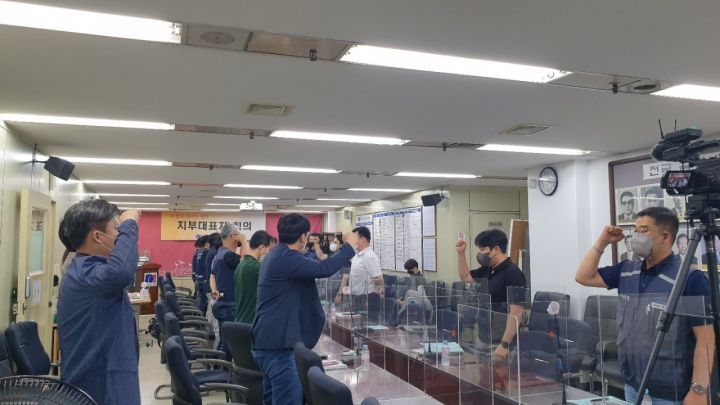
[Asia Economy Reporter Kiho Sung] The National Financial Industry Labor Union is gradually escalating its level of struggle ahead of the nationwide online and offline general strike rally scheduled for next month. Specifically, the plan is to start with one-person protests this month and hold the general strike rally on the 10th of next month. Concerns are rising that conflicts between both sides will intensify further as disagreements over the wage increase rate remain unresolved.
According to the financial sector on the 15th, the Financial Union decided on the struggle plan through an emergency branch representatives meeting held on the 12th.
The Financial Union plans to begin by establishing a main union struggle situation room on the 12th of this month, complete the establishment of struggle situation rooms at each branch by the 17th, conduct protest visits by the negotiation delegation to the employer representatives and simultaneous one-person protests by the main union and negotiation delegation branches from the 24th to the 31st, and hold simultaneous one-person protests by all full-time executives on the 31st of this month and the 1st of next month.
The strike authorization vote for union members, which will decide on the strike, is scheduled for the 2nd of next month. Following that, the general strike rally will be held online and offline on the 10th of next month, and simultaneous use of lunch breaks for protests will take place on the 24th of next month. The Financial Union plans to produce and distribute struggle guidelines, posters (web and paper), card news, and leaflets to each branch according to the struggle schedule at each stage.
Earlier, on the 2nd, the Financial Union and the Financial Industry Employers’ Council attended the second mediation meeting at the Central Labor Relations Commission but failed to narrow their differences on the core issue of wage increase rates, resulting in a breakdown.
Since the first central collective bargaining session on April 20th, the financial labor and management sides have shown significant differences over the wage increase rate. Initially, the Financial Union demanded a 4.3% wage increase for regular employees and 8.6% for low-wage groups, but during negotiations, reflecting the Bank of Korea’s recent inflation and economic growth forecasts, they raised their demands to 5.8% for regular employees and 11.6% for low-wage groups.
On the other hand, the employers have insisted on an increase rate below 1%. After initially proposing a 0.4% wage increase, they raised it to 0.9% following union opposition. The employers argue that although some financial institutions have performed well, this is not the overall atmosphere across the financial sector. They also contend that negotiations must align with payment capacity and the government’s wage increase guidelines for public officials. The government decided last September that this year’s public official wage increase rate would be 0.9%.
As mediation by the Central Labor Relations Commission began, the Financial Union finally proposed a 4.8% increase, while the Employers’ Council proposed 1.2%. The Commission suggested a 2.2% wage increase adjustment plan. However, both financial labor and management rejected the Commission’s proposal, leading to the breakdown of the second mediation meeting and the Commission’s decision to suspend mediation.
With the Commission’s mid-term mediation decision, the Financial Union has acquired the right to strike. If the strike is approved in the upcoming union member vote, they will be able to proceed with a legal strike.
© The Asia Business Daily(www.asiae.co.kr). All rights reserved.

















