Professor Arima Detsuo of Waseda's book claims "All Comfort Women Were Under Contract" in the preface with forced assertions
"I sincerely hope Japanese readers will not be deceived" plea included
[Asia Economy International Desk Reporter] Mark Ramseyer, a Harvard Law School professor who sparked controversy by writing a paper that labeled comfort women as prostitutes, has outright denied the forced recruitment by the Japanese military.
Professor Ramseyer claimed in the preface of the book titled "All Comfort Women Were Under Contractual Agreement," published on the 30th of last month by Arima Tetsuo of Waseda University, that "the Japanese military neither needed nor had the capacity to forcibly recruit prostitutes." He added that even Japanese military official documents from World War II show no evidence of forced recruitment of comfort women.
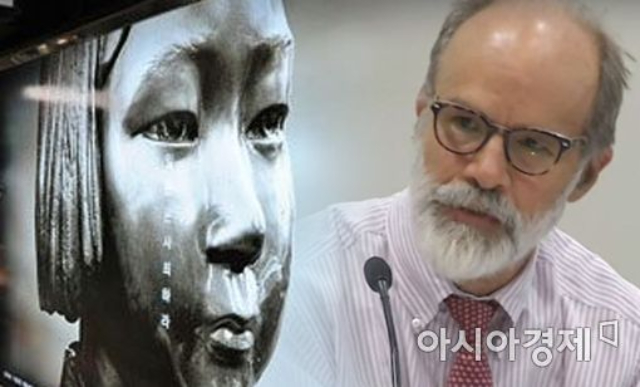
He argued that compensation claims in Korea began after the publication in 1983 of Yoshida Seiji’s memoir "My War Crime," which contains testimonies of direct abductions of comfort women in Jeju Island. He further insisted, "Previously, women said they worked in comfort stations to earn money or became comfort women due to their fathers' pressure, but later they started claiming they were forcibly taken by the Japanese military," making an unfounded assertion.
In particular, he questioned the credibility of abduction testimonies by mentioning controversies related to Yoon Mee-hyang, a lawmaker and former chairperson of the Justice and Memory Foundation, which operated shelters for comfort women victims. Ramseyer stated, "Many women who testified that they were forced into prostitution and filed lawsuits against the Japanese government lived in facilities run by extremely dishonest politicians." He argued that "in scholarly debates, attacks tend to intensify as facts become clearer," suggesting that criticism against him falls into this category. He also described criticism of his paper as "a chaotic uproar orchestrated by a disorderly mob through Korean media and political factions."
Professor Ramseyer even urged, "I hope Japanese readers will not be deceived by such claims." He distorted the situation by saying, "Some people thought my paper was an insult to Korea, and some Korean Americans attacked it as an insult to their homeland," implying that Koreans criticized his paper abnormally.
Professor Lee Jin-hee of the Department of History at Eastern Illinois University pointed out, "Ramseyer is merely using the platform of Japanese right-wing propaganda publications to spread their wishes or his personal opinions," and criticized him for "neglecting the fundamental attitude and role of a scholar to pursue academic truth."
© The Asia Business Daily(www.asiae.co.kr). All rights reserved.

















