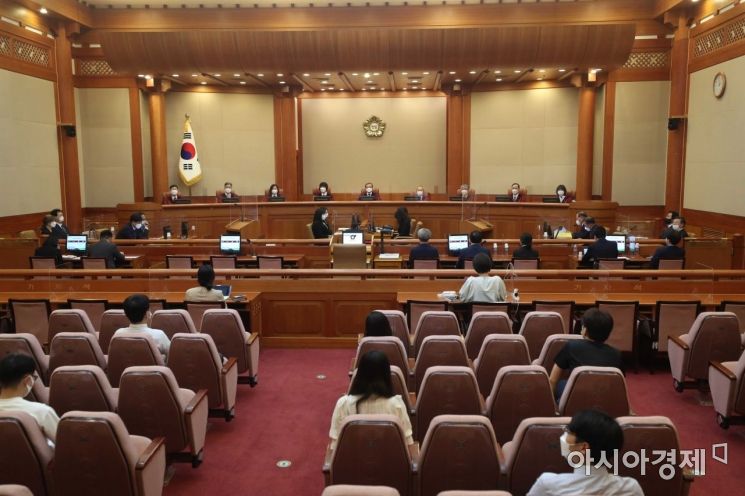
 Chief Justice Yoo Nam-seok of the Constitutional Court and the justices are attending the final hearing of the impeachment trial of former Chief Judge Lim Seong-geun at the Grand Bench of the Constitutional Court in Jongno-gu, Seoul, on the 10th, waiting for the trial to begin. Photo by Moon Ho-nam munonam@
[Asia Economy Legal Affairs Reporter Choi Seok-jin] The third and final hearing for the impeachment trial of former Busan High Court Chief Judge Im Seong-geun was held on the 10th.
As scheduled, during this hearing, the petitioner (prosecutor) side presented a PowerPoint presentation explaining the connection between each impeachment charge and the evidence, followed by the respondent (former Chief Judge Im Seong-geun) side rebutting these claims.
With the final statements from both sides, all trial procedures were concluded.
At the end of the trial, Chief Justice Yoo Nam-seok of the Constitutional Court stated, "Based on the arguments and evidence presented by both sides so far, we will make a careful and in-depth judgment," adding, "The date of the verdict will be notified to both parties later."
Is dismissal possible after retirement? Advice or recommendation from a senior, or instruction and coercion?
According to the summary of the National Assembly's impeachment charges, former Chief Judge Im is accused of improperly intervening in three trials during 2015-2016 when he served as the Senior Criminal Presiding Judge at the Seoul Central District Court under former Chief Justice Yang Seung-tae. These include ▲a defamation case involving former Sankei Shimbun Seoul bureau chief Kato Tatsuya related to reports on former President Park Geun-hye's whereabouts on the day of the Sewol ferry disaster ▲a case involving lawyers from the Lawyers for a Democratic Society (Minbyun) charged with assault during the Ssangyong Motor protests ▲and a professional baseball players' gambling case involving Oh Seung-hwan and Lim Chang-yong.
In the Kato Tatsuya case, he requested the presiding judge of the trial panel to revise interim judgments or the oral judgment transcript. In the baseball players' case, he summoned the judge who referred a summary order case to a formal trial, advising him to consult other judges, which eventually led to a reversal of the decision. In the Minbyun lawyers' assault case, he caused modifications to the already issued judgment, thereby infringing on the constitutional independence of the judiciary and the independence of trials, violating the Court Organization Act and the Criminal Procedure Act.
The core issues in this impeachment trial are, procedurally, whether dismissal is possible for a public official who has already retired, and substantively, whether the problematic acts of former Chief Judge Im can be seen as instructions or coercion to other judges, thus constituting interference in trials.
On this day, the petitioner side presented evidence such as investigation records submitted in former Chief Judge Im's criminal trials, arguing that the intentions of the Court Administration Office to avoid upsetting the Blue House, aiming to establish the Supreme Court of Appeals?a long-standing goal of the Yang Seung-tae judiciary?were conveyed to the trial panel through former Chief Judge Im. They contended that, given his position as Senior Criminal Presiding Judge, his influence over judges of the Seoul Central District Court should be regarded as instruction or coercion.
Conversely, the respondent side rebutted by presenting testimonies from junior judges submitted in the criminal trials and statements made in court, emphasizing that the acts were advice or recommendations from a senior judge with whom former Chief Judge Im had a friendly relationship. They highlighted that the presiding judges or chief judges of the cases in question testified that the rulings were made through panel consensus, not due to former Chief Judge Im's instructions.
Meanwhile, both sides presented completely opposing interpretations regarding Article 53, Paragraph 1 of the Constitutional Court Act, which stipulates that "if the impeachment petition is justified, the Constitutional Court shall issue a decision to dismiss the respondent from the public office." Former Chief Judge Im retired on February 28 after not applying for reappointment before his term expired, thus no longer holding judicial office.
The petitioner side argued that impeachment trials, like constitutional complaints or constitutional review of laws, serve to uphold constitutional order. Therefore, even though former Chief Judge Im has retired, the interest in the trial still exists, and a dismissal decision must be made in some form. They suggested that the order could be dated before his retirement or that the dismissal decision could be retroactively effective, noting that the Constitutional Court has previously issued various modified decisions in other cases, so this would not be problematic.
In contrast, the respondent side argued that the essential function of impeachment is not to uphold constitutional order but to dismiss public officials who violate the constitution or laws to maintain constitutional authority. They pointed out that the Constitutional Court Act applies the Civil Procedure Act, under which the interest in the trial must exist not only at the time of filing but also until judgment. If the interest disappears, the case should be dismissed.
Petitioner Representative Lawmaker Park Ju-min: "Judicial values damaged by judges... Must prevent second and third Im Seong-geun"
During the final statements, both sides summarized their key arguments.
First, the petitioner side was represented by Park Ju-min, acting chair of the National Assembly's Legislation and Judiciary Committee and a member of the Democratic Party.
Park stated, "Respondent Im Jong-heon directly undermined judicial independence and fairness, which the constitution and laws aim to protect," emphasizing, "Judicial independence exists to ensure fair trials."
He continued, "It was not just anyone but a judge who damaged constitutional values, and the content is shocking. This was unexpected in a 21st-century court," pointing out, "The judicial administration organization, which should protect judicial independence, instead damaged and threatened it."
He expressed concern over the indifferent attitude of other judges toward the respondent, criticizing the court's lukewarm response.
Park said, "Judges treat the respondent's extralegal acts violating trial independence as mere advice, and exploit legislative gaps to wield acquittals in criminal trials as a trump card," stressing, "To resolve this judicial confusion, the wisdom and decision of the Constitutional Court justices are needed."
He urged, "To prevent second and third Im Seong-geun, create an opportunity to inform judges that they can and must refuse interference in trials," and called for a strict judgment on the respondent's acts that damaged judicial fairness and independence.
Petitioner Lawyer Yang Hong-seok: "Blatant case of judicial independence infringement... Must set precedent at Constitutional Court"
Yang Hong-seok, representing the petitioner, stated, "The impeachment charges prove, through evidence, that the respondent, as Senior Criminal Presiding Judge, interfered with trial content, results, and procedures, violating constitutional provisions on judicial independence (Articles 103, 101), the right to be tried by an independent judge (Article 27, Paragraph 1), due process (Article 12, Paragraph 1), the former Court Organization Act Article 7, and Criminal Procedure Act Article 38."
Yang emphasized that more important than examining whether the respondent's acts violated the constitution or laws is that these acts shattered public trust in the judiciary, which people believed to be the last bastion of the rule of law in Korea. He pointed out that the reality revealed that state interests, specific institutions' ideals, and various requests were conveyed to trial panels and became subjects of behind-the-scenes coordination.
He stressed, "This ability to actually change trials shakes the foundation of judicial trust, which is the most serious aspect of this case."
Yang criticized the respondent's claim that the acts were mere advice or recommendations and customary practices, arguing that this insults all Korean judges and that the claim of no serious legal violations shows a lack of remorse.
He argued that the illegality of the respondent's conduct is not determined by the reaction of others; whether the other judges perceived it as instruction/coercion or advice/recommendation, once certain demands or pressures are made, illegality is established.
Yang condemned judges' evasive statements and testimonies as shameful attempts to avoid responsibility.
He called on the Constitutional Court to set a precedent against acts infringing judicial independence, as this is the first impeachment case involving a judge.
Yang noted, "There has been no prior case where judicial independence was so blatantly violated by a judge, and no precedent or mainstream academic theory applies directly to this case."
He stressed the importance of the Constitutional Court's judgment, stating that the constitutional provisions and spirit should be the guiding principles, and that the court's founding purpose and the impeachment system's intent should be the ultimate standards in this trial.
Yang also criticized the respondent side's argument that the case should be dismissed because the respondent retired, warning that the Constitutional Court should not continue to avoid trials in similar future cases and should find appropriate solutions consistent with legal mandates and expectations.
He suggested two possible forms of orders the court could issue: "Dismiss the respondent from judicial office as of February 28, 2021," or "Dismiss the respondent from judicial office, with the decision retroactive to February 28, 2021."
Yang pointed out that the respondent never showed remorse during the impeachment trial process.
However, the petitioner side rebutted in their final statement that former Chief Judge Im appeared in person at the first hearing and apologized to the judiciary and the public.
Finally, Yang urged, "This case seriously damages the objective constitutional order, and if left as is, public trust in the judiciary cannot be restored. Please accept this impeachment petition."
Respondent Lawyer Lee Dong-heup: "Lack of procedural fairness... Retroactive dismissal decision is unconstitutional"
Representing the respondent, former Constitutional Court Justice Lee Dong-heup stated in his final statement, "This case arose when the National Assembly, claiming the first-ever impeachment of a judge in constitutional history, hastily passed the impeachment without prior investigation by the Legislation and Judiciary Committee, despite opposition from the opposition party, just 24 days before the respondent's term expired. This procedure has been criticized for disregarding procedural fairness, a core democratic value."
However, Lee said he would withdraw previous claims related to infringement of the National Assembly's autonomy to simplify the issues.
He argued that the part of the impeachment charges referring to the referral of the baseball player Oh Seung-hwan's summary case to a formal trial should be dismissed as improper due to double jeopardy.
Lee pointed out that the current impeachment system for dismissing judges is disciplinary, not criminal, and since the respondent has already been disciplined by Chief Justice Kim Myung-soo, impeachment on the same grounds violates the constitutional principle against double punishment (Article 13, Paragraph 1).
He cited Article 20, Paragraph 1 of the Judges Disciplinary Act, which suspends disciplinary procedures when impeachment is pending, as legislative recognition that impeachment and disciplinary procedures are of the same nature.
Lee argued that the essential function of impeachment is not to uphold constitutional order but to remove officials who violate the constitution or laws to maintain constitutional authority, and that this case should be dismissed due to lack of trial interest during proceedings.
He rebutted the petitioner's claim that modified decisions are acceptable, stating that such exceptions apply only to constitutional complaints or disputes requiring constitutional interpretation, not to impeachment cases whose main purpose is not to uphold constitutional order.
Lee cited constitutional law scholar Heo Young's explanation that since the respondent has already retired, dismissal is impossible, and dismissal of the case is inevitable.
He criticized the petitioner's argument that the respondent's authority is suspended upon delivery of the impeachment resolution, pointing out that Article 134, Paragraph 2 of the National Assembly Act prohibits accepting resignation or dismissal of the impeached person, making the petitioner's claim unnecessary.
Lee emphasized that the National Assembly's late impeachment decision left only 24 days before the respondent's term expired, making it physically impossible to decide the impeachment trial in time, and that the petitioner's argument unfairly shifts blame from the National Assembly to the respondent and the Constitutional Court.
He warned that the petitioner's argument ignores Article 134, Paragraph 2 of the National Assembly Act and would imply that not only retired officials but also those who resign mid-term could be impeached.
Lee rejected the petitioner's comparison to former U.S. presidential impeachment cases, stating that the U.S. system is fundamentally different and more political, and argued that the German Federal Constitutional Court Act should be referenced instead.
He noted that without explicit provisions suspending the term of fixed-term officials upon impeachment, their term cannot be halted, and that retroactive dismissal violates constitutional principles and is unconstitutional.
Lee criticized the petitioner's arguments as forced logic lacking basic theoretical foundation and urged the Constitutional Court to make a decision befitting its international stature.
Regarding the petitioner's claim that the respondent showed no remorse, Lee stated that the respondent apologized at the first hearing, expressing regret for causing burden to the Constitutional Court, judiciary, and the public, and that the petitioner's claim to the contrary is regrettable.
Former Prosecutor General Kang Chan-woo: "All perceived as advice from a senior; judgment transcript revisions are routine practice... No serious constitutional or legal violations"
Kang Chan-woo, former Suwon District Prosecutor and special prosecutor in the 2010 "Grandeur Prosecutor" case, clearly summarized the respondent side's rebuttal on key issues.
He stated that while the respondent seeks dismissal of the case, even if the Constitutional Court proceeds to substantive judgment, no serious constitutional or legal violations occurred.
Regarding the Kato Tatsuya case, Kang said, "The petitioner's claim that the respondent infringed on Judge Lee's trial independence is based on a false premise. The respondent, as Senior Criminal Presiding Judge, merely gave advice to Judge Lee, with whom he had a close and friendly relationship, on a case of international importance."
He added that Judge Lee had suffered a stroke before the trial, and the respondent and his spouse had visited him in the hospital, showing personal concern and motivation to help.
Kang noted that Judge Lee consistently testified that he accepted the respondent's advice but was not bound by it and that the trial panel reached decisions through consensus, with no infringement of independence.
He emphasized that presiding Judge Lim also testified in criminal court that he was not opposed to the respondent's advice and ruled according to his own opinion.
Regarding the request for interim judgment revisions, Judge Lim testified in the appellate court that he thought the defense's evidence request was an attempt to politicize the case by highlighting irrelevant issues, and he praised the presiding judge's dismissal of the request.
Kang argued that there was no instruction from the respondent to the presiding judge to revise judgment reasons or oral transcripts, and that the presiding judge accepted the revisions as aligned with the chief judge's views, so judicial independence was not violated.
He noted that the Kato Tatsuya case attracted significant attention from foreign governments and media, and that the Foreign Ministry coordinated with the Blue House and Ministry of Justice on various measures, but the respondent was unaware of these.
Kang emphasized that no evidence shows the respondent knew or could have known about these discussions or participated in them.
He also rebutted the petitioner's claim that the respondent violated Articles 55 and 56 of the Court Organization Act by requesting advance notice of the case conclusion, noting that the prosecution investigated but found no evidence of official secrets leakage.
Regarding the baseball players' gambling case, Kang cited the presiding Judge Kim's consistent testimony that he regarded the respondent's intervention as advice, not instruction, and that the decision to reverse was appropriate, denying any interference in the trial.
On the Minbyun lawyers' assault case, Kang said that the presiding Judge Choi and the respondent were close, and the respondent's advice was perceived as concern, not instruction, with no opposition from Judge Choi.
Kang criticized the petitioner's claims as contradicting court practice, explaining that criminal judgments are based on signed paper originals, and that the court's judgment document management system is used for administrative purposes, with many cases of judgment re-registration after corrections.
He noted that from 2015 to 2018, over 4,000 cases per year involved re-registration of judgment originals after cancellation and correction, indicating established practice for correcting and re-registering judgment documents.
In conclusion, Kang argued that the case lacks trial interest and should be dismissed without substantive judgment, but even if judged on the merits, the respondent's acts do not constitute serious constitutional or legal violations justifying dismissal.
He called on the court to apply a unified legal interpretation weighing public and private interests, as in previous presidential impeachment cases.
Kang referred to the respondent's first trial judgment, noting that although some acts were inappropriate, they stemmed from attempts to provide advice worthy of attention by junior judges, had no impact on trial results, and all involved judges testified no infringement occurred, so dismissal is not justified.
Former Korean Bar Association President Kim Hyun: "Impeachment of acquitted cases is court intimidation"… Chief Justice Kim Myung-soo points out 'political neutrality damage'
Kim Hyun, former Korean Bar Association president and part of the respondent's defense team representing 155 free lawyers, stated, "The large defense team was not formed because this is the first impeachment of a sitting judge or due to personal ties with the respondent."
He criticized that under Chief Justice Kim Myung-soo's administration, some judges affiliated with the International Human Rights Law Association, who showed political leanings, pushed for impeachment of judges involved in judicial administration with the former Chief Justice, and some judges immediately entered politics after retirement. This has led to criticism that the judiciary, which should be most neutral, is influenced by political or ideological pressures.
Kim pointed out that Chief Justice Kim deliberately delayed accepting the respondent's resignation for political reasons and lied to the National Assembly and media, severely damaging public trust in the judiciary.
He claimed that the impeachment was politically motivated to intimidate the court after unfavorable rulings against the ruling party, citing cases such as the guilty verdict against Professor Jeong Gyeong-sim and the injunction against Prosecutor General Yoon Seok-youl.
Kim noted that the National Assembly hastily impeached the respondent just 24 days before his term expired, raising suspicions of political motives, and that eight former Bar Association presidents, including himself, issued a statement condemning the impeachment as political intimidation, leading many lawyers to volunteer for the defense team.
He reiterated that since the respondent is no longer a judge, the case lacks trial interest and should be dismissed, criticizing the petitioner's claim for retroactive dismissal as unconstitutional and violating the principle of non-retroactivity and legislative authority.
Kim stated that impeachment is a constitutional right of the National Assembly, but whether this impeachment is substantively and procedurally justified will be judged critically by history.
He concluded by urging the Constitutional Court to make a decision consistent with law and common sense, affirming justice and reason in society.
Petitioner Lawyer Yang Hong-seok's Additional Statement: "Cannot portray judgment interference as a heartwarming story"
After the final statements, Chief Justice Yoo Nam-seok asked the petitioner side if they had any additional statements. Yang Hong-seok requested 2-3 minutes to speak.
Yang began by saying that the respondent's defense repeated written arguments, but he wished to add remarks.
He emphasized that both sides talk about common sense and the constitution, but portraying interference in judgments as a heartwarming story between senior and junior judges or brothers is unacceptable, and this is why the Constitutional Court must make a strict judgment in this impeachment trial.
Yang reflected that the respondent feared exposure during the investigation, and now reluctantly admits the acts, which proves they were not mere heartwarming stories but illegal acts.
He questioned why the respondent only intervened in these cases and not others if he was trying to advise and assist judges as Senior Criminal Presiding Judge, arguing this reveals the petitioner's acts were unconstitutional and illegal, not just heartwarming or justifiable.
Respondent Lawyer Jeong Jin-kyung: "This impeachment contradicts common sense"… "If allowed, majority parties can impeach any disliked judge"
Finally, former Chief Judge Jeong Jin-kyung delivered the respondent's final statement, emphasizing the practical necessity of advice from senior judges to junior judges based on his judicial experience.
Jeong criticized the petitioner's argument on trial interest as possibly valid in constitutional amendment or legislative theory but highly unreasonable under current legal interpretation.
He stated, "Our constitution clearly declares that the purpose of impeachment is limited to dismissal from public office. If dismissal is the direct purpose, it is common sense that one cannot dismiss a retired person."
Jeong rebutted the petitioner's use of U.S. cases to argue for dismissal, noting that the U.S. impeachment process is more political, involving both houses of Congress, and that a few minority cases cannot be cited as precedent.
He cited the Richard Nixon case, where despite serious acts like halting the Watergate investigation, impeachment ended with Nixon's resignation, and no constitutional textbook suggests continuing the trial after resignation.
Jeong addressed the petitioner's claims on individual impeachment charges, stating that judicial independence does not mean judges must decide in a vacuum without any interference.
He explained that Korean judges are appointed very young with limited social experience, unlike U.S. judges who start in their late 40s or early 50s, so the only way to make proper judgments is to listen, especially to advice from senior judges.
He said, "If there is reason, judges can accept advice; if not, they can reject it. The biggest threat to judicial independence today is not pressure from senior judges but interference from power and public opinion."
Jeong added, "Judicial independence is something judges must protect themselves."
He described the U.S. system where government advisors can appear in court to present the government's position and social impact statements, helping judges broaden their perspective and make rational decisions.
He noted that Korea lacks such systems, leading to structural problems where the Blue House communicates through the Court Administration Office.
Jeong argued that rejecting all advice in the name of judicial independence risks fostering judicial arrogance and isolation, and that judges who perceive reasonable advice as infringement lack judicial qualifications.
He criticized the real problem in courts as young judges' arrogance and unilateral rulings, not pressure from administration or senior judges.
On the seriousness of the charges, Jeong said that the petitioner assumes violations of the constitution and laws automatically imply seriousness, but judges' tenure protection is vital, and impeachment inherently has political aspects.
He warned that lightly accepting impeachment for any constitutional or legal violation would allow the majority party in the legislature to control all judges arbitrarily, which is unacceptable.
Jeong noted that even the Chief Justice who supported the impeachment said he did not think impeachment was necessary, indicating the political nature of this case.
He concluded, "Law should be common sense, and this impeachment clearly contradicts common sense. Therefore, the petition should be dismissed."
© The Asia Business Daily(www.asiae.co.kr). All rights reserved.

















