National Average Price Standard Surpasses 1.5 Billion Won This Year in Seongbuk, Guro, and Gangseo
Eunpyeong, Gwanak, Nowon, Jungnang, and 7 Other Areas Also Approaching 1.5 Billion Won
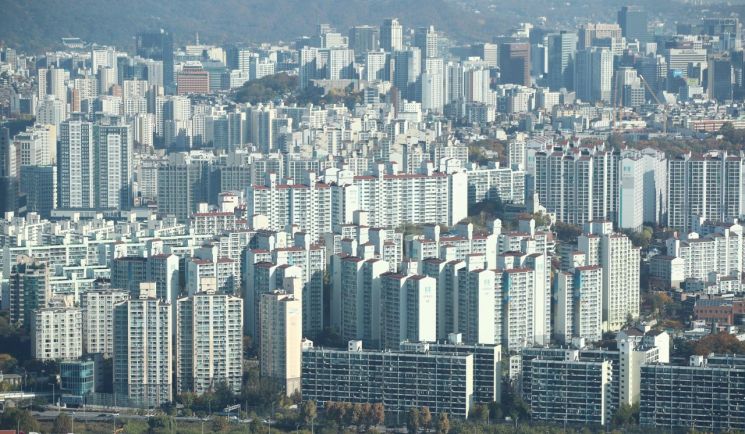
[Asia Economy Reporter Kim Hyemin] Cases of 84㎡ (exclusive area) apartments, known as the national standard size, exceeding the loan prohibition threshold are rapidly increasing even in the outskirts of Seoul. This year alone, three more autonomous districts have surpassed the 1.5 billion KRW limit where mortgage loans are banned. Among the 25 autonomous districts, only seven remain where the market price of 84㎡ apartments has not exceeded 1.5 billion KRW. Despite criticism that the government's artificial loan regulations are 'anti-market,' the upward trend in housing prices has not stopped.
According to the Ministry of Land, Infrastructure and Transport's real transaction price disclosure system on the 11th, cases exceeding 1.5 billion KRW for 84㎡ apartments have appeared this year in Seongbuk, Guro, and Gangseo districts.
The first district to join the '1.5 Billion KRW Club' this year was Seongbuk-gu. The 'Raemian Gireum Centerpiece' in Gireum New Town was traded at 1.506 billion KRW at the end of January. This was the first case in Seongbuk-gu where an apartment of this size exceeded the loan prohibition threshold. The actual transaction price of this apartment has risen to 1.55 billion KRW as of May. In Guro-gu, the 84㎡ unit in Sindorim-dong's Sindorim 4th e-Pyeonhansesang entered the '1.5 Billion KRW Club' with a transaction of 1.523 billion KRW in June. Then, last month, in Gangseo-gu, the Hillstate Master in Magok District 13 Complex changed hands at 1.5 billion KRW, surpassing the loan prohibition line.
With three additional districts this year, the number of autonomous districts where the highest price for 85㎡ apartments exceeds 1.5 billion KRW has increased to 18. Apartments priced over 1.5 billion KRW are classified as ultra-high-end. Since the government banned loans on houses exceeding 1.5 billion KRW in regulated areas in December last year, this has become the 'loan prohibition line.' When loans are blocked, transactions may halt, making this a psychological boundary for both sellers and buyers.
The fact that even the outskirts of Seoul have broken the 1.5 billion KRW barrier reflects the sentiment that housing prices will continue to rise. It is also suggested that buyers may have raised funds by leveraging increased jeonse (long-term deposit lease) prices despite the impossibility of mortgage loans. Demanders looking to switch apartments may have sold their existing homes and used a form of 'gap investment' to move into apartments priced over 1.5 billion KRW.
The number of apartments exceeding the loan prohibition line is expected to increase further. In seven districts including Nodogang (Nowon, Dobong, Gangbuk), Geumcheon, Gwanak, Eunpyeong, and Jungnang-gu, where no 84㎡ apartment has yet exceeded 1.5 billion KRW, transactions approaching this amount are already occurring.
For example, DMC SK View in Susaek-dong, Eunpyeong-gu, was traded last month at 1.4612 billion KRW. In Gwanak-gu, the e-Pyeonhansesang Seoul National University Entrance 1 Complex in Bongcheon-dong was traded at 1.45 billion KRW (17th floor) in April, and Cheonggu 3rd in Junggye-dong, Nowon-gu, was sold for 1.42 billion KRW in February. Sagajeong Central I-Park in Myeonmok-dong, Jungnang-gu, which is entering its second year since occupancy, was also traded at 1.4 billion KRW in June. Kim Hakryeol, head of SmartTube Real Estate Research Institute, predicted, "Due to the lack of listings, transaction volumes will decrease, and record-high prices will continue to be set."
© The Asia Business Daily(www.asiae.co.kr). All rights reserved.

















