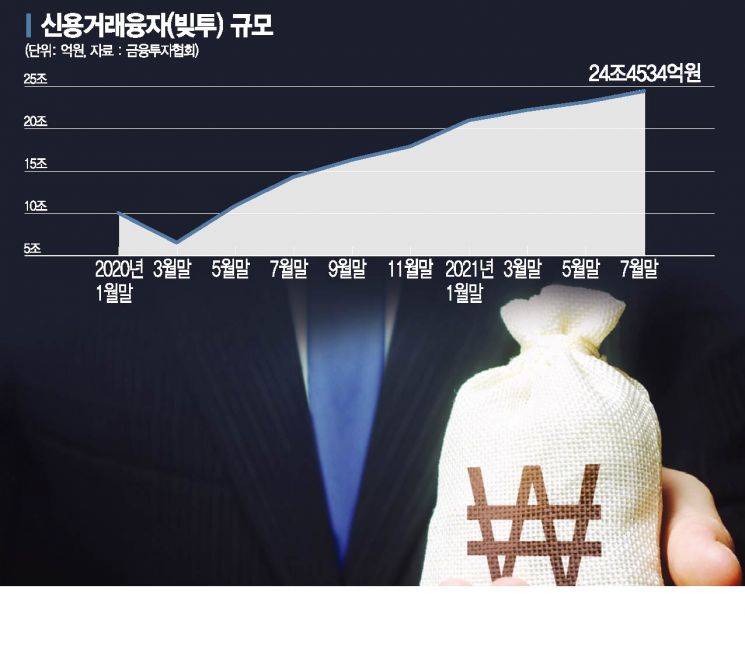
[Asia Economy Reporter Ji Yeon-jin] As the Bank of Korea is expected to raise the base interest rate in August, national research institutes are consecutively expressing cautious views. Since last year, a stock investment craze has surged, and the scale of leveraged investment, or 'debt investment,' has ballooned like a snowball. There are concerns that a rise in interest rates could dampen investment sentiment, leading to a sharp drop in asset prices, which could pose a significant burden on the economy.
According to the Capital Market Institute on the 10th, Seung-ho Lee, Senior Research Fellow of the Capital Market Office, stated in a report released the day before, "Unlike in the past, recent asset price increases rely heavily on abundant liquidity and leverage. Therefore, changes in monetary policy stance should be cautious in terms of timing and speed, assuming a visible recovery in the real economy and employment conditions."
The domestic stock index recorded an all-time high last month (KOSPI 3305.2 on July 3), rising more than 120% from the low point after the outbreak of COVID-19. While this stock price increase reflects expectations of economic recovery, it is analyzed that the underlying factors were the expansion of market liquidity due to accommodative monetary policy and the increase in leveraged investments.
Therefore, if the monetary policy stance changes in the future, liquidity may decrease, and investment sentiment may be affected by rising interest rates, which could lead to adjustments in asset prices such as stocks. In fact, after the U.S. announced the end of quantitative easing in 2013, many emerging countries experienced capital outflows, sharp stock price declines, and currency depreciation, which exacerbated economic difficulties. Lee said, "Given the high uncertainty regarding the timing of real economic recovery due to the recent spread of variant viruses, there is a significant risk of prolonged volatility in financial markets. Changes in risk appetite among international investors are sensitively influenced by the global COVID-19 situation, and countries with fragile underlying economic conditions, significant financial instability, or excessively widened domestic-foreign interest rate differentials compared to advanced countries are expected to face relatively greater capital outflow pressures."
According to the Bank for International Settlements, South Korea's private debt reached 214.9% at the end of last year, with the fastest growth rate among major countries. Household loans showed a sharp increase not only in bank mortgage loans but also in non-bank loans to meet the demand for stock investment and to compensate for income reductions. The credit balance for stock investment loans fell to 6 trillion won in March last year during the COVID-19 market crash but has rapidly increased every month, surpassing 24 trillion won at the end of last month, showing nearly an eightfold increase.
Lee suggested, "Rising interest rates increase the interest burden on economic agents, hindering domestic demand recovery such as consumption, and may undermine macroprudential stability by causing sharp declines in asset prices and increasing financial market volatility. Rather than artificial debt reduction related to private debt, it is desirable to strengthen support systems for vulnerable groups, promote corporate productivity improvement and profit generation, and mitigate potential risks through income recovery of households."
Hyung-seok Lim, Senior Research Fellow at the Korea Institute of Finance, also predicted in a report released the day before, "If interest rate normalization begins, borrowers with variable-rate loans and short maturities, such as credit loans, will be relatively more affected than mortgage loan borrowers." Jeong Kyu-chul, Director of the Economic Outlook Office at the Korea Development Institute (KDI), said at a seminar in June, "Although exports have recently improved and the economy is recovering moderately, it still lags behind the pre-crisis growth path," and emphasized, "Monetary policy stance changes should be pursued cautiously."
© The Asia Business Daily(www.asiae.co.kr). All rights reserved.
![Clutching a Stolen Dior Bag, Saying "I Hate Being Poor but Real"... The Grotesque Con of a "Human Knockoff" [Slate]](https://cwcontent.asiae.co.kr/asiaresize/183/2026021902243444107_1771435474.jpg)
















