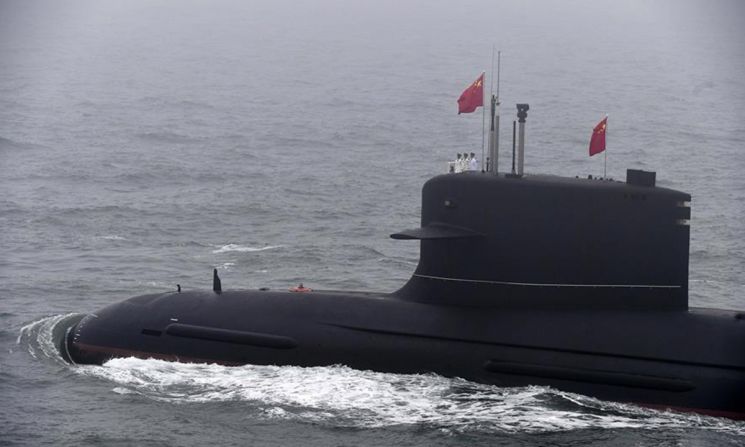
[Asia Economy Reporter Yujin Cho] In response to British media reports that a Chinese nuclear submarine was detected while tracking a British aircraft carrier strike group, Chinese media has denied the claims as untrue.
On the 10th, China’s state-run Global Times dismissed reports that the Chinese People's Liberation Army (PLA) nuclear submarine shadowed the British 'Queen Elizabeth' aircraft carrier strike group as "unreliable."
The outlet cited Chinese military expert Song Zhongping, who said, "The UK is trying to elevate itself and showcase its anti-submarine capabilities," adding, "Many of the UK's vessels are not fully combat-ready, and their anti-submarine capabilities are even more limited."
Another submarine expert also stated that the reported circumstances were not factual but acknowledged the possibility that a Chinese submarine might have targeted the Queen Elizabeth carrier as a necessary defensive measure 'near its home turf.'
An anonymous military expert harshly criticized, "The British carrier coming to the East Asia region to demonstrate military power, disrupt regional peace and stability, and play the victim with baseless lies is a typical tactic of Western powers to distort facts, fabricate stories, attack China, and create a China threat narrative."
Earlier, the British Daily Express reported on the 8th (local time) that a Chinese nuclear submarine attempted to shadow the British Royal Navy’s aircraft carrier Queen Elizabeth while sailing in the Pacific Ocean.
The British carrier strike group’s escort ships Kent and Richmond detected two Chinese 7,000-ton nuclear submarines of the Type 093 class using sonar.
These submarines and reconnaissance vessels were apparently shadowing until detected by the anti-submarine sonar.
This Chinese intelligence activity emerged amid escalating tensions with the United States over the South China Sea, a disputed territorial area.
The United States and its allies have continuously deployed warships and military aircraft to the South China Sea, and China has responded by conducting large-scale military exercises, heightening tensions in the region.
The U.S. Indo-Pacific Command announced on the 2nd that it had launched a large-scale joint land, sea, and air exercise involving all branches of the military, including the Marine Corps, in the region. The exercise, running until the 27th, also includes participation from British, Australian forces, and the Japan Self-Defense Forces.
© The Asia Business Daily(www.asiae.co.kr). All rights reserved.
![Clutching a Stolen Dior Bag, Saying "I Hate Being Poor but Real"... The Grotesque Con of a "Human Knockoff" [Slate]](https://cwcontent.asiae.co.kr/asiaresize/183/2026021902243444107_1771435474.jpg)
















