Seoul is the 3rd hottest on record by number of heatwave days
The hottest years on record are 1994 and 2018
17-day rainy season, Central region and Jeju have the 3rd shortest rainy season on record
Rainy season starts the latest since 1982... Nationwide simultaneous start and end for the first time
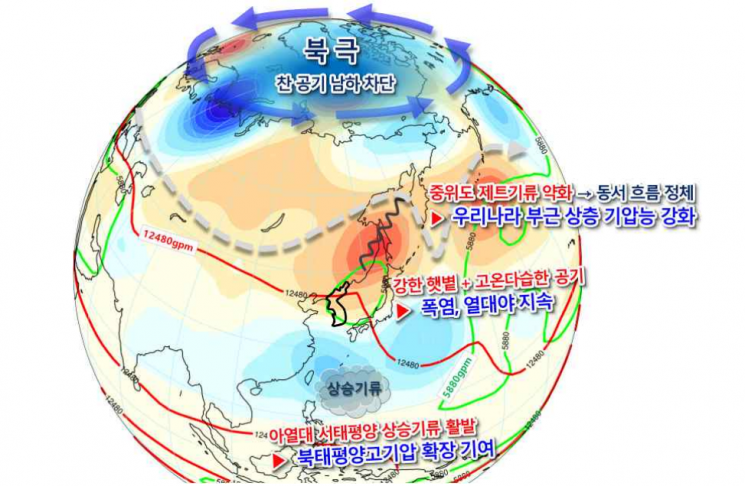
[Asia Economy Reporter Han Jinju] July this year was the fifth hottest since 1973. This was due to a short rainy season and the early influence of the North Pacific High, which caused extreme heatwaves.
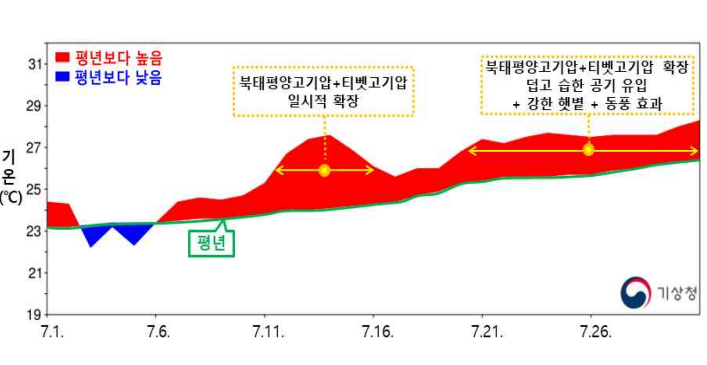
On the 6th, the Korea Meteorological Administration announced that from July, due to the hot and humid North Pacific High and strong sunlight, the nationwide number of heatwave days in July was 8.1 days, and the national average temperature was 26 degrees Celsius.
This year, the rainy season was unusually short, and after it ended, the Tibetan High in the upper atmosphere (about 12 km above ground) and the North Pacific High in the mid-atmosphere (about 5.5 km above ground) expanded over South Korea, continuing the heatwave. Additionally, the east wind effect contributed to prolonged heatwaves and tropical nights, especially in the western regions including the Seoul metropolitan area.
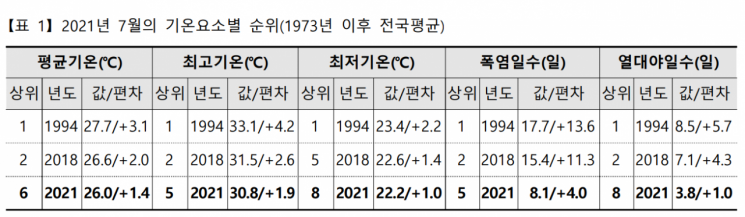
However, compared to the extreme heatwaves of 1994 and 2018, the average temperature and number of heatwave days this year were relatively shorter. The number of heatwave days was 17.7 days in 1994, ranking first, and 11.3 days in 2018, ranking second, with average temperatures of 27.7 degrees and 26.6 degrees respectively.
In particular, as the heatwave intensified in the Seoul metropolitan area and western regions, record-breaking heatwave days were observed by region. Cheongju recorded 18 days, ranking third since 1973; Chuncheon 17 days, ranking second; Icheon 16 days, ranking third; and Seoul 15 days, ranking third.
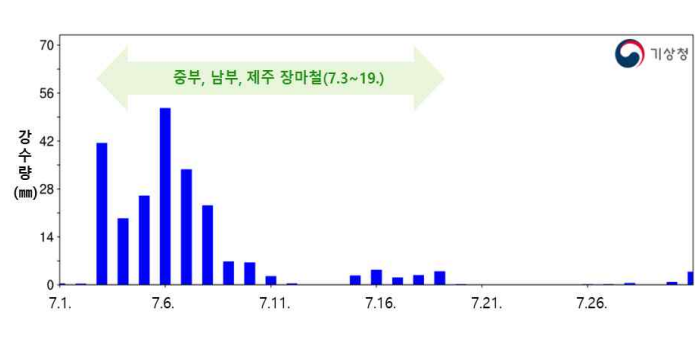
This year’s rainy season ended after 17 days. It started on July 3 and ended on the 19th. It was the latest rainy season since 1982. Also, for the first time, the rainy season started and ended simultaneously nationwide. The rainy seasons in the central region and Jeju were the third shortest on record. However, the final start and end dates of the rainy season may change after retrospective analysis.
The rainfall during the rainy season was 227.5 mm, and the number of rainy days was 9.9 days. This is 64.5% and 57.4% of the average respectively. The rainy season was mainly concentrated in the southern regions, resulting in large regional disparities, and except for last year (701.4 mm) which had heavy rainfall, the trend since 2014 has been less rainfall than average.
Meanwhile, from early July, the stationary front activation and southwest airflow brought heavy rainfall mainly to the southern regions. After mid-July, localized showers occurred, resulting in nationwide rainfall being less than average and a significant gap between the central and southern regions.
The total rainfall in July was 233.8 mm, with 154.8 mm in the central region and 290.9 mm in the southern region. The number of rainy days was 11.1 days, 3.7 days shorter than average.
© The Asia Business Daily(www.asiae.co.kr). All rights reserved.



















